
Outdoor path lights do more than just make your walkway look good at night. The right lighting can prevent trips and falls, highlight your garden’s best features, and even make your home feel safer. But if you’ve ever tried to buy outdoor path lights, you know one question comes up again and again: How many lumens do you really need? It’s not as simple as picking the brightest bulb. Too much light can feel harsh or ruin the atmosphere, while too little might leave guests stumbling in the dark. Finding the sweet spot is key.
This guide will help you understand lumens, why they matter for outdoor lighting, and how to choose the right brightness for your path lights. Whether you’re lighting a short garden walkway or a long driveway, you’ll find clear advice, practical tips, and answers to common questions.
You’ll also see real-world examples, helpful tables, and expert guidance to make your path both beautiful and safe.
What Are Lumens And Why Do They Matter?
When you shop for light bulbs, you’ll see two common measurements: watts and lumens. Watts measure how much energy a bulb uses. Lumens measure how much light it actually gives off. For outdoor path lights, lumens are the most important number to watch.
A higher lumen number means a brighter light. For example, a typical candle gives off about 12 lumens. A 60-watt incandescent bulb produces about 800 lumens. Outdoor lighting needs are different from indoor lighting—too much light can cause glare or waste energy, while too little can leave areas unsafe.
Why use lumens instead of watts?
Modern bulbs, like LEDs, use much less energy than old incandescent bulbs but can produce the same amount of light. That’s why watts are not the best way to compare brightness anymore. With LEDs, you might get the same brightness for a fraction of the power.
How Lumens Affect Outdoor Pathways
Getting the right brightness for your walkway is a balance. Too many lumens can wash out landscaping or create a harsh glare. Not enough, and you risk missing steps or tripping on uneven ground.
Factors that impact your lumen needs:
- Width of the path
- Length of the walkway
- Amount of background light (streetlights, house lights)
- Type of fixture (shielded, open, low to the ground)
Typical Lumen Ranges For Outdoor Path Lights
For most residential paths, lights should be bright enough to see each step clearly but not so bright they overpower the area. Here are general guidelines:
- Low brightness (50–100 lumens): Soft accent lighting, short garden paths, or decorative edges.
- Medium brightness (100–200 lumens): Standard walkways, main paths, and areas with some ambient light.
- High brightness (200–400 lumens): Long driveways, dark rural paths, or places with no other light source.
You rarely need more than 400 lumens per fixture for residential paths. In fact, brighter is not always better—too much can create sharp shadows or light pollution.
Example: Comparing Lumen Levels
Here’s a quick look at how different lumen levels appear in real outdoor path settings:
| Lumens per Fixture | Visual Effect | Best For |
|---|---|---|
| 50–75 | Soft glow, subtle markers | Short garden paths, decorative edges |
| 100–150 | Clear walkway, gentle highlight | Front path, side walkways |
| 200–300 | Bright, wide coverage | Driveways, long paths, steps |
| 400+ | Intense, can be harsh | Large properties, security areas |
Insight: Many beginners think more lumens is always better. In reality, too much light can create glare and actually make it harder to see.

Credit: www.amazon.com
How To Calculate Total Lumens Needed
Knowing how many lumens you need per fixture is just the start. You also need to know how many fixtures to use and where to place them. Here’s a simple method:
- Measure the length of your path.
- Decide on spacing: Most path lights are placed 5–8 feet apart.
- Choose your desired brightness: Use the lumen guidelines above.
- Calculate the number of fixtures: For a 40-foot path, with lights every 6 feet, you’ll need about 7 lights.
- Multiply fixtures by lumens per fixture: For 7 lights at 100 lumens each, your total is 700 lumens.
Example Calculation
Let’s say you have a 30-foot garden path and want soft accent lighting.
- Path length: 30 feet
- Light spacing: Every 6 feet → 5 fixtures
- Lumen level: 75 lumens per fixture
- Total lumens: 5 x 75 = 375 lumens
Tip: It’s usually better to have more fixtures with lower lumens than a few very bright lights. This gives even coverage and avoids sharp shadows.
Key Factors That Affect Lumen Needs
Not every path is the same. Here are important factors that can change how many lumens you need:
1. Path Width And Material
Wider paths need more light to cover the space. Dark surfaces (like black stone) absorb more light, so you may need brighter fixtures. Lighter surfaces reflect more, so you can use lower lumens.
2. Background Light
If your path is near streetlights or porch lights, you may need less from your path lights. In rural or dark areas, choose higher lumens for safety.
3. Fixture Design
Some path light fixtures have wide, open tops. Others use hoods or shades to direct light down. Shielded fixtures prevent glare and focus light where you need it, so you can use lower lumens more effectively.
4. Power Source
Solar-powered lights often have lower lumens than wired options. If you want very bright lights, check the specifications carefully—don’t assume all solar lights will be bright enough.
5. Light Color (kelvin)
While not the same as lumens, the color temperature (measured in Kelvin) affects how bright light appears. Warm white (2700–3000K) looks softer, while cool white (4000K+) can seem brighter even at the same lumen level.
6. Landscape Features
Bushes, trees, or walls close to the path can block or reflect light. Plan your fixture placement and lumen levels based on the actual layout of your garden or yard.
Comparing Path Light Types By Lumen Output
Choosing the right type of path light is just as important as choosing the brightness. Here’s a side-by-side look at common options:
| Type | Typical Lumens | Advantages | Drawbacks |
|---|---|---|---|
| Solar LED | 20–150 | Easy install, no wiring, energy-saving | Lower brightness, weather affects output |
| Low-Voltage LED | 100–400 | Reliable, bright, long-lasting | Requires transformer and wiring |
| Line Voltage | 200–800 | Very bright, suitable for long driveways | Professional installation needed, higher energy use |
| Battery-Powered | 30–150 | Portable, no wiring | Battery changes, usually less bright |
Non-obvious insight: The lens and design of a fixture can make a 100-lumen light look brighter than a poorly designed 200-lumen light.
Mistakes To Avoid When Choosing Lumens
Even with guidelines, some common mistakes can lead to disappointing results. Here’s what to watch out for:
- Choosing the brightest option by default.
- High lumens can overpower small or narrow paths, causing glare and discomfort.
- Ignoring fixture design.
- Some fixtures scatter light in all directions, wasting energy. Pick fixtures that focus light downward and shield from the sides.
- Not considering other light sources.
- If you already have porch lights or garage lights, your path lights can be softer.
- Over-spacing fixtures.
- Large gaps can create dark spots. It’s better to use more fixtures with lower lumens than a few powerful ones.
- Relying only on solar lights in shady areas.
- Solar lights need full sun to charge well. In shaded paths, they may not get bright enough.
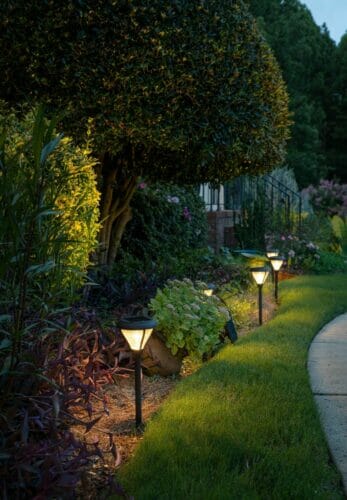
Tip: Always check the manufacturer’s specifications. Two lights labeled “100 lumens” can look very different depending on their design and lens.
Credit: gamasonic.com
Matching Lumens To Specific Pathway Needs
Every path is unique. Here’s advice for common situations:
Short Garden Paths
- Recommended lumens: 50–100 per fixture
- Spacing: 5–6 feet apart
- Why: You want a soft glow to highlight plants and edges. Too much light can overwhelm small spaces.
Main Walkways (front Or Side Paths)
- Recommended lumens: 100–200 per fixture
- Spacing: 6–8 feet apart
- Why: These areas need clear visibility for guests and family but should still feel welcoming.
Driveways And Long Walks
- Recommended lumens: 200–400 per fixture
- Spacing: 8–10 feet apart
- Why: Longer areas need more light for safety and to avoid dark stretches. Consider using a mix of path lights and floodlights.
Stairs And Steps
- Recommended lumens: 100–200 per fixture, placed closely
- Why: Steps are a tripping hazard in the dark. Use lights on each riser or edge for safety.
Rural Or Very Dark Areas
- Recommended lumens: 200–400 per fixture
- Why: With no background light, you need more lumens for the same level of visibility.
Practical example: A 25-foot front walkway in a city with lots of streetlight might only need 4 lights at 75 lumens each. The same path in a dark rural setting might do better with 4 lights at 150 lumens each.
How To Test And Adjust Lumen Levels
It’s hard to imagine what your path will look like just from numbers. Here’s how to get it right before you commit:
- Start with lower lumen fixtures.
- Test at night: Use a flashlight with known lumen output (many LED flashlights list this) to simulate.
- Check for glare: Walk the path at night. If you see bright spots or harsh shadows, adjust spacing or shield the lights.
- Add more fixtures if needed: It’s easier to add than to remove.
- Consider dimmable fixtures: These allow you to adjust brightness as needed.
Non-obvious insight: Some LED fixtures let you adjust brightness after installation. This can be valuable if your needs change.
How Fixture Placement Affects Perceived Brightness
The position of each light changes how bright your path feels.
- Low to the ground: Spreads light evenly, reduces glare.
- Angled toward path: Focuses light on walking surface.
- Too high: Can create harsh, direct glare in your eyes.
- Too close to the edge: Light spills off the path, reducing effectiveness.
Tip: For curved paths, place lights on the inside of the curve for better coverage.
Energy Efficiency And Environmental Impact
Choosing the right lumens isn’t just about visibility—it also affects your power bill and the environment.
- LED path lights use up to 80% less energy than old incandescent bulbs for the same lumens.
- Solar lights cost nothing to run but may be dimmer, especially in winter or shady spots.
- Lower lumens reduce light pollution, helping local wildlife and keeping the night sky visible.
Practical advice: Use timers or motion sensors where possible so lights only run when needed.
Upgrading Existing Path Lights
If you already have path lights but want to improve brightness or efficiency:
- Check if you can swap bulbs. Some fixtures let you replace halogen or incandescent bulbs with LEDs of the same size.
- Add reflectors or shields. Focusing the light downward can make a big difference even without increasing lumens.
- Clean lenses and covers. Dirt and debris can block 20–30% of the light.
- Replace old fixtures. If your lights are outdated, new LEDs often offer better brightness and energy savings.
Tip: When upgrading, measure your current lights’ lumens with a smartphone light meter app to compare before and after.
Sample Layouts For Common Path Types
Here’s how you might set up path lights for different scenarios:
Straight Front Walkway (20 Feet)
- 4 lights, spaced 5 feet apart, 100 lumens each
- Place lights in a staggered pattern on each side for even coverage
Curved Garden Path (30 Feet)
- 5 lights, spaced 6 feet apart, 75 lumens each
- Place lights on the inside of the curve, focus on plants and features
Long Driveway (50 Feet)
- 7 lights, spaced 7 feet apart, 200 lumens each
- Mix with a low-output floodlight at the garage for extra security
Budgeting: Cost Vs. Lumen Output
Not all bright lights cost more. Here’s how price can relate to lumen output:
| Fixture Type | Typical Price (USD) | Lumens per Dollar | Expected Lifespan |
|---|---|---|---|
| Basic Solar LED | $10–$20 | 5–10 | 2–5 years |
| Low-Voltage LED | $20–$50 | 8–15 | 5–10 years |
| Designer or Smart LED | $50–$100+ | 6–12 | 7–15 years |
Insight: Sometimes, mid-range fixtures offer the best balance of brightness, durability, and price.
Frequently Asked Questions
How Many Lumens Are Best For Solar Path Lights?
Most solar path lights produce 20–100 lumens per fixture. This is enough for short garden paths or accent lighting. For main walkways or dark areas, look for solar lights that offer 80 lumens or more, and check user reviews for real-world brightness.
Can I Mix Different Lumen Levels On The Same Path?
Yes, you can. In fact, using brighter lights for steps or entry points and softer lights for straight sections can improve both safety and ambiance. Just make sure the changes aren’t too sudden, which can confuse the eyes.
Are Higher Lumens Always Better For Outdoor Lighting?
No. More lumens can cause glare and light pollution. It’s usually better to use more fixtures with lower lumens for even, comfortable coverage. Too much light can wash out landscaping and disturb neighbors.
What If My Path Lights Seem Too Dim After Installation?
First, check for dirt or cloudy lenses—this can block a lot of light. If everything is clean, consider:
- Adding more fixtures closer together
- Upgrading to higher-lumen bulbs (if your fixture supports it)
- Using a different fixture design that focuses light downward
How Do I Know If A Path Light Is Bright Enough Before Buying?
Look for real lumen ratings, not just “watt equivalent.” Read reviews for actual brightness in outdoor settings. If possible, test with a flashlight at home—many LED flashlights list lumen output, so you can see how it looks in your yard before buying.
Lighting your outdoor path the right way is about more than just brightness. It’s a mix of safety, style, and efficiency. By understanding how many lumens you need—and how to use them wisely—you’ll create a walkway that’s both welcoming and functional.
For more on lighting and energy efficiency, you can check resources like the U.S. Department of Energy.
With thoughtful planning, the right lumens, and quality fixtures, your outdoor path will not only stand out at night but also last for years with minimal hassle.
Credit: gamasonic.com