
Last updated: October 2026 · Specs are taken from manufacturer listings on Amazon; prices and availability change, so always confirm on the product page.
Are battery snow blowers worth it? For most suburban homeowners with paved driveways and typical storms, yes. A good battery blower starts instantly in the cold, needs almost no maintenance, is far quieter than gas and stores easily. Where battery machines are not worth it yet is very deep or wet snow on long or gravel driveways, where gas two-stage blowers still win on power and runtime.
Below is an honest look at where battery snow blowers shine, where they fall short, and how to decide for your own driveway.
The short answer
- Worth it: paved driveways up to about three cars, storms usually under 8-10 inches, noise-sensitive neighborhoods, and anyone already invested in a battery tool platform.
- Worth it with caveats: frequent heavy storms, if you buy a battery two-stage machine and enough battery capacity.
- Usually not worth it: long rural driveways, gravel, regular deep lake-effect snow, or anyone who needs to blow snow for hours at a time.
Pros and cons at a glance
| Pros | Cons |
|---|---|
| Push-button start in any cold | Runtime limited by battery capacity |
| No gas, oil, spark plugs or carburetor problems | Batteries are expensive to add or replace |
| Much quieter, no exhaust fumes | Fewer heavy-duty two-stage options |
| Lighter and easier to store | Cold reduces available battery capacity |
| Batteries power other yard tools | Very deep, wet snow can overwhelm smaller models |
Where battery snow blowers really shine
Instant, reliable starts
Cold-weather starting is the classic gas snow blower headache: pull cords, chokes, primers and stale fuel that sat since last March. Battery machines start with a button. For many owners, that single change is enough to justify the switch.
Almost no maintenance
There is no oil to change, no spark plug, no carburetor to clean and no fuel to drain before summer. Keep the auger and chute clean, check the scraper and paddles, and store batteries indoors. That is the full routine.
Quiet and fume-free
Battery blowers are dramatically quieter than gas, which matters at 6 a.m. and in neighborhoods with noise rules. There is also no exhaust drifting back at you as you work into the wind.
Lighter and easier to store
Most battery single-stage machines are much lighter than gas two-stage blowers, and many fold for storage. That makes them easier to maneuver on tight driveways and easier for more members of the household to use.
Batteries that work year-round
If your snow blower shares batteries with your mower, trimmer and leaf blower, the batteries earn their keep in every season. That is the hidden value of brands like EGO and Greenworks; our best cordless leaf blower guide shows how those platforms extend across yard tools.
Where battery snow blowers fall short
Runtime is finite
A gas machine runs as long as you keep adding fuel. A battery machine runs until the packs are empty. Manufacturer claims help (EGO rates its 21-inch SNT2114 kit at up to a 16-car driveway with 8 inches of snow), but heavy, wet snow uses far more energy than powder. If your driveway is long, plan on large batteries or a spare set.
Cold weather reduces capacity
Lithium-ion batteries deliver less energy when they are cold. The fix is simple: keep batteries indoors and put them in the machine right before you start. Charge them indoors, too, since many manufacturers advise against charging below freezing.
Fewer heavy-duty models
Most battery snow blowers are single-stage. Two-stage battery machines exist, such as EGO's self-propelled 24-inch model, but they are expensive once you add batteries, and the selection is small compared with gas.
Batteries cost money
Batteries are the most expensive part of any cordless tool. Kits that include large batteries cost more upfront, and replacement packs years down the line are a real cost to plan for.
Cost of ownership: battery vs gas
| Ongoing cost or task | Battery single-stage | Gas machine |
|---|---|---|
| Fuel | Electricity to recharge | Gasoline, often with stabilizer |
| Oil changes | None | Usually yearly (4-stroke) |
| Spark plug, carburetor care | None | Periodic |
| Off-season prep | Store batteries indoors | Drain or stabilize fuel, run dry |
| Big replacement item | Batteries after several years | Engine and drive components |
The upfront price of a battery kit can match or exceed a comparable gas machine. Over several winters, the savings on fuel, oil and servicing, plus the time you do not spend fixing a machine that will not start, close much of the gap. The math is strongest when you already own compatible batteries.
Regulations are pushing in the same direction
Some states are tightening rules on small gas engines. California's Air Resources Board, for example, now requires most newly manufactured small off-road engines (the category that includes many snow blowers, leaf blowers and mowers) to be zero-emission. Even if you live elsewhere, it is a sign of where the market is heading: more battery models, better batteries and more support over time.
Real-world performance: what to expect
On a paved driveway with 4-8 inches of normal snow, a good battery single-stage blower clears quickly and scrapes close to the pavement. In 8-12 inches, you will slow down and may need partial-width passes. In heavy, wet snow, expect the chute to clog more easily and the battery to drain faster; going out mid-storm helps a lot.
The plow ridge at the end of the driveway is the toughest test. Single-stage battery machines can struggle with dense, icy chunks. Take small bites, or break it up with a shovel first. If the ridge defeats you every storm, a two-stage machine is the real fix; our single-stage vs two-stage snow blower guide explains why.

EGO Power+ SNT2112 21-inch Single-Stage
The EGO Power+ SNT2112 is a 21-inch single-stage with a steel auger and two 56V 5.0Ah batteries in the box. It is a strong example of how capable battery snow blowers have become for typical driveways.
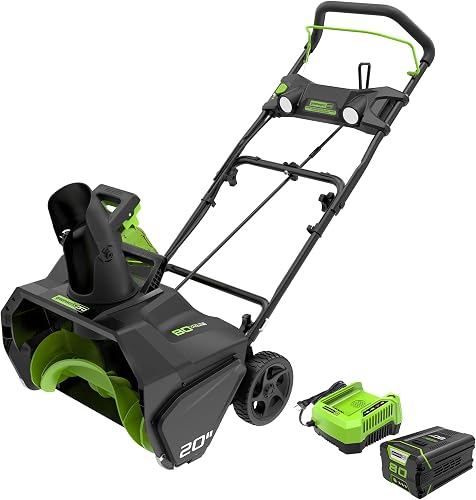
Greenworks 80V 20-inch Brushless
Greenworks' 80V 20-inch blower is a lower-cost way into battery snow clearing, rated for snow up to 10 inches deep. Plan on a bigger battery for larger driveways.
What to look for if you decide to buy
- Auger material. Steel augers cope better with hard-packed snow and ice than rubber paddles.
- Clearing width and intake height. About 20-21 inches suits most driveways; intake height tells you how deep a pass it can take.
- Batteries in the box. Compare kits by total amp-hours, not just voltage. Tool-only listings look cheap until you add packs and a charger.
- Chute control. A handle-mounted control lets you redirect snow without stopping.
- Lights. LED headlights make dark morning clearing safer.
- Platform. Choose a brand whose batteries you will also use in spring and summer.
Battery care that extends lifespan
Lithium-ion packs last longest when they avoid extremes. Bring them inside after every storm and let them warm up before charging. For long breaks, such as summer storage, leave them partially charged rather than full or empty, and keep them somewhere cool and dry, not in a hot garage or shed. Wipe snow and moisture off the contacts before inserting a pack. Treated this way, a quality battery should serve several winters, plus the mowing seasons in between if you share it with other tools. If you put the whole machine away for summer, our guide on storing a snow blower for summer covers the rest.
Who should switch, and who should not
| Your situation | Battery worth it? | Why |
|---|---|---|
| Paved 1-3 car driveway, storms usually under 10 in | Yes | Single-stage battery models cover this easily |
| You already own a 56V/60V/80V battery platform | Very likely | Shared batteries cut the real cost |
| Noise rules or early-morning clearing | Yes | Battery machines are far quieter |
| Frequent 12 in+ storms, heavy wet snow | Maybe | Only with a battery two-stage and big batteries |
| Very long rural driveway or gravel | Usually no | Gas two-stage still leads on runtime and power |
| Rarely snows, a few light dustings | Consider a powered shovel | Cheaper and enough for occasional use |
Tips to get the most from a battery snow blower
- Store batteries indoors between storms and charge them at room temperature.
- Clear in stages during long storms instead of waiting for 12 inches to pile up.
- Use variable auger speed if your machine has it; lower speeds stretch runtime in light snow.
- Keep the chute and auger clear of ice buildup. A light coat of silicone spray can help snow slide. Never clear a clog with your hands; see how to fix snow blower clogging.
- Pair it with a shovel or powered shovel for steps and the plow ridge.
- Prep before the season. Charge every pack and test the machine before the first forecast; our guide to starting a snow blower after storage has a checklist.
Common myths about battery snow blowers
"They only handle a dusting." Modern single-stage machines with steel augers handle typical storms on paved drives well.
"Cold kills the battery instantly." Cold reduces capacity, but batteries stored indoors and installed just before use perform well.
"You need two of everything." Many owners clear their driveway on one set of packs. Spare batteries are about convenience for long drives and big storms.
"Battery means cheap and flimsy." Premium battery machines use brushless motors, steel augers and solid chutes. Budget models exist too, so choose by the specs, not the power source.
Ready to compare models?
Ready to compare models? Our cordless snow blower guide covers single-stage, two-stage and powered shovel options with the batteries included in each kit.
The bottom line
Are battery snow blowers worth it? For paved driveways and normal winters, absolutely: instant starts, quiet operation and near-zero maintenance make them easier to live with than gas. If you face deep, heavy storms, gravel, or a very long driveway, a battery machine is only worth it in its two-stage form with plenty of battery capacity, and gas may still be the more practical choice. Match the machine to your snow, keep the batteries warm, and a battery snow blower can be one of the most satisfying tools you own.
Frequently Asked Questions
Are battery powered snow blowers any good?
Yes, for the right driveway. Modern single-stage battery blowers handle typical storms on paved driveways well, start instantly and need almost no maintenance. They are less suited to very deep, wet snow, long rural drives and gravel, where gas two-stage machines still lead.
Do battery snow blowers work in very cold weather?
They work, but cold reduces how much energy a lithium-ion battery can deliver. Store batteries indoors at room temperature and install them just before you start. Most manufacturers also advise charging batteries indoors rather than in a freezing garage.
How long do snow blower batteries last?
Per storm, runtime depends on battery size and snow. EGO rates its 21-inch blower with two 7.5Ah batteries at up to a 16-car driveway with 8 inches of snow. Over the long term, lithium-ion batteries typically last several years with gradual capacity loss, especially if stored correctly.
Is a battery snow blower cheaper than gas?
Upfront, battery kits can cost as much as or more than gas machines of similar size. Over time, they save on fuel, oil and servicing. The math is best if you already own batteries from the same brand.
Can a battery snow blower handle the plow ridge?
Single-stage battery blowers often struggle with the dense, icy ridge a plow leaves. Take it in small bites or clear it by hand. A battery two-stage machine handles it better.