
Last updated: October 2026 · Written by the LawnVibe editorial team.
A regular hose timer waters on a fixed schedule whether it rained yesterday or not. A smart garden watering system lets you change that schedule from your phone, water a bed remotely when a heat wave hits and, with some models, skip watering when rain is forecast. The best smart watering systems for gardens are mostly Wi-Fi hose timers that attach at the faucet and run drip, soaker or sprinkler lines, plus app-controlled pump waterers for pots. Our top pick is the Orbit B-hyve XD 4-port smart hose timer, which runs four zones from one faucet. Below we compare eight systems and explain how to set up a smart garden.
Listings change often, so check current details on Amazon before you buy. As an Amazon Associate we earn from qualifying purchases.
Our top picks at a glance
| # | Product | Best for | Link |
|---|---|---|---|
| 1 | Orbit B-hyve XD 4-Port Smart Hose Timer | Gardens with several beds on one faucet | Check price |
| 2 | Rachio Smart Hose Timer with Wi-Fi Hub | Gardeners who want automatic weather adjustments | Check price |
| 3 | RainPoint Wi-Fi 2-Zone Smart Hose Timer | Front and back gardens on one tap | Check price |
| 4 | 3-Zone Smart Wi-Fi Sprinkler Timer | Larger gardens with three watering areas | Check price |
| 5 | Smartale Wi-Fi and Bluetooth Hose Timer | Flexible control at home and away | Check price |
| 6 | HEKIWAY 60 ft Drip Irrigation Kit with Water Timer | Starting a drip system from scratch | Check price |
| 7 | LetPot Wi-Fi Automatic Watering System | Patio and indoor pots without a faucet | Check price |
| 8 | Sainlogic Automatic Plant Waterer (15 Pots) | Up to 15 pots with on-device control | Check price |
Best smart watering systems for gardens: reviews
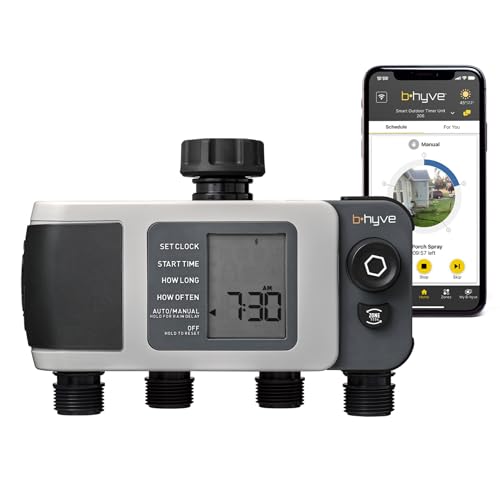
Orbit B-hyve XD 4-Port Smart Hose Timer
Best for: Gardens with several beds on one faucet
A four-port smart hose timer from Orbit that runs up to four garden zones from one faucet, scheduled from the B-hyve app.
- Four independent zones
- App scheduling
- Established irrigation brand
- Wi-Fi features may need a separate hub
- Larger unit on the faucet

Rachio Smart Hose Timer with Wi-Fi Hub
Best for: Gardeners who want automatic weather adjustments
An app-controlled outdoor faucet timer from Rachio, supplied with a Wi-Fi hub for remote control and smart scheduling.
- Remote control via hub
- Smart scheduling features
- Well-known smart irrigation brand
- Hub must be within range
- Single valve in this kit

RainPoint Wi-Fi 2-Zone Smart Hose Timer
Best for: Front and back gardens on one tap
A Wi-Fi hose timer with a brass inlet and two zones, controlled from the RainPoint app.
- Two zones
- Brass inlet
- App control
- Needs Wi-Fi gateway or coverage
- Remove before freezing

3-Zone Smart Wi-Fi Sprinkler Timer
Best for: Larger gardens with three watering areas
A three-zone Wi-Fi water timer for garden hoses, advertised with long wireless range between the gateway and timer.
- Three zones
- Long advertised range
- App scheduling
- Unbranded listing
- Setup can take longer

Smartale Wi-Fi and Bluetooth Hose Timer
Best for: Flexible control at home and away
A programmable hose timer that can be controlled over Bluetooth nearby or over Wi-Fi remotely.
- Bluetooth and Wi-Fi control
- Programmable schedules
- Works with any hose-fed system
- Lesser-known brand
- App quality may vary

HEKIWAY 60 ft Drip Irrigation Kit with Water Timer
Best for: Starting a drip system from scratch
A drip kit bundled with a water timer, giving an automated starting point for beds and pots.
- Timer included
- Complete drip starter
- Easy to expand
- Timer is not app-connected
- Small kit size

LetPot Wi-Fi Automatic Watering System
Best for: Patio and indoor pots without a faucet
A Wi-Fi pump-based waterer for potted plants that draws from a container and is scheduled from an app.
- No faucet needed
- App control
- Good for containers
- Reservoir needs refilling
- Needs Wi-Fi coverage

Sainlogic Automatic Plant Waterer (15 Pots)
Best for: Up to 15 pots with on-device control
A pump-based waterer from Sainlogic for up to 15 pots with on-device programming.
- Clear controls
- Covers 15 pots
- No faucet needed
- Not Wi-Fi connected
- Single zone
How we chose these systems
We compared smart timers and waterers by number of zones, how they connect (Wi-Fi hub, gateway or Bluetooth), scheduling and weather features, build quality at the faucet and how well each works with drip and soaker systems. We included established brands such as Orbit, Rachio and RainPoint alongside less known options, plus two smart pot waterers. We do not list prices because they change often.
What makes a watering system smart?
A smart system adds connectivity and decision-making to a timer. At a minimum, you program it from an app rather than buttons on the faucet. Most also allow remote control, so you can start or stop watering from anywhere. More advanced systems adjust watering based on local weather data or connected sensors, skipping runs after rain and adding water in heat. Our explainer on what smart irrigation is and how it works goes deeper into the technology.
Types of smart garden watering systems
Smart hose timers
Attach to an outdoor faucet and control one or more outlets. They are the easiest way to make a garden smart and work with any hose-fed drip, soaker or sprinkler system.
Multi-zone smart timers
Two to four outlets on one timer let different beds run on different schedules from a single faucet.
Smart pot waterers
Pump-based systems draw from a reservoir and water containers on a schedule, with app control.
Smart in-ground controllers
Wall-mounted controllers for buried sprinkler and drip zones. For lawns, see our roundup of the best smart watering systems for lawns.
How to choose a smart system for your garden
- Zones: count your beds and areas with different needs; choose a timer with enough outlets.
- Connectivity: Wi-Fi hubs allow remote control; Bluetooth only works within range.
- Wi-Fi coverage: check signal strength at the faucet or where the hub will sit.
- Weather features: rain delay is common; forecast-based skipping is more advanced.
- Build: a brass or metal inlet resists cross-threading and leaks.
- Power: most use batteries; check expected battery life.
- System type: make sure it suits drip, soaker or sprinklers as needed.
Smart hose timer vs smart in-ground controller
A smart hose timer screws onto a faucet, runs on batteries and controls one to four outlets. It is ideal for gardens with drip lines, soaker hoses and hose-end sprinklers, needs no wiring and moves with you. A smart in-ground controller mounts on a wall, connects to buried valves and controls many zones of sprinklers and drip. It suits homes with an existing in-ground system and large landscapes. Many homes use both: an in-ground controller for the lawn and a smart hose timer for vegetable beds and pots. For wired multi-zone options, see our guide to the best irrigation controller for 4 zones.
Wi-Fi vs Bluetooth control
Wi-Fi timers, usually through a hub or gateway plugged in indoors, let you check and change watering from anywhere and receive notifications. They depend on your home network reaching the garden. Bluetooth timers connect directly to your phone but only within a short range, so you must be nearby to change settings; they still run their programs on their own. Some timers offer both. If you travel often or want weather features, Wi-Fi is worth it. If you mainly want easy programming without fiddly buttons, Bluetooth may be enough.
Is your Wi-Fi strong enough?
Faucets are often on the far side of brick walls from the router. Before buying, walk to the faucet with your phone and check signal strength. Most hub-based timers place the hub indoors near a window facing the garden, with the hub talking to the timer over a longer-range radio link. A mesh Wi-Fi point near the garden can also help. If coverage is poor, choose a system with a dedicated gateway and long advertised range.
Setting up a smart hose timer
- Check Wi-Fi at the faucet. Stand at the tap with your phone; if the signal is weak, plan where the hub or gateway will go indoors.
- Install batteries and attach the timer to the faucet by hand, using the supplied washer. Avoid overtightening plastic threads.
- Add a backflow preventer, filter and pressure regulator after the timer if you are running drip.
- Connect each outlet to a drip line, soaker hose or sprinkler.
- Pair the timer and hub in the app and name each zone.
- Set schedules per zone, then run a manual test of each.
- Turn on weather features such as rain delay or forecast skipping if available.
Our guide on how to control a smart irrigation system from your phone covers app setup and remote features in more detail.
Planning zones in a smart garden
Smart timers shine when each zone matches a group of plants with similar needs. A typical layout might put vegetables on one zone, flower beds on another, pots on a third and a lawn strip or newly seeded area on a fourth. Vegetable drip may run longer every couple of days; pots may need short daily runs; established shrubs need less. Name zones clearly in the app so you remember what each one waters. For two-zone setups without app control, our guide to the best dual outlet hose timer has simpler options.
Weather-aware watering
Rain delay pauses watering for a set number of days after a storm, which you trigger in the app. Forecast-based skipping uses local weather data to cancel scheduled runs when rain is expected. Some systems also adjust run times based on temperature. These features save water, but no system is perfect: local showers may miss your garden while the forecast says rain. Check soil moisture occasionally and override the app when needed. A rain sensor offers another layer of protection; see our guide to the best rain sensor for sprinkler systems.
Saving water with smart systems
Smart systems help you water only when needed: skipping after rain, adjusting for season and stopping leaks quickly when you notice unusual usage. Pairing a smart timer with drip irrigation multiplies the savings because drip itself uses water efficiently. Our guide on how to conserve water with smart watering systems in gardens explains practical settings, and the EPA WaterSense program lists labeled smart irrigation controllers and outdoor water-saving tips.
Smart timers with drip irrigation
Drip and smart timers are a natural pair. Fit the timer first at the faucet, then a backflow preventer, filter and pressure regulator, then the drip line. Because drip flows slowly, schedules are longer than for sprinklers; start with longer runs every day or two and check moisture a few inches down. Smart scheduling makes it easy to fine-tune as plants grow. For kits to pair with your timer, see our roundup of the best drip irrigation kit options.
Smart watering for containers and patios
Pots and planters dry out faster than beds and are often far from a faucet. App-controlled pump waterers draw from a bucket or tank and water each pot through thin tubing. They are well suited to balconies, patios and greenhouses. Size the reservoir for the number of pots and the time you will be away, and keep it below pot level to prevent siphoning. For more options, see our guides to the best watering systems for indoor plants and the best solar powered watering systems.
Is a smart garden watering system worth it?
If you travel, have several distinct beds or simply want to water less often by hand, a smart timer is a worthwhile upgrade over a basic timer. The ability to pause watering after a storm or add a run during a heat wave from your phone saves both water and plants. If your garden is a single bed watered on a steady schedule, a basic hose timer may do the job for less.
Troubleshooting
- Timer offline: move the hub closer, check router settings or replace batteries.
- Valve not opening: check batteries, water supply and whether a rain delay is active.
- Schedules not running: confirm the timer's clock, time zone and that the zone is enabled.
- Leaks at the faucet: replace the washer and tighten by hand.
- App errors: update the app and timer firmware, or reset the device.
If problems persist, our guides on how to troubleshoot smart irrigation and how to reset a smart watering system timer walk through fixes.
Seasonal care
- Spring: install fresh batteries, update firmware and test every zone.
- Summer: adjust schedules for heat and check that weather features are working.
- Autumn: shorten runs as plants slow down.
- Winter: remove the timer and store it indoors before freezing nights; drain hoses and drip lines.
Common mistakes
- Ignoring Wi-Fi range at the faucet.
- One schedule for every zone.
- Trusting forecasts blindly without checking soil.
- Leaving timers outside in frost.
- Skipping the pressure regulator with drip.
- Letting batteries run flat mid-season.
The bottom line
For most gardens, the Orbit B-hyve XD 4-port smart hose timer is the best all-round choice, running four zones from one faucet with app scheduling. Choose Rachio for weather-smart scheduling from a well-known brand, RainPoint for a two-zone Wi-Fi timer with a brass inlet, a three-zone timer for larger gardens and a Wi-Fi pot waterer for patios without a faucet. Pair any smart timer with drip irrigation for the biggest water savings.
Frequently Asked Questions
What is a smart garden watering system?
It is a timer or controller you program from a phone app, often over Wi-Fi, that can water on schedule, be adjusted remotely and in some cases respond to weather.
Do smart hose timers need Wi-Fi?
Many need Wi-Fi through a hub or gateway for remote control. Some work over Bluetooth only when you are nearby. Check what each model requires.
Can a smart timer skip watering when it rains?
Many smart timers offer rain delay, and some use weather forecasts or a sensor to skip watering automatically. Features vary by brand.
Can I use a smart timer with drip irrigation?
Yes. Smart hose timers connect at the faucet, so they work with drip, soaker hoses or sprinklers.
Are smart watering systems worth it for gardens?
They are worth it if you travel, have several zones or want to adjust watering without going outside. A basic timer may be enough for simple gardens.