
Last updated: October 2026 · Written by the LawnVibe editorial team.
Rotary sprinkler heads are what professional installers use to water medium and large lawns evenly. Instead of the quick, misty fan of a spray head, a rotor turns a stream slowly across the lawn, reaching farther and applying water gently enough to soak in rather than run off. The best rotary sprinkler heads for permanent systems combine an adjustable arc, adjustable distance and interchangeable nozzles, which is why the Hunter PGP-ADJ is our top pick. We also include a pressure-regulating Rain Bird rotary head for smaller areas, a DIY rotor kit and two gear-drive hose sprinklers for people without an in-ground system.
Listings change often, so check current details on Amazon before you buy. As an Amazon Associate we earn from qualifying purchases.
Our top picks at a glance
| # | Product | Best for | Link |
|---|---|---|---|
| 1 | Hunter PGP-ADJ 3/4″ Rotor Sprinkler | Permanent in-ground lawn systems | Check price |
| 2 | Rain Bird 12SAPROPR Pressure Pro Rotary Sprinkler | Smaller areas and high-pressure systems | Check price |
| 3 | Rain Bird 32HE In-Ground Pro Rotor Pop-up Kit | DIY rotor coverage from a hose connection | Check price |
| 4 | Eden 16030 5-Pattern Turbo Gear Drive Rotary Sprinkler | Above-ground watering with rotary coverage | Check price |
| 5 | Orbit H2O-Six Gear-Drive Sprinkler | Budget lawn and garden watering | Check price |
Best rotary sprinkler heads reviews

Hunter PGP-ADJ 3/4" Rotor Sprinkler
Best for: Permanent in-ground lawn systems
A widely used rotor with a preinstalled 3.0 GPM nozzle and an arc that adjusts from 40 to 360 degrees, suitable for medium to large lawn zones.
- Adjustable arc from 40 to 360 degrees
- Adjustable spray distance
- Interchangeable nozzles
- Common in professional installs
- Needs a proper in-ground system
- Sold as individual heads

Rain Bird 12SAPROPR Pressure Pro Rotary Sprinkler
Best for: Smaller areas and high-pressure systems
Includes pressure-regulating technology and an adjustable pattern from 45 to 270 degrees, with a spray distance of about 13 to 18 feet.
- Built-in pressure regulation
- Adjustable 45 to 270 degree pattern
- Good for smaller lawn sections
- Shorter throw than full rotors
- Not a full 360 degree pattern
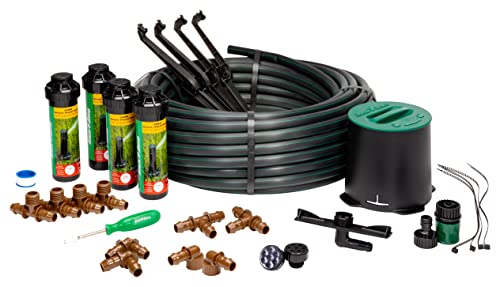
Rain Bird 32HE In-Ground Pro Rotor Pop-up Kit
Best for: DIY rotor coverage from a hose connection
A pop-up rotor kit with a Click-N-Go garden hose connection, a simple way to add buried rotors without tapping the main line.
- Pop-up rotors in a kit
- Garden hose connection
- Retracts below mowing height
- Coverage limited by faucet flow
- Requires trenching

Eden 16030 5-Pattern Turbo Gear Drive Rotary Sprinkler
Best for: Above-ground watering with rotary coverage
A hose-end gear-drive sprinkler with five spray patterns and full 360 degree coverage, designed to water without flooding.
- Five spray patterns
- Turbo gear drive
- Full 360 degree coverage
- Above-ground, must be moved
- Less throw than in-ground rotors

Orbit H2O-Six Gear-Drive Sprinkler
Best for: Budget lawn and garden watering
A gear-drive sprinkler from Orbit with six spray patterns for watering lawns and gardens from a hose.
- Six spray patterns
- Gear drive for steady rotation
- Affordable
- Hose-end, not permanent
- Plastic construction
How we chose these heads
We compared adjustability, nozzle options, pressure handling, build quality and suitability for different lawn sizes. Permanent in-ground heads came first, because that is where rotary heads make the biggest difference, but we included hose-end gear-drive sprinklers for renters and anyone watering without a buried system. We do not list prices because they change often.
Rotors vs spray heads
Spray heads pop up and release a fixed fan of water over a short radius, often 5 to 15 feet. They apply a lot of water quickly, which suits small, narrow or irregular areas, but on clay or slopes water can run off before it soaks in.
Rotors pop up and turn one or more streams slowly across a much wider radius, often 20 feet or more. They apply water at a lower rate, which gives soil time to absorb it and makes them better for larger open lawns.
Rotary nozzles are a hybrid: they fit on spray-head bodies but rotate multiple streams, combining the short radius of a spray head with the slower application of a rotor. They are a popular upgrade for small lawn zones.
The key rule is never to mix rotors and sprays on the same zone. Because they apply water at very different rates, one area will be soggy while another is dry.
Rotary sprinkler head buying guide
Arc adjustment
Look for heads that adjust from a narrow arc to a full circle. This lets you water corners, edges and strips beside paths without wasting water on pavement.
Distance adjustment and nozzles
A radius adjustment screw shortens throw, and interchangeable nozzles let you match flow to each head's position. Matched precipitation, where heads covering a half circle use about half the flow of full-circle heads, gives even watering across a zone.
Pressure regulation
High water pressure causes misting, where water breaks into fine droplets that drift away. Heads with built-in pressure regulation, such as the Rain Bird Pressure Pro, keep droplet size and distance consistent.
Pop-up height and inlet size
Pop-up height should clear the grass. A 3/4 inch inlet is common on residential rotors; make sure replacements match your existing risers.
Durability
Rotors live in the ground through sun, cold and mower strikes. Proven brands, strong pop-up stems and filter screens that protect the gear drive help them last.
Which head is right for you?
- Permanent lawn zones: Hunter PGP-ADJ.
- Smaller areas or high pressure: Rain Bird 12SAPROPR.
- DIY rotor system from a faucet: Rain Bird 32HE kit.
- No in-ground system: Eden 16030 or Orbit H2O-Six gear-drive sprinklers.
If you are building a system from scratch, our roundup of the best in-ground sprinkler system kits compares complete options.
How to adjust a rotor
Most rotors have a fixed left edge and an adjustable right edge. Turn the head to the left stop, align it with the edge of the area, then set the arc with the adjustment key and fine-tune distance with the radius screw. Run the zone and watch a full rotation. Our step-by-step guide on how to adjust rotor sprinkler head settings shows the process with common brands.
Spacing for even coverage
Rotors need head-to-head coverage: each head's spray should reach the next head. Spacing too far apart leaves dry areas between heads, while uneven nozzle choices cause wet and dry patches. If your lawn already has brown rings or stripes, our guide to uneven sprinkler coverage explains how to diagnose and fix it.
How long to run rotors
Rotors apply water slowly, so they need longer run times than spray zones, often 30 to 45 minutes or more per session depending on nozzles and soil. A catch-cup test tells you exactly how much water each zone applies. Our guide on how many minutes to run sprinkler walks through the test.
Choosing heads for your lawn size
As a rough guide, small front lawns and narrow strips under about 15 feet wide are best served by spray heads or rotary nozzles. Medium lawns with open areas of 20 to 35 feet across suit residential rotors set to a shorter radius. Large lawns, sports areas and open backyards benefit most from full rotors set near their maximum radius, because fewer heads cover more ground with even, slow watering. Measure the width of each area before buying, and plan positions on paper first, marking where each head will go and what arc it needs. Mark obstacles such as trees, beds and paths, since they block streams and change where heads should sit.
Replacing a broken rotor
Dig carefully around the head, unscrew it from the riser, keep dirt out of the open pipe, screw in the new head with the same inlet size and set its arc to match the old one. Flush the line before installing the nozzle. Our guide to sprinkler system repair covers each step.
When to upgrade from sprays to rotors
If a large, open section of lawn is watered by many spray heads, you may get better coverage and less runoff by redesigning that zone with rotors. Signs it is worth considering include runoff onto sidewalks after only a few minutes of watering, puddles on clay soil, and dry patches between spray heads that cannot be fixed by adjusting nozzles. Converting a zone means removing or capping the old spray heads, installing rotors at wider spacing with matched nozzles and lengthening run times. It is more work than swapping heads one for one, but on the right lawn the results are much more even and use water more efficiently.
Small lawns, narrow side yards and curved beds are better left with spray heads or upgraded to rotary nozzles, which fit existing spray bodies. Rotary nozzles bring much of the slow, even application of rotors to small spaces without changing your pipe layout, so they are often the easiest upgrade for older systems with runoff problems.
Maintaining rotary heads
Rotary heads are reliable, but they benefit from a quick check each spring and a few times through summer. Run each zone and watch for heads that do not pop up fully, stick in one position, spray in the wrong direction or leak at the base. Clean the filter screen under the nozzle if flow drops, because grit can jam the gear drive. Raise heads that have sunk below the turf as thatch builds up, and straighten tilted heads so they throw evenly. Keep grass trimmed around heads, and avoid running the mower over them while they are popped up. In cold climates, winterize the system by draining or blowing out the lines before the first hard freeze, since water left in the heads and pipes can crack them.
Understanding nozzles and flow
The nozzle in a rotor controls how much water it puts out, measured in gallons per minute, and how far it throws. Many rotors ship with a set of nozzles in different sizes. The goal is to give every head in a zone the same precipitation rate, meaning the same depth of water per hour over the area it covers. A head watering a full circle covers twice the area of a half-circle head at the same radius, so it needs roughly twice the flow. A quarter-circle corner head needs roughly a quarter. When nozzles are matched this way, the whole zone gets even water in the same run time. If every head uses the same nozzle regardless of arc, corner heads overwater and full-circle heads underwater, creating the classic pattern of soggy corners and dry centers.
Pressure matters too. Each nozzle has an ideal pressure range. Too little and the stream falls short; too much and it mists into fine droplets that drift on the wind. Heads with pressure regulation, or a pressure-regulating valve on the zone, solve the second problem and make performance more predictable.
Hose-end gear-drive sprinklers vs in-ground rotors
If you do not have a buried system, hose-end gear-drive sprinklers like the Eden 16030 and Orbit H2O-Six give you rotary-style coverage that you move around the lawn. They are inexpensive and flexible, and multiple spray patterns let you water different shapes, but they need to be moved, they can be tripped over and they rarely match the even coverage of a properly designed in-ground system. For a lawn you water often, a buried rotor system controlled by a timer saves time every week. For occasional watering, renters or small yards, a hose-end gear-drive sprinkler is the practical choice.
Common mistakes
- Mixing rotors and spray heads on one zone.
- Using the same nozzle on full and part-circle heads.
- Leaving heads tilted, which throws water unevenly.
- Ignoring high pressure misting.
- Running rotors for spray-head run times, so the lawn stays dry.
The EPA WaterSense program recommends matched-precipitation nozzles and pressure regulation to improve sprinkler efficiency.
The bottom line
The best rotary sprinkler heads for permanent lawn systems are rotors like the Hunter PGP-ADJ, with adjustable arc, distance and nozzles. Choose the Rain Bird Pressure Pro for smaller or high-pressure areas, the Rain Bird 32HE kit for a DIY rotor system and a gear-drive hose sprinkler if you do not have buried irrigation. Keep rotors on their own zones, space them head to head and run them long enough to soak the root zone.
Frequently Asked Questions
What are the best rotary sprinkler heads?
For permanent lawn systems, the Hunter PGP-ADJ is our top pick thanks to its adjustable arc, distance and interchangeable nozzles.
What is the difference between a rotor and a spray head?
Spray heads release a fixed fan of water quickly over a short radius. Rotors rotate one or more streams across a longer radius and apply water slowly.
Can I replace spray heads with rotors?
Only if you redesign the zone. Rotors need wider spacing and longer run times, and should not be mixed with sprays on the same zone.
How far apart should rotors be?
Space them so each rotor's spray reaches the next head, called head-to-head coverage, based on the radius you set.
Why is my rotor not turning?
Low pressure, debris in the nozzle or filter, or a worn gear drive. Clean the filter screen and nozzle first.