
Last updated: October 2026 · Written by the LawnVibe editorial team.
Raised beds drain fast, warm up early and grow intensively, which also means they dry out faster than in-ground gardens. Hand watering every bed every day quickly becomes a chore. The best drip irrigation for raised beds delivers water straight to the roots of every plant, keeps leaves dry and can run on a timer while you are away. For a standard 4×8 bed, a preassembled grid like the Garden Grid is the easiest solution. For several beds of different sizes, a quick-connect kit with both 1/2 inch and 1/4 inch tubing gives the most flexibility. Below we compare six options and explain how to lay out drip in a raised bed.
Listings change often, so check current details on Amazon before you buy. As an Amazon Associate we earn from qualifying purchases.
Our top picks at a glance
| # | Product | Best for | Link |
|---|---|---|---|
| 1 | Garden Grid Preassembled Raised Bed Watering System (4×8) | Standard 4×8 raised beds | Check price |
| 2 | Bonviee 230 ft Quick-Connect Drip Irrigation System | Gardeners who dislike barbed fittings | Check price |
| 3 | 230 ft Quick-Connect Drip Kit (1/2″ + 1/4″) | Many beds fed from one faucet | Check price |
| 4 | 230 ft Weeping Drip Line System | Densely planted beds of greens and roots | Check price |
| 5 | MIXC 200 ft 1/4″ Drip Irrigation Kit | Small beds close to the faucet | Check price |
| 6 | MIXC 100 ft 1/4″ Drip Irrigation Kit | One or two small raised beds | Check price |
Best drip irrigation for raised beds reviews
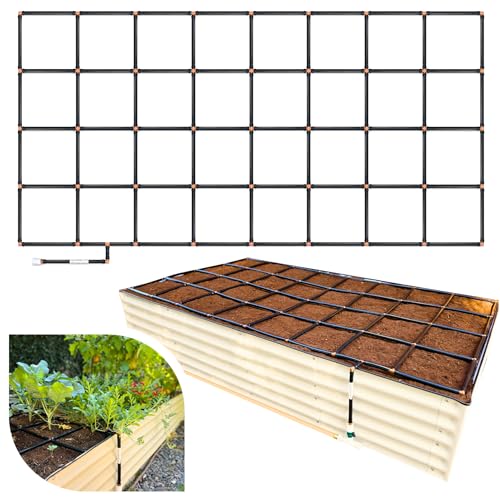
Garden Grid Preassembled Raised Bed Watering System (4×8)
Best for: Standard 4×8 raised beds
A preassembled grid that lays on a 4 by 8 foot bed and connects to a hose, giving even coverage without cutting or punching tubing.
- Preassembled, near-zero setup
- Even grid coverage across the bed
- Lift out easily for planting and cleanup
- Pairs with any hose timer
- Fixed bed size
- Higher cost per bed than DIY kits

Bonviee 230 ft Quick-Connect Drip Irrigation System
Best for: Gardeners who dislike barbed fittings
Uses push-in quick-connect fittings instead of stiff barbed connectors, making it faster to lay out and change lines between beds.
- Quick-connect fittings
- 230 ft total tubing
- Easy to rearrange
- Quick-connects can be bulkier
- Check emitter count for your beds

230 ft Quick-Connect Drip Kit (1/2" + 1/4")
Best for: Many beds fed from one faucet
Includes both 1/2 inch and 1/4 inch tubing with quick-connect fittings for broad coverage across several beds.
- Mainline plus distribution tubing
- Long total length
- Quick-connect assembly
- Unbranded listing title
- More parts than one small bed needs

230 ft Weeping Drip Line System
Best for: Densely planted beds of greens and roots
Uses weeping drip tubing that seeps water along its length, useful for closely spaced crops where individual emitters are impractical.
- Waters along the whole line
- Good for dense plantings
- Water efficient under mulch
- Output can vary on long runs
- Needs a filter to prevent clogging

MIXC 200 ft 1/4" Drip Irrigation Kit
Best for: Small beds close to the faucet
A 1/4 inch kit using components sized for US compatibility, with adjustable nozzles for small beds and pots near the tap.
- 200 ft of 1/4" tubing
- US-compatible 1/4" fittings
- Adjustable nozzles
- All 1/4" tubing limits long runs
- Not ideal for many large beds

MIXC 100 ft 1/4" Drip Irrigation Kit
Best for: One or two small raised beds
The 100 ft version of the MIXC kit, enough for one or two small raised beds near the faucet.
- Compact and affordable
- Easy to install
- US-compatible 1/4" parts
- Limited tubing
- Small beds only
How we chose these systems
We looked at what makes raised bed watering different: compact beds with dense plantings, often several beds in a row, close to a faucet. We compared preassembled grids, quick-connect kits, weeping drip lines and simple 1/4 inch kits, judging each on coverage, ease of installation, how well it adapts to different bed sizes and how easy it is to remove or rearrange when replanting. We do not list prices because they change often.
Why drip suits raised beds
Raised beds hold a lot of plants in a small space, and overhead watering wets leaves, wastes water on paths and can spread disease. Drip puts water directly on the soil around roots, so every square foot is watered evenly without splashing. Because raised bed soil drains quickly, frequent, moderate watering works well, and a timer makes that easy. Drip also keeps paths dry, which reduces weeds and mud between beds.
Raised bed drip buying guide
Grids vs kits vs weeping lines
Preassembled grids sit on top of the bed and connect to a hose. They are almost instant to set up and give even coverage, but they come in fixed sizes. Kits with tubing, emitters and fittings can be cut to any bed and expanded to many beds. Weeping or porous drip lines release water along their length, which suits densely planted greens, carrots and onions.
Supply line for multiple beds
If you have several beds, run a 1/2 inch supply line from the faucet along the ends of the beds, then branch into each bed with 1/4 inch tubing or short lengths of dripline. This keeps pressure even across beds. A manifold with a small valve for each bed lets you turn off beds that are fallow.
Line spacing
In most raised beds, lines about 12 to 18 inches apart give good coverage. Sandy mixes drain fast and need closer spacing; heavier soil spreads water sideways and can use wider spacing. A 4 foot wide bed often uses three lines running the length of the bed.
Quick-connect vs barbed fittings
Quick-connect fittings push together and pull apart easily, ideal for beds you replant each season. Barbed fittings are secure and inexpensive but harder to undo.
Filter, regulator and timer
Every drip setup needs a filter to prevent clogs and a pressure regulator to protect fittings. A hose timer makes the system automatic. Our guide to set up drip irrigation explains the faucet assembly.
Which system is right for you?
- One or two standard 4×8 beds: Garden Grid.
- Many beds, flexible layout: 230 ft quick-connect kit with 1/2" and 1/4" tubing.
- Easiest installation: Bonviee quick-connect system.
- Dense greens and root crops: weeping drip line system.
- Small beds near the faucet: MIXC 1/4" kits.
How to lay out drip in a raised bed
- Bring the supply line to one end of the bed, either over the edge or through a drilled hole.
- Run lines along the length of the bed, spaced 12 to 18 inches apart.
- Add emitters at each large plant, such as tomatoes, peppers and squash, or use dripline or weeping line for dense crops.
- Stake the lines so they stay in place.
- Cap the ends after flushing the system.
- Test and check that every part of the bed gets wet.
- Mulch over the lines.
For a step-by-step walkthrough with diagrams, see our guide to drip irrigation for raised beds.
Emitter choices for raised bed crops
Tomatoes, squash and peppers benefit from one or two emitters each, placed near the stem and moved outward as plants grow. Leafy greens, carrots and onions do better with closely spaced emitters or weeping line, so moisture is even across the whole planting. Herbs such as rosemary and thyme prefer drier conditions, so give them fewer emitters or a separate line. Our guide to drip emitter size has flow rates by plant type.
How long to run drip in raised beds
Raised beds usually need watering more often than in-ground beds. In summer, many gardeners run drip for 20 to 40 minutes two to four times a week. Young seedlings need less; fruiting tomatoes and squash in heat need more. Check the soil a few inches down a couple of hours after watering: it should be moist, not soggy. Our guide on how long to run drip irrigation explains how to fine-tune timing.
Getting water into the bed neatly
The point where the supply line enters a raised bed is where most setups look messy or get damaged. Bringing tubing over the top edge is simplest, but it can be kinked or knocked by tools and wheelbarrows. Drilling a small hole through the side of a wooden bed and running tubing through it keeps the line low and protected; seal around it if the bed holds a lot of moist soil against the wood. For metal beds, run the line over a corner where it is least likely to be bumped, and protect it with a short length of split tubing or a rubber grommet where it touches the sharp edge. Keep the supply line between beds tucked along the edges of paths, or bury it shallowly under mulch, so it is not a tripping hazard.
Drip for tall and trellised crops
Raised beds often grow climbing crops such as cucumbers, pole beans and tomatoes on trellises along one side. These plants are thirsty once they start fruiting, so give the trellis row its own line or a couple of extra emitters per plant. Run the line along the base of the trellis, a few inches from the stems, and add emitters as the plants grow. Because trellised plants shade part of the bed, crops on the shaded side may need a little less water, which is easy to adjust with adjustable drippers.
Soil mix and watering
Many raised beds are filled with a light, fluffy mix high in compost, which drains quickly and dries out faster than garden soil. Mixes heavy in peat or coir can become hard to rewet if they dry completely. Drip helps here because it keeps moisture steady, preventing the soil from drying to the point of repelling water. Adding compost each season improves water holding, and a 2 to 3 inch layer of mulch over the drip lines reduces evaporation dramatically. If you notice water running straight out of the bottom of the bed, shorten each run and water more often.
Raised beds and crop rotation
Raised beds are often replanted several times a season. Choose a system that is easy to lift out or rearrange: grids lift off in one piece, and quick-connect kits come apart without cutting. Leave the supply line in place along the bed edge and change only the lines inside the bed as crops change.
Grid vs DIY kit: cost and effort
A preassembled grid costs more per bed than a DIY kit, but it saves the most time. You unpack it, set it on the bed and connect a hose, and coverage is even from day one. A DIY kit is cheaper per bed and adapts to any size, but you will spend an hour or two cutting tubing, punching holes and placing emitters for each bed, plus some trial and error to get coverage right. If you have one or two standard beds and value convenience, a grid is hard to beat. If you have many beds, odd sizes or a tight budget, a kit wins. Many gardeners start with a grid on their main bed and use a kit to expand to others.
Seasonal adjustments
In spring, seedlings and transplants need little water, so short, frequent runs keep the top few inches moist. As plants grow and temperatures rise, lengthen run times and water deeper. In midsummer, fruiting crops in raised beds can need water most days in hot, dry weather. In fall, reduce watering as growth slows and rain returns. Before the first hard freeze, drain the lines and store the timer, filter and regulator indoors.
Maintenance
- Clean the filter regularly during the season.
- Flush lines at the start of the season and after replanting.
- Check emitters each time you harvest.
- Lift lines before turning or amending the soil.
- Drain and store components before freezing weather.
Common mistakes
- Using one long 1/4 inch line for several beds.
- Spacing lines too far apart in sandy raised bed mix.
- Watering on a fixed schedule without checking soil.
- Leaving lines exposed to sun instead of mulching.
- Forgetting to flush after cutting new holes.
The EPA WaterSense program notes that drip irrigation can significantly reduce water use compared with sprinklers in planted beds.
The bottom line
The best drip irrigation for raised beds depends on how many beds you have. For one or two standard 4×8 beds, a preassembled Garden Grid is fast and even. For several beds, a quick-connect kit with a 1/2 inch supply line and 1/4 inch branches is the most flexible, and weeping lines suit dense greens. Space lines 12 to 18 inches apart, add a filter, regulator and timer, mulch over the lines and adjust run times as crops grow.
Frequently Asked Questions
What is the best drip irrigation for raised beds?
For a standard 4×8 bed, a preassembled grid like Garden Grid is the easiest. For several beds of different sizes, a quick-connect kit with 1/2 inch and 1/4 inch tubing is more flexible.
How many drip lines does a raised bed need?
Many 4 foot wide beds use two or three lines about 12 to 18 inches apart. Sandy soil needs closer spacing.
How long should I run drip in a raised bed?
Often 20 to 40 minutes, two to four times a week in summer, but check soil moisture a few inches down and adjust.
Can I connect several raised beds to one faucet?
Yes. Run a 1/2 inch supply line to each bed and branch into the beds, or use a manifold with a valve for each bed.
Should drip lines go under mulch in raised beds?
Yes. Mulch over drip lines reduces evaporation and keeps tubing out of the sun.