
Last updated: October 2026 · Written by the LawnVibe editorial team.
Moving hoses and sprinklers around the yard gets old fast. The best in-ground sprinkler system for a DIY homeowner buries pop-up heads below mowing height, runs automatically and can be installed in a weekend. For most small to medium lawns our top pick is the Rain Bird 32ETI, which connects to an outdoor faucet so you avoid tapping into the main water line. Below we compare six options, from all-in-one kits to individual rotor heads for building a permanent system, and explain how to size, lay out and install your system.
Listings change often, so check current details on Amazon before you buy. As an Amazon Associate we earn from qualifying purchases.
Our top picks at a glance
| # | Product | Best for | Link |
|---|---|---|---|
| 1 | Rain Bird 32ETI DIY In-Ground Automatic Sprinkler System Kit | Small to medium lawns watered from an outdoor faucet | Check price |
| 2 | Rain Bird 32HE In-Ground Pro Rotor Pop-up Sprinkler System Kit | Wider lawn areas that need rotor throw | Check price |
| 3 | Orbit 50022 Medium-Area 1-Zone All-in-One Sprinkler Kit | One medium lawn area with a single zone | Check price |
| 4 | Orbit 50020 All-in-One Automatic Watering Kit | Small front lawns and side yards | Check price |
| 5 | Quick-Snap QSK-745 5-Inch Pop-Up Sprinkler 5-Pack | Custom layouts and odd-shaped lawns | Check price |
| 6 | Hunter PGP-ADJ 3/4″ Rotor Sprinkler | Building or upgrading a permanent system | Check price |
Best in-ground sprinkler system reviews

Rain Bird 32ETI DIY In-Ground Automatic Sprinkler System Kit
Best for: Small to medium lawns watered from an outdoor faucet
A hose-connected in-ground kit that attaches to an outdoor faucet, so you get buried pop-up sprinklers and automatic watering without tapping into the main water line.
- Connects to an outdoor faucet, no main-line tap
- Buried pop-ups stay out of the mower path
- Waters automatically through the season
- From a major irrigation brand
- Coverage limited by faucet flow
- Still requires digging shallow trenches
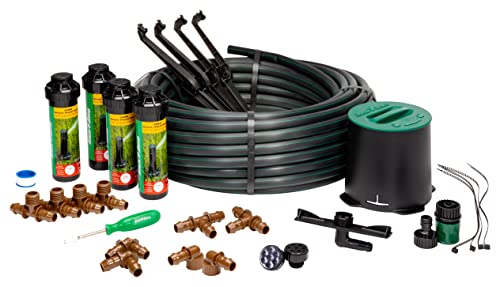
Rain Bird 32HE In-Ground Pro Rotor Pop-up Sprinkler System Kit
Best for: Wider lawn areas that need rotor throw
Uses pop-up rotor heads, which throw water farther than spray heads, with a Click-N-Go garden hose connection.
- Rotor heads cover larger areas per head
- Hose connection for easy hookup
- Pop-ups retract below mowing height
- Rotors need longer run times
- Plan head spacing carefully for overlap
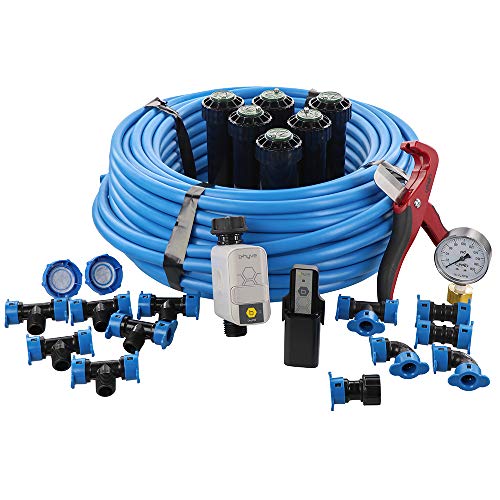
Orbit 50022 Medium-Area 1-Zone All-in-One Sprinkler Kit
Best for: One medium lawn area with a single zone
An all-in-one automatic kit for a single zone, including what you need to water a medium-sized area from a hose bib.
- Single box with timer-ready layout
- Designed for one medium area
- Good first in-ground project
- Single zone only
- Not for multi-zone yards

Orbit 50020 All-in-One Automatic Watering Kit
Best for: Small front lawns and side yards
A smaller all-in-one Orbit kit aimed at compact lawn areas where one short zone is enough.
- Sized for small areas
- Simple all-in-one setup
- Hose-bib connection
- Limited coverage
- Expansion needs extra parts

Quick-Snap QSK-745 5-Inch Pop-Up Sprinkler 5-Pack
Best for: Custom layouts and odd-shaped lawns
A five-pack of adjustable 5 inch pop-up sprinklers with quick hose connectors and splitters, so you can build your own buried layout.
- 5 adjustable pop-up heads
- Quick connectors and splitters included
- Easy to reconfigure
- You design the layout yourself
- Hose-fed pressure limits how many heads run at once

Hunter PGP-ADJ 3/4" Rotor Sprinkler
Best for: Building or upgrading a permanent system
A professional-style rotor with a preinstalled 3.0 GPM nozzle and an adjustable arc from 40 to 360 degrees, a common choice for permanent in-ground systems.
- Adjustable arc and throw
- Widely used in permanent systems
- Interchangeable nozzles
- Sold as single heads, not a full kit
- Needs proper pipe, valves and controller
How we chose these systems
We looked for options that a homeowner can realistically install without a contractor. That meant kits that connect to an outdoor faucet, kits with clear layouts for a single area and quality heads for anyone building or upgrading a permanent system. We compared head type, coverage, how the system connects to water, how easily it expands and whether it suits small or large lawns. We do not list prices because they change often; each pick links to its current Amazon listing.
Faucet-fed kits vs main-line systems
There are two broad ways to build an in-ground system.
Faucet-fed (hose bib) kits connect to an outdoor tap. Water flows from the faucet through a timer into buried tubing and pop-up heads. They are the easiest DIY option because you do not need to cut into household plumbing, install a backflow assembly or run wires to valves. The trade-off is flow: a single faucet can only supply so many heads at once, so these kits suit small to medium lawns or a single zone.
Main-line systems tap into the water supply, usually near the meter or main shutoff, with a backflow preventer, valves for each zone and a controller. They can water large yards with many zones, but installation is more involved and often requires a permit and a licensed plumber for the connection. Individual heads like the Hunter PGP-ADJ are typical in these systems.
In-ground sprinkler buying guide
Measure your lawn
Sketch the lawn on paper with rough measurements, noting beds, paths, trees and slopes. Divide the lawn into areas of similar shape and sun. This sketch tells you how many heads you need, where they go and whether a single zone or several are required.
Check flow and pressure
Your water supply limits how many heads can run at once. A simple test is to time how long it takes your outdoor faucet to fill a 5 gallon bucket, which gives a rough gallons-per-minute figure. A pressure gauge on the faucet gives static pressure. Kit instructions often tell you how many heads a typical faucet can supply. If you have more heads than your flow allows, split them into zones that run one after another.
Spray heads vs rotors
Spray heads produce a fixed fan of water, typically covering a radius of roughly 5 to 15 feet, and apply water quickly. They are ideal for small, narrow or irregular areas. Rotors rotate a stream of water and throw it much farther, often 20 feet or more, and apply water slowly, which suits larger open lawns and clay soils. Do not mix sprays and rotors on the same zone, because they apply water at very different rates.
Head-to-head coverage
For even watering, sprinkler patterns should overlap so that each head's spray reaches the next head. This is called head-to-head coverage. Lawns without enough overlap develop dry rings and brown patches between heads.
Pop-up height
Pop-up heights of 4 to 6 inches clear most lawn grass. Taller grass, such as fescue mowed high, may need taller pop-ups so the spray is not blocked.
Timer or controller
A faucet-fed kit needs a hose timer to run automatically. A main-line system needs a controller wired to the valves. Smart controllers adjust watering for weather; see our roundup of the best irrigation controller 4 zone options.
Expansion
If you might add areas later, choose a system with standard fittings and room for more zones. Our guide on how to add a sprinkler zone explains what is involved.
Which system is right for you?
- Most small to medium lawns, no plumbing work: Rain Bird 32ETI.
- Larger open lawn from a faucet: Rain Bird 32HE rotor kit.
- One medium area, simplest setup: Orbit 50022.
- Small front lawn or side yard: Orbit 50020.
- Odd-shaped lawn, custom layout: Quick-Snap 5-pack.
- Building or upgrading a permanent system: Hunter PGP-ADJ rotors.
How to install a DIY in-ground sprinkler system
- Call before you dig. Have underground utilities marked before trenching.
- Plan the layout with head positions for head-to-head coverage.
- Lay out the tubing and heads on the surface and test the system before burying anything.
- Dig narrow trenches along the tubing route, keeping the sod to replace later.
- Set the heads so their tops sit flush with the soil.
- Connect to the faucet with a backflow preventer and timer.
- Flush the lines before installing nozzles to clear dirt.
- Adjust arcs and distance so water lands on grass, not pavement.
- Backfill and replace sod, then water to settle the soil.
For a step-by-step walkthrough, see our guide to install in-ground sprinkler system.
DIY kit vs professional installation
A DIY kit is the cheapest way to get automatic watering for a modest lawn, and most homeowners can finish one in a weekend with a flat spade, a trenching tool and some patience. A professionally installed main-line system costs considerably more but can cover a whole property with many zones, uses a dedicated backflow assembly and is designed around your water supply. If your lawn is large, sloped or has many separate areas, it can be worth getting a quote even if you plan to do part of the work yourself. For a small front yard or a single backyard lawn, a faucet-fed kit is usually the practical choice.
Planning for slopes and clay soil
Water runs off slopes and clay before it can soak in. On these areas, rotors are often a better choice than sprays because they apply water more slowly. Split watering into two or three shorter cycles with a soak period between them, a technique called cycle and soak. Place heads so they spray across or down the slope rather than throwing water uphill against the grade, and avoid heads at the very bottom of a slope where runoff collects. Aerating compacted clay lawns before installing also helps water penetrate.
Adding drip zones for beds
In-ground sprinkler kits are designed for turf. Shrub beds, flower borders and vegetable gardens are better served by drip irrigation on their own zone, because drip puts water at the roots without wetting leaves or walls. If your controller or timer has a spare zone, a drip kit can share the same water supply and run on a different schedule. Our roundup of the best drip irrigation kit options covers kits suited to beds and containers.
Upgrading an existing system
If you already have an older in-ground system, you may not need a new kit at all. Replacing worn spray heads with rotors on large areas, upgrading to matched-precipitation nozzles, fixing low heads and adding a smart controller can dramatically improve coverage and cut water use. Start by running each zone and noting dry spots, geysers and overspray onto paving, then fix the worst problems first. Small fixes such as straightening tilted heads, cleaning clogged nozzles and adjusting arcs away from sidewalks often make a bigger difference than a full replacement, and they cost very little.
How long to run an in-ground system
Most established lawns need about an inch of water a week in summer, including rain, applied in two or three deep sessions. Spray zones may need 10 to 20 minutes per session; rotor zones often need 30 minutes or more. Run times depend on your heads and soil, so the best approach is a catch-cup test: place several straight-sided containers in the zone, run it for 15 minutes and measure. Our guide on how many minutes to run sprinkler explains the test in detail.
Maintaining your system
- Walk each zone monthly while it runs and look for tilted, clogged or broken heads.
- Raise or level heads that have sunk below the grass.
- Clean nozzles and filters if spray patterns become uneven.
- Adjust arcs after mowing or edging knocks heads out of alignment.
- Winterize in cold climates by draining or blowing out the lines.
If a head breaks, see our sprinkler system repair guide. Before freezing weather, follow our steps to winterize sprinkler system lines.
Tools you will need
A DIY installation does not require specialist equipment. A flat spade or half-moon edger for cutting sod, a narrow trenching shovel, a tape measure, marking flags or spray paint, a utility knife for tubing, and the fittings supplied with the kit will cover most jobs. A pressure gauge that screws onto the faucet is inexpensive and helps you confirm the kit will perform as expected. For larger projects, a rented trencher saves a lot of digging, and a few bags of topsoil help level trenches after backfilling. Lay out every component on the surface first, run water through the system and adjust heads before you bury anything; fixing a layout mistake above ground takes minutes, while fixing one after backfilling means digging again.
Common mistakes
- Too many heads on one zone, leaving weak spray and dry spots.
- Mixing rotors and sprays on the same zone.
- No overlap between heads, causing dry rings between sprinklers.
- Burying before testing the layout.
- Skipping the backflow preventer at the faucet, which protects your drinking water.
- Watering in the evening, which can encourage lawn disease.
- Setting heads too deep or too high, so they are blocked by grass or clipped by the mower.
The EPA WaterSense program offers guidance on efficient sprinkler design and scheduling that applies to DIY systems too.
The bottom line
For most DIY homeowners, the best in-ground sprinkler system is a faucet-fed kit like the Rain Bird 32ETI, which gives you buried pop-ups and automatic watering without plumbing work. Choose a rotor kit for larger lawns, an all-in-one Orbit kit for a single area, a Quick-Snap pack for custom layouts and Hunter rotors if you are building a permanent system. Plan for head-to-head coverage, test before you bury and set deep, early-morning schedules.
Frequently Asked Questions
What is the best in-ground sprinkler system for DIY?
For most small to medium lawns, a faucet-fed kit like the Rain Bird 32ETI is the easiest way to get buried, automatic sprinklers without tapping into the main water line.
Can an in-ground sprinkler system connect to a hose bib?
Yes. Several DIY kits connect to an outdoor faucet. Coverage is limited by the faucet's flow, so larger lawns may need multiple zones or a main-line system.
How deep should sprinkler lines be buried?
Many DIY kits use shallow trenches of a few inches for flexible tubing, while permanent PVC or poly systems are often buried deeper. Follow the kit instructions and local frost guidance.
Spray heads or rotors?
Spray heads suit small, narrow areas and apply water quickly. Rotors throw farther and apply water slowly, better for larger open lawns.
Do I need a permit for a sprinkler system?
Some areas require permits or backflow devices for systems connected to the main water supply. Check local rules before starting.