
Last updated: October 2026 · Written by the LawnVibe editorial team.
If you have a big lawn, a long fence line or low water pressure, the classic chk-chk-chk of an impact sprinkler is hard to beat. Instead of spraying through many small holes, it fires one concentrated stream that a spring-loaded arm breaks up as it ticks around the circle, throwing water much farther than most hose-end sprinklers. The best impact sprinkler for most homes is a brass head like the Orbit Heavy Duty, which lasts for years and fits spikes, sleds and tripods. For watering over tall plants, a tripod model lifts the stream above the canopy. Below we compare five impact sprinklers and explain how to set them up for even coverage.
Listings change often, so check current details on Amazon before you buy. As an Amazon Associate we earn from qualifying purchases.
Our top picks at a glance
| # | Product | Best for | Link |
|---|---|---|---|
| 1 | Orbit Heavy Duty 1/2 Inch Brass Impact Sprinkler | Durable head for spike, tripod or riser mounting | Check price |
| 2 | Orbit Tripod Lawn Zinc Impact Sprinkler | Watering over tall plants, gardens and large lawns | Check price |
| 3 | FANHAO Heavy Duty Metal Pulsating Impact Sprinkler (Spike Base) | Large lawns with soft ground | Check price |
| 4 | Hourleey Zinc Alloy Impact Pulsating Sprinklers | Covering a big lawn with more than one head | Check price |
| 5 | STYDDI Heavy Duty Metal Impact Pulsating Sprinkler | Medium to large lawns on a budget | Check price |
Best impact sprinkler reviews

Orbit Heavy Duty 1/2 Inch Brass Impact Sprinkler
Best for: Durable head for spike, tripod or riser mounting
A classic brass impact head from Orbit with full or part-circle coverage up to 360 degrees. Brass resists wear and sun damage better than plastic heads.
- Brass construction lasts for years
- Adjustable full or part circle
- Fits standard 1/2 inch mounts
- Handles lower water pressure well
- Head only; buy a base or spike separately
- Louder than oscillating sprinklers

Orbit Tripod Lawn Zinc Impact Sprinkler
Best for: Watering over tall plants, gardens and large lawns
An impact sprinkler on an adjustable tripod that raises the head above tall grass, crops and shrubs for wide 360 degree coverage.
- Tripod lifts spray over tall plants
- Wide 360 degree coverage
- Zinc impact head
- Tripod can tip in wind on uneven ground
- Takes more storage space

FANHAO Heavy Duty Metal Pulsating Impact Sprinkler (Spike Base)
Best for: Large lawns with soft ground
An all-metal impact sprinkler on a spike base, designed for wide coverage on large lawns.
- All-metal construction
- Spike base keeps it steady
- Large-area coverage
- Spike needs soft soil
- Newer brand; check reviews
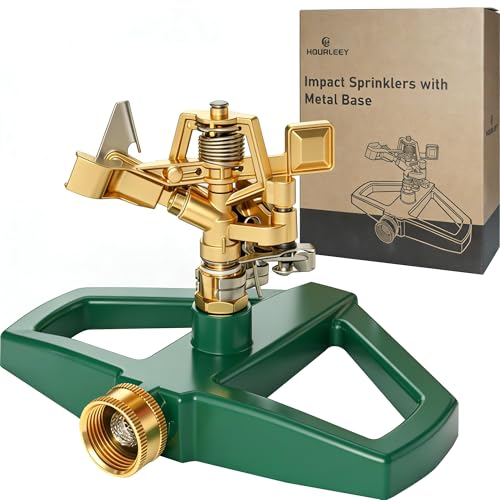
Hourleey Zinc Alloy Impact Pulsating Sprinklers
Best for: Covering a big lawn with more than one head
Made from zinc alloy with a heavy-duty base, aimed at durability and rust resistance for long seasons of use.
- Zinc alloy head and base
- Rust-resistant build
- Good value for multiple heads
- Check how many come in the pack
- Lesser-known brand

STYDDI Heavy Duty Metal Impact Pulsating Sprinkler
Best for: Medium to large lawns on a budget
An all-metal circular impulse sprinkler built for medium to large lawn areas.
- All-metal construction
- Adjustable coverage pattern
- Good for medium to large lawns
- Lesser-known brand
- Base stability varies on slopes
How we chose these sprinklers
We compared head material, base type, adjustability, coverage and suitability for different lawns and gardens. Brass and metal heads ranked higher because impact sprinklers take a lot of mechanical wear and sun exposure. We included a tripod for tall plants, spike models for soft ground and good-value metal options for covering large areas with more than one head. We do not list prices because they change often; each pick links to its current Amazon listing.
How impact sprinklers work
Water exits through a single nozzle as a strong jet. A spring-loaded drive arm swings into the stream, which pushes it away; the spring snaps it back, and each strike nudges the head around a few degrees. That repeated impact both rotates the sprinkler and breaks the jet into droplets so water falls across the whole radius, not just at the far edge. A diffuser screw lets you break up the stream further to water closer to the head. Two trip collars on the base set the start and end of a partial circle; when the head reaches one, a reversing lever flips it back. Because all the water passes through one nozzle, impact sprinklers keep their throw at pressures where multi-hole sprinklers struggle, which is why they are popular on wells, long hoses and rural properties.
Impact sprinkler buying guide
Head material
Brass heads are the most durable. They resist wear on the pivot, stay accurate for years and tolerate sun and frost better than plastic. Zinc and other metal alloys are also durable and often cheaper. Plastic heads are light and inexpensive but wear faster and can crack.
Base type
Spike bases push into the lawn and keep the head steady on soft ground. Sled or weighted bases sit on top of the grass and are easy to move, good for flat lawns. Tripods raise the head several feet high so water clears tall grass, vegetable crops and shrubs. Risers mount the head on a pipe for semi-permanent use.
Coverage and adjustability
Look for full and part-circle settings, a diffuser to control distance and an easy way to set trip collars. A good impact sprinkler can water a wide circle, so check the stated radius against your lawn size and remember it depends on pressure.
Thread size
Most residential impact heads use 1/2 inch threads. Make sure the head and the base or riser match, especially if you buy them separately.
Noise
Impact sprinklers are louder than oscillating ones. For most yards this is not a problem, but if you water very early near bedroom windows, consider positioning or a quieter sprinkler type.
Which sprinkler is right for you?
- Long-lasting, versatile head: Orbit Heavy Duty brass impact.
- Watering over tall plants or crops: Orbit tripod impact sprinkler.
- Large lawn with soft ground: FANHAO spike model.
- Several heads for a big area: Hourleey zinc alloy sprinklers.
- Metal build on a budget: STYDDI impact sprinkler.
For square or rectangular lawns with good pressure, an oscillating sprinkler may water more gently; see our roundup of the best oscillating sprinkler options.
How to set up an impact sprinkler
- Place the sprinkler where it can reach the farthest edges you want to water.
- Set the trip collars for a full circle or the arc you need, so you do not soak the house, fence or driveway.
- Turn the water on fully and watch a full rotation.
- Adjust the diffuser screw to break up the stream and water closer to the head if the inner area stays dry.
- Check overlap if you use more than one sprinkler; spray from each head should reach the next head.
- Measure output with a few straight-sided cans across the circle.
Getting even coverage with impact sprinklers
Impact sprinklers apply more water near the outer part of the circle than close to the head unless they are adjusted. The diffuser screw is the fix: screwing it into the stream breaks off more droplets close by, at the cost of a little distance. On large lawns, place heads so circles overlap generously, a layout often described as head-to-head, so each part of the lawn gets water from more than one direction. When watering a corner or strip, set a quarter or half circle rather than letting water hit pavement. Check after the first few waterings for dry crescents, which show where to adjust the diffuser or move the head.
How long to run an impact sprinkler
Impact sprinklers often apply water fairly slowly over a large area, so they usually need longer run times than oscillating sprinklers. Do a catch-can test: run the sprinkler for 20 or 30 minutes and measure the average depth in the cans. Most established lawns need roughly an inch a week in summer, including rain, applied in two or three deep sessions. Our guide on how many minutes to run sprinkler walks through the calculation, and our lawn watering schedule guide explains how often to water through the seasons.
Low water pressure and long hoses
Impact sprinklers are one of the best choices when pressure is limited, but they still need a steady supply. Use a 5/8 or 3/4 inch hose rather than a narrow one, keep runs as short as practical and avoid splitting the faucet between several sprinklers at once. A sturdy, kink-resistant hose makes a noticeable difference to throw distance; see our roundup of the best heavy duty garden hose options for hoses that hold up to being left out across the lawn.
Automating impact sprinklers
An impact sprinkler connected to a hose timer becomes a simple automatic system for a large lawn. Set the timer for early morning, two or three days a week, and adjust seasonally. If one faucet waters two areas, a two-outlet timer can run them one after the other. Our roundup of the best hose bib timer options covers programmable and smart timers.
Impact sprinklers for gardens and fields
Tripod impact sprinklers are popular in vegetable gardens and small orchards because they lift the stream above tall crops and water a wide area from one spot. Keep in mind that overhead watering wets leaves, which can encourage some fungal diseases, so water early in the day so foliage dries quickly. For beds of closely spaced vegetables or flowers, drip irrigation or a soaker hose is usually more efficient, and impact sprinklers are better saved for lawns, pastures, wildflower areas and large open plantings.
Impact vs oscillating vs rotor sprinklers
Impact sprinklers throw one strong stream in a circle or arc, reach far and work well on low pressure and in light wind. They are louder and can leave dry rings near the head if not adjusted. Oscillating sprinklers sweep a rectangle with gentle droplets, which suits typical suburban lawns with decent pressure but loses range when pressure drops. In-ground rotors are the permanent version of impact-style watering, buried and controlled by a timer, with matched nozzles for even coverage. Many homeowners keep an impact sprinkler for the back lawn or field and an oscillator for smaller rectangular areas near the house.
Choosing a base for your yard
The right base keeps the sprinkler steady and the spray consistent. On soft, flat lawns, a spike is the simplest option and resists being knocked over. On hard or compacted soil, or if you move the sprinkler around often, a weighted sled base is easier to place. Over tall grass, meadows or vegetable gardens, a tripod lifts the head so the stream clears plants, though it should be pushed firmly into the ground or weighted in windy areas. If you water the same spot all season, a riser on a stake gives a semi-permanent setup that you can leave in place and connect with a quick-connect fitting. Whichever base you choose, check that it sits level, because a tilted head throws farther on one side than the other and leaves an uneven pattern on the lawn.
Maintenance
- Clean the nozzle if the stream breaks up unevenly or distance drops.
- Check the drive arm spring moves freely and is not bent.
- Rinse grit from the pivot bearing; sand causes wear.
- Drain and store indoors before freezing weather.
- Replace washers at the hose connection if it leaks.
- Tighten the head on its base if it wobbles, which can stop rotation.
Common mistakes
- Leaving trip collars set for a full circle next to the house or driveway.
- Ignoring the diffuser, leaving a dry ring near the head.
- Watering in the evening, which keeps grass wet overnight.
- Running a long, narrow hose that cuts throw distance.
- Mixing impact and oscillating sprinklers on one faucet at the same time.
The EPA WaterSense program recommends watering early in the morning and adjusting sprinklers so water lands only on plants, which is easy with an impact sprinkler's adjustable arc.
The bottom line
The best impact sprinkler for most homes is a brass head like the Orbit Heavy Duty, which lasts for years and fits spikes, sleds, risers and tripods. Choose the Orbit tripod for tall plants, a spike model for soft lawns and good-value metal sprinklers when you need several heads for a big area. Set the trip collars, use the diffuser for even coverage, measure output and water deeply in the early morning.
Frequently Asked Questions
What is the best impact sprinkler?
For most people, a brass impact head like the Orbit Heavy Duty is the best long-term choice because brass outlasts plastic. Pair it with a spike, sled or tripod base.
Are impact sprinklers good for low water pressure?
Yes. Their single concentrated stream often throws farther on low pressure than multi-nozzle sprinklers.
How far does an impact sprinkler spray?
Many throw water in a radius of roughly 20 to 40 feet or more, depending on pressure, nozzle and adjustment.
How do I set an impact sprinkler to a partial circle?
Move the two trip collars on the base to the start and end points you want; the head reverses when it hits each one.
Why is my impact sprinkler not rotating?
Low pressure, a sticky drive arm spring or debris in the nozzle are common causes. Clean the nozzle and check the arm moves freely.