

Last updated: October 2026 · Written by the LawnVibe editorial team.
Fifty feet is not always enough. If your yard is wide, your faucet is on one side of the house or you water beds along a long fence, a 75 ft hose saves you from moving the hose to a second faucet or joining two hoses together. The best 75 ft garden hose reaches the far corners without becoming too heavy to drag and coil. Our top pick is a lightweight all-weather 75 ft hose that comes with a 10-function nozzle. Below we compare five 75 ft hoses, from light fabric designs to a stainless steel hose for heavy use, and explain how to choose the right length and material.
Listings change often, so check current details on Amazon before you buy. As an Amazon Associate we earn from qualifying purchases.
Our top picks at a glance
| # | Product | Best for | Link |
|---|---|---|---|
| 1 | 75 ft Lightweight All-Weather Garden Hose with 10-Function Nozzle | Average to large yards | Check price |
| 2 | 75 ft Garden Hose with 96-Ply Woven Jacket | Rough paths and frequent dragging | Check price |
| 3 | 75 ft Stainless Steel Garden Hose (Latex Core, Brass Connectors) | Pets, rough ground and heavy use | Check price |
| 4 | 75 ft Anti-Kink Garden Hose (Lead-Free Fittings) | Yards with corners and obstacles | Check price |
| 5 | 75 ft Anti-Kink Garden Hose (Alternate Listing) | A second color or style of the same design | Check price |
Best 75 ft garden hose reviews

75 ft Lightweight All-Weather Garden Hose with 10-Function Nozzle
Best for: Average to large yards
An all-weather, lightweight 75 ft hose sold with a 10-function spray nozzle, aimed at reducing fatigue during long watering sessions.
- Lightweight for a 75 ft hose
- All-weather design
- Nozzle included
- Leak-resistant fittings
- Unbranded listing
- Included nozzle may be basic
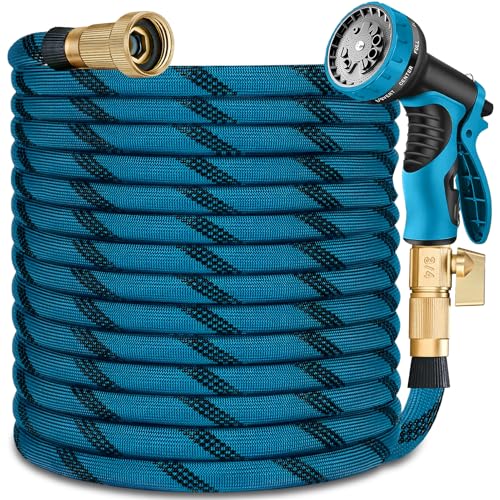
75 ft Garden Hose with 96-Ply Woven Jacket
Best for: Rough paths and frequent dragging
Pairs a 96-ply high-density woven outer fabric with a multi-layer flexible inner core for toughness without much weight.
- Dense woven jacket resists abrasion
- Flexible inner core
- Light for its size
- Fabric holds dirt
- Lesser-known brand

75 ft Stainless Steel Garden Hose (Latex Core, Brass Connectors)
Best for: Pets, rough ground and heavy use
A non-expanding stainless steel hose with a latex inner core and 3/4 inch solid brass connectors.
- Stainless outer resists punctures and chewing
- Solid brass connectors
- Does not expand or shrink
- Heavier than fabric hoses
- Latex core may not suit drinking water

75 ft Anti-Kink Garden Hose (Lead-Free Fittings)
Best for: Yards with corners and obstacles
An anti-kink 75 ft hose with corrosion-resistant, lead-free fittings designed so you do not have to stop and untangle knots.
- Anti-kink design
- Lead-free, corrosion-resistant fittings
- Good reach
- Unbranded
- Check weight on listing

75 ft Anti-Kink Garden Hose (Alternate Listing)
Best for: A second color or style of the same design
Another listing of the same anti-kink 75 ft design with lead-free fittings.
- Anti-kink
- 75 ft reach
- Lead-free fittings
- Same design as above
- Compare versions before buying
How we chose these hoses
We compared weight, materials, kink resistance, fittings and included accessories for hoses sold in 75 ft lengths. We included a lightweight all-weather hose, a woven fabric hose, a stainless steel hose and two listings of an anti-kink design. We do not list prices because they change often, and most of these hoses come from less established brands, so we recommend checking recent reviews on each listing.
Is 75 feet the right length?
Measure from the faucet to the farthest point you water, following the path you will actually walk around beds, paths and the house, then add a few feet. If the result is between 50 and 75 feet, a 75 ft hose is the right choice. If you mostly water near the house and only occasionally reach far corners, a 50 ft hose plus a 25 ft extension for occasional use may be easier to live with. A hose much longer than you need is heavier, takes longer to coil and loses a little pressure.
75 ft garden hose buying guide
Weight
At 75 feet, weight really matters. Fabric, hybrid and latex-core hoses are light enough to drag comfortably. Rubber hoses are durable but heavy at this length. Metal hoses are the toughest but heaviest. If you have a large yard and limited strength, choose a lightweight design and a good reel.
Kink resistance
Longer hoses kink more often, simply because there is more hose to twist around corners. Choose a hose marketed as kink resistant and handle it well: uncoil fully before use and turn the water on before you start pulling.
Diameter and flow
Most 75 ft hoses are 5/8 inch, which keeps flow reasonable over the longer length. If you run sprinklers at the far end, a wider hose helps maintain pressure.
Fittings
Brass or lead-free metal fittings resist leaks and crushing. With a long hose, you will drag the fittings across the ground often, so durability matters more than on a short patio hose.
Drinking water safety
If you fill pet bowls or water vegetables, choose a hose described as drinking water safe or lead-free.
Which hose is right for you?
- Most medium and large yards: lightweight all-weather 75 ft hose with nozzle.
- Rough paths: 75 ft woven fabric hose.
- Pets and heavy use: 75 ft stainless steel hose.
- Lots of corners: 75 ft anti-kink hose.
If you need maximum toughness, compare our roundup of the best heavy duty garden hose options; for the lightest handling, see the best kink-free garden hose picks.
75 ft vs 50 ft vs 100 ft
A 50 ft hose is the most common size and suits many suburban front and back yards. It is lighter, easier to coil and delivers slightly better pressure. A 75 ft hose is the sweet spot for wider lots, corner properties and gardens that run along the back fence, reaching farther without the weight and bulk of 100 feet. A 100 ft hose is for large properties and acreage, but it is heavy, slow to coil and noticeably reduces flow on lower-pressure supplies. If you are unsure, measure twice before ordering: most people overestimate how much hose they need, and the right length makes every watering session easier.
Material choices at 75 feet
Material matters more on a long hose because weight and stiffness add up. Fabric and hybrid hoses are the easiest to drag and coil, making them popular for long runs. Latex-core hoses combine flexibility with light weight but may not be rated for drinking water. Rubber hoses last a long time and handle heat and cold well, but a 75 ft rubber hose is heavy. Stainless steel hoses resist punctures, chewing and kinks, though they are heavier and the metal gets hot in sun. Think about how often you will move the hose: if it lives on a reel and comes out daily, light weight wins; if it stays across the lawn for a sprinkler, durability may matter more.
Using a 75 ft hose with sprinklers and soaker hoses
When a 75 ft hose feeds a sprinkler at the far side of the lawn, keep it straight and free of kinks so the sprinkler gets full flow. Lay it along the edge of beds rather than across the lawn, where the mower might catch it. For soaker hoses and drip lines, a long garden hose works well as a supply line from the faucet to the beds, keeping the soaker section inside the planted area. Add a pressure regulator at the faucet for soaker and drip systems.
Storing a 75 ft hose
A long hose left in a pile tangles and kinks. A wall-mounted reel or cart keeps it neat and makes coiling quick; look for a reel rated for at least 75 ft of 5/8 inch hose. Our roundup of the best garden hose reel options covers wall, cart and ground-mount reels.
Water pressure over 75 feet
A longer hose has more internal friction, so the flow at the nozzle is slightly lower than with a short hose. For hand watering with a nozzle, the difference is minor. For sprinklers at the far end of the yard, use a 5/8 inch or wider hose, avoid kinks and do not run two sprinklers from one faucet at the same time.
Handling a long hose without frustration
A 75 ft hose is easier to manage with a few habits. Before turning on the water, pull the hose out fully in gentle curves so it is not twisted. Turn the water on and let it fill before dragging, because a pressurized hose resists kinking. Pull the hose from a point a few feet behind the nozzle rather than by the nozzle itself, and walk around corners instead of tugging the hose around them. When finished, turn off the water and release pressure with the nozzle before coiling, which makes the hose softer and easier to wind. Coil in loops rather than twisting it around your arm, or use a reel that lays it in even layers.
Protecting a long hose
Long hoses are more likely to be run over by mowers, wheelbarrows and cars simply because they cover more ground. Keep the hose along the edges of lawns and paths when it is in use, and never leave it across a driveway. If the hose must cross a path often, a hose guide or a short buried conduit can keep it out of the way. Store it away from sharp edges, rough stone and hot paving, which wear the outer layer over time. A hose left lying in full summer sun on dark paving can also heat the water inside enough to scald delicate plants, so let the first few seconds of water run off before watering seedlings.
Is a 75 ft hose worth it?
If your measurements say you need more than 50 feet, yes. Constantly unscrewing hoses to reach the far corner, or joining two short hoses that leak at the connection, gets old quickly. A single 75 ft hose on a reel near the faucet makes watering faster and more pleasant. If you only occasionally need the extra reach, a 50 ft hose plus a short extension stored away may suit you better.
Care and winter storage
- Drain the hose after use, especially before freezing nights.
- Store it out of direct sun on a reel or hanger.
- Replace washers each spring.
- Check the full length for cracks before the busy season.
- Bring it indoors or store it in a shed over winter in cold climates.
Our guide on how to store garden hose in winter explains the full process, and our guide on how to choose a garden hose covers materials in more depth.
Fixing leaks and damage
On a long hose, leaks usually start at the couplings, which take the most abuse when dragged. Replace worn washers first, since they fix most leaks at the faucet and nozzle. If a coupling is crushed or the hose splits along its length, cut out the damaged part and fit a hose mender or a new end; this is far cheaper than replacing the whole 75 feet. Keep a mender kit and spare washers in the shed so small problems do not turn into a lost watering day. Our roundup of the best hose mender connector kit options lists kits sized for common 5/8 inch hoses.
Common mistakes
- Buying more length than you need.
- Leaving a long hose in a pile, where it kinks.
- Running sprinklers on a narrow, long hose and losing pressure.
- Ignoring weight when choosing material.
- Dragging the hose by the nozzle, which strains the coupling.
- Leaving water in the hose during freezing weather.
Pairing any long hose with a shut-off nozzle is an easy water-saving habit recommended by the EPA WaterSense program.
The bottom line
The best 75 ft garden hose for most medium and large yards is a lightweight, kink-resistant hose like our top pick, which includes a 10-function nozzle. Choose a woven fabric hose for rough paths, stainless steel for pets and heavy use and an anti-kink design for yards with many corners. Measure the walking path before buying, store the hose on a reel and drain it before winter.
Frequently Asked Questions
What is the best 75 ft garden hose?
For most yards, a lightweight all-weather 75 ft hose like our top pick balances reach and handling. Choose stainless steel for maximum toughness.
Is 75 ft too long for a garden hose?
Not for medium to large yards. If you rarely reach beyond 50 ft, a shorter hose is lighter and gives slightly better pressure.
Does a longer hose reduce water pressure?
Yes, a little. Longer hoses add friction, so flow at the end is slightly lower than with a short hose of the same diameter.
How heavy is a 75 ft garden hose?
It varies widely by material: fabric and hybrid hoses are light, while rubber and metal hoses are much heavier.
Can I join two shorter hoses instead?
Yes. Two hoses joined with a good coupling are easier to handle, though each connection is another possible leak point.