

Last updated: October 2026 · Written by the LawnVibe editorial team.
Overseeding is how you turn a thin, patchy lawn into a thick one without starting over. The idea is simple: spread new grass seed over existing turf so it fills the gaps. The tool you use to do it matters more than most people think. The best overseeder puts the right amount of seed exactly where it needs to go, ideally into soil that has been opened by aeration or dethatching, so seeds make contact and root quickly.
This guide compares ten overseeding tools for every lawn size: tow-behind spiker seeders and combination aerator spreaders for riding mowers, walk-behind broadcast spreaders, a battery-powered handheld seeder, and a simple hand-crank spreader for small patches. You will also learn how professional slit seeders compare, and how to get even, thick results whatever tool you choose.
| # | Product | Best for | Link |
|---|---|---|---|
| 1 | Brinly AS2-40BH-G 40″ Combination Aerator Spreader | Large lawns | Check price |
| 2 | Agri-Fab Tow Behind Spiker Seeder | Medium to large lawns | Check price |
| 3 | Agri-Fab 45-0614 130 lb Push Broadcast Spreader | Up to about 1/2 acre | Check price |
| 4 | Chapin 8401C SureSpread Professional Turf Spreader | Frequent seeding | Check price |
| 5 | EarthWay 2150 Commercial 50 lb Broadcast Spreader | Uneven lawns | Check price |
| 6 | Scotts Turf Builder EdgeGuard DLX Broadcast Spreader | Lawns up to about 15,000 sq ft | Check price |
| 7 | CRAFTSMAN V20 Four Season Handheld Seed Spreader | Small yards and patches | Check price |
| 8 | Scotts Whirl Hand-Powered Spreader | Spot repair | Check price |
| 9 | Agri-Fab 110 lb Tow Behind Broadcast Spreader | Up to about 1/3 acre per fill | Check price |
| 10 | Brinly BS26BH-A 125 lb Tow Behind Broadcast Spreader | Large lawns | Check price |
How We Chose the Best Overseeder
We did not run hands-on field tests. We compared overseeding tools on published specifications and features that matter for seeding: whether the tool opens the soil, spread pattern (drop or broadcast), hopper capacity, calibration controls, spread width, edge control, tire size, frame and hopper materials, and how well the tool suits different lawn sizes. We also weighed common owner feedback themes such as uneven spreading, clogging and assembly difficulty.
Specifications change between model years, so confirm the current listing before you buy.

Brinly AS2-40BH-G 40" Combination Aerator Spreader
Best for: Large lawns
A 40 inch tow-behind unit with 3D steel spike tines and a hopper that drops seed or fertilizer, so you aerate and overseed in one pass.
- Opens soil and seeds together
- 3D steel tines
- Pneumatic tires
- Spikes, not plugs
- Requires tow vehicle

Agri-Fab Tow Behind Spiker Seeder
Best for: Medium to large lawns
A 32 inch spiker with a 100 lb drop hopper for seed, fertilizer, salt and ice melt. Covered by a 3-year limited warranty.
- Spike and seed in one pass
- Year-round use
- Simple design
- Drop pattern needs overlap
- Narrower width

Agri-Fab 45-0614 130 lb Push Broadcast Spreader
Best for: Up to about 1/2 acre
A walk-behind broadcast spreader with a 130 lb hopper rated for about half an acre, a 10 to 12 ft spread width, 13 x 4 inch pneumatic tires and direct rod flow control.
- Large hopper
- Wide spread
- Big pneumatic tires
- Heavy when full
- Broadcast reaches beds without care
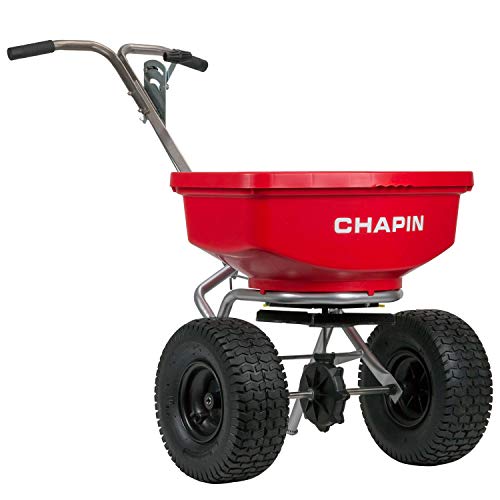
Chapin 8401C SureSpread Professional Turf Spreader
Best for: Frequent seeding
An 80 lb spreader with a one-piece poly hopper on a stainless steel frame, an enclosed gearbox, spread pattern control and 14 inch pneumatic tires.
- Stainless steel frame
- Enclosed gearbox
- Spread pattern control
- Higher cost
- Large to store

EarthWay 2150 Commercial 50 lb Broadcast Spreader
Best for: Uneven lawns
A 50 lb walk-behind spreader with 13 inch pneumatic stud tires, a clog-free grate, a 3-hole drop system with side-spread control and a fully enclosed gearbox.
- Side-spread control
- Clog-free grate
- Enclosed gearbox
- Smaller hopper than some
- Assembly required

Scotts Turf Builder EdgeGuard DLX Broadcast Spreader
Best for: Lawns up to about 15,000 sq ft
A pre-calibrated push broadcast spreader holding product for up to 15,000 sq ft, with EdgeGuard technology to keep seed off beds and drives.
- No assembly
- EdgeGuard side shield
- Easy to use
- Smaller capacity
- Lighter build

CRAFTSMAN V20 Four Season Handheld Seed Spreader
Best for: Small yards and patches
A battery-powered handheld spreader with a 1.2 gallon hopper, 6 speed settings, a 4.5 to 5.7 ft adjustable swath and coverage of up to 5,000 sq ft per tub. Tool only.
- Consistent powered spreading
- Adjustable speed and swath
- Year-round use
- Battery sold separately
- Small hopper

Scotts Whirl Hand-Powered Spreader
Best for: Spot repair
A hand-crank spreader that holds product for up to 1,500 sq ft, with an adjustable arm support for comfort.
- Inexpensive
- Great for small patches
- Easy storage
- Manual cranking
- Small capacity

Agri-Fab 110 lb Tow Behind Broadcast Spreader
Best for: Up to about 1/3 acre per fill
A tow spreader with a 110 lb rustproof poly hopper, up to a 10 ft spread width, seat-reachable flow control and 10 inch pneumatic tires.
- Control from the seat
- Rustproof hopper
- Wide spread
- Needs a tow vehicle
- Calibrate carefully

Brinly BS26BH-A 125 lb Tow Behind Broadcast Spreader
Best for: Large lawns
A 125 lb tow spreader with a rust- and dent-proof poly hopper, corrosion-resistant parts, autoflow with spread pattern control and a locking calibration dial.
- Spread pattern control
- Corrosion-resistant parts
- Quick assembly
- Tow only
- Does not open soil
Types of Overseeders
Slit seeders (gas-powered)
Slit seeders, sometimes called slice seeders, are self-propelled gas machines that cut shallow grooves in the soil and drop seed directly into them. They give excellent seed-to-soil contact and are the tool many lawn professionals use. However, they are heavy, expensive and mostly available through equipment rental shops and dealers rather than general retailers. For most homeowners, renting one for a day is more practical than buying.
Tow-behind spiker seeders and aerator spreaders
These attach to a riding mower or lawn tractor. Spike tines open the soil while a hopper drops seed behind them, combining two steps into one pass. They are the closest homeowner equivalent to a riding overseeder. Our guide to the best aerator and overseeder combo covers these in depth.
Broadcast spreaders (push and tow)
Broadcast spreaders throw seed in a wide fan. They are fast, versatile and useful all year for fertilizer and ice melt too. Used after core aeration, a broadcast spreader is an effective overseeder for most lawns.
Handheld and battery seeders
Handheld spreaders, including hand-crank and battery-powered models, are ideal for small yards, patch repairs and tight areas around beds. A battery seeder spins seed at a consistent speed, which can make coverage more even than hand cranking.
Overseeder Comparison by Lawn Size
| Lawn size | Best tool | Why |
|---|---|---|
| Patches and small yards | Handheld or battery seeder | Precise, inexpensive, easy to store |
| Up to about half an acre | Push broadcast spreader | Fast, even coverage after aeration |
| Half an acre and up | Tow spreader or spiker seeder | Covers ground quickly behind a mower |
| Major renovation | Rented slit seeder | Best seed-to-soil contact |
Overseeder Buying Guide
Seed-to-soil contact
This is the single biggest factor in overseeding success. Tools that open the soil, such as spiker seeders and slit seeders, help seed contact soil directly. If you use a spreader, aerate or dethatch first. University extension services generally recommend core aeration before overseeding compacted lawns; Kansas State University Research and Extension describes the process in its guide to aerating your lawn.
Drop vs broadcast pattern
Drop spreaders release seed straight down in a defined band, which is accurate but requires careful overlap. Broadcast spreaders cover a much wider area and blend passes more forgivingly, but they can throw seed onto beds and walkways unless they have edge control.
Calibration controls
A clear, lockable rate setting makes it easier to match the seed label. Direct rod controls and calibrated dials help you repeat the same setting every season.
Hopper capacity
Handheld spreaders hold enough for small areas, while push spreaders often hold 50 to 130 lbs and tow units more. Larger hoppers mean fewer refills but more weight.
Wheels and frame
Large pneumatic tires roll smoothly over bumpy lawns. Stainless steel frames and poly hoppers resist corrosion from fertilizer, which matters if you also use the spreader for feeding.
Edge control
Side deflectors or edge guards keep seed and fertilizer off flower beds, sidewalks and driveways. This is especially useful in small yards with many borders.
How to Overseed a Lawn
- Pick the right season. Early fall is best for cool-season grass; late spring to early summer suits warm-season grass.
- Mow short and bag the clippings so seed can reach the soil.
- Open the soil with core aeration or dethatching. See how to dethatch a lawn if thatch is thick.
- Choose the right seed for your climate, sun and traffic.
- Calibrate your tool to the overseeding rate on the seed label.
- Spread in two directions, using half the seed for each pass.
- Lightly rake or roll to improve seed-to-soil contact.
- Keep the surface moist with light, frequent watering until seed germinates.
For a complete walkthrough, read how to overseed a lawn after aerating and our guide to overseeding in fall for a green lawn.
Renting a Slit Seeder: What to Know
If your lawn needs a major renovation, renting a gas slit seeder for a day can be worth it. Reserve early, because fall weekends are busy at rental shops. You will need a truck or trailer and at least one helper to load and unload the machine, which is heavy. Mow short and mark sprinkler heads before you start, since the blades cut into the soil. Make two passes at an angle to each other, splitting the seed between them. Clean the hopper before returning the machine, and follow the rental shop's safety briefing.
Choosing Grass Seed for Overseeding
Seed choice matters as much as the tool. Cool-season lawns are commonly overseeded with tall fescue, Kentucky bluegrass or perennial ryegrass blends, chosen for sun, shade and traffic. Warm-season lawns such as Bermuda and zoysia spread by runners and are sometimes repaired with sod or plugs instead of seed, though seeded varieties exist. Buy fresh, certified seed with a high germination rate and low weed content, and follow the label's overseeding rate rather than the new-lawn rate.
Spreader Calibration Basics
Start with the setting suggested in the spreader manual or on the seed bag, then test it on a measured area. Weigh the seed before and after spreading, and adjust until the amount used matches the label rate. Recheck whenever you switch seed or fertilizer, because particle size changes how fast material flows.
Choosing an Overseeder for Thick or Tall Grass
If your lawn is still fairly dense, seed can get stuck in the canopy and never reach the soil. Mow lower than normal before overseeding, rake out debris, and consider dethatching. A spiker seeder or slit seeder is the better choice for thick turf because it places seed into the soil rather than on top of the grass. Our article on how to pick the best lawn overseeder for thick grass explains more.
Overseeding a Small Yard
In a small yard, precision matters more than speed. A handheld or battery spreader lets you target thin areas without wasting seed on beds and paths. Pair it with a manual core aerator for best results. See how to choose the best overseeder for small yards and our guide to the best manual lawn aerator.
Aftercare for New Seed
Water lightly once or twice a day until most seedlings appear, then switch to deeper, less frequent watering. Hold off on mowing until new grass reaches normal mowing height. Avoid weed control products unless the label says they are safe for new seedlings, and keep foot traffic to a minimum for several weeks.
How Often Should You Overseed?
Many lawns benefit from overseeding every year or two, especially high-traffic or shaded areas where grass thins naturally. Lawns with dense, healthy turf may only need spot seeding. Our guide on how often to aerate and overseed explains schedules by grass type and use.
Overseeder Maintenance
Empty hoppers after each use and rinse spreaders to remove seed dust and fertilizer residue, which can corrode parts. Let everything dry before storage, lubricate moving parts as the manual suggests, and check tire pressure. Our guide on how to clean and store a lawn overseeder has a full checklist.
Overseeding Shady Areas
Shade is one of the most common reasons grass thins. Choose a shade-tolerant seed blend, prune low branches to let in more light, and rake fallen leaves promptly so new seedlings are not smothered.
Common Overseeding Mistakes
The most common mistake is spreading seed on top of thatch or dense grass, where it never touches soil. Others include using too much or too little seed, seeding in midsummer heat, letting the seedbed dry out, and mowing too soon. Using a spreader that has not been calibrated is another frequent cause of patchy, striped results.
Final Verdict: Which Overseeder Should You Buy?
The best overseeder depends on your lawn size and how you prepare the soil.
- Best for riding mowers: the Brinly AS2-40BH-G combination aerator spreader or the Agri-Fab spiker seeder.
- Best push spreader: the Agri-Fab 45-0614 130 lb push broadcast spreader.
- Best professional push spreader: the Chapin 8401C SureSpread with a stainless steel frame.
- Best commercial-style option: the EarthWay 2150 with side-spread control.
- Best for small yards: the Scotts Turf Builder EdgeGuard DLX.
- Best battery seeder: the CRAFTSMAN V20 handheld seed spreader.
- Best for patches: the Scotts Whirl hand-powered spreader.
- Best tow spreaders: the Agri-Fab 110 lb and Brinly 125 lb tow-behind broadcast spreaders.
Open the soil, calibrate carefully and keep new seed moist, and any of these overseeders will help you grow a thicker, healthier lawn.
Frequently Asked Questions
What is the best overseeder for a home lawn?
For most homeowners, a quality push broadcast spreader such as the Agri-Fab 130 lb or Chapin 8401C, used right after aeration, is the most practical overseeder. With a riding mower, a tow-behind spiker seeder spikes and seeds in one pass.
What is the difference between a slit seeder and a spreader?
A slit seeder, often a gas-powered rental machine, cuts shallow grooves and drops seed into them for excellent seed-to-soil contact. A spreader scatters seed on the surface, so it works best after aeration or dethatching.
Are gas-powered overseeders worth buying?
Gas slit seeders are heavy commercial machines that most homeowners rent rather than buy. For yearly overseeding, aerating and then using a spreader is usually more economical.
Is there an electric overseeder?
There are battery-powered handheld spreaders, such as the CRAFTSMAN V20 seed spreader, that make small-yard seeding easier. Electric slit seeders for homeowners are uncommon.
How much seed should I use when overseeding?
Follow the rate on the seed label for overseeding, which is usually lower than the rate for a new lawn. Calibrate your spreader to match and split the seed across two passes in different directions.
Should I aerate before overseeding?
Yes, in most cases. Aerating or dethatching first opens the soil and improves seed-to-soil contact, which is the biggest factor in good germination.