
Last updated: October 2026 · Specs are taken from manufacturer listings on Amazon; prices and availability change, so always confirm on the product page.
A battery operated pump sprayer uses a small electric pump and a rechargeable battery to keep spray pressure steady, so you just squeeze the trigger and walk. A manual pump sprayer relies on your arm: you pump air into the tank, or work a lever on a backpack, and the pressure falls as you spray. Both apply herbicides, fertilizers and insecticides, but they feel very different in use and produce different levels of consistency.
The short answer: if you spray regularly or cover more than a few patches, battery power is worth it. If you only treat a handful of weeds a few times a year, a manual sprayer does the job for less money.
Battery vs pump sprayer at a glance
| Factor | Manual pump sprayer | Battery operated pump sprayer |
|---|---|---|
| How pressure is made | You pump air into the tank or work a lever | Electric pump driven by a rechargeable battery |
| Pressure consistency | Drops as you spray; re-pump often | Steady while the battery lasts |
| Effort | Constant pumping | Squeeze the trigger and walk |
| Application accuracy | Varies with pressure | More consistent output |
| Upfront cost | Low | Moderate to high |
| Weight | Lighter | Slightly heavier (pump and battery) |
| Maintenance | Seals, gaskets, pump parts | Seals, filters, battery care, electrical parts |
| Charging | None | Needs a charged battery |
How a manual pump sprayer works
A typical compression tank sprayer has a hand pump in the lid. You pump air into the tank, which pressurizes the liquid and pushes it out through the wand when you open the valve. As you spray, the air expands and pressure falls, so the spray pattern shrinks and output drops until you pump again.
Manual backpack sprayers work a little differently, using a side lever that you work continuously with one hand while spraying with the other. Pressure is steadier than on a compression tank, but only as long as you keep pumping at an even rhythm.
Manual sprayers are inexpensive, light and need no charging. They are perfect for small, occasional jobs.
How a battery operated pump sprayer works
A battery sprayer replaces your arm with a small electric diaphragm pump powered by a rechargeable battery. The pump draws liquid from the tank and pushes it to the nozzle at a set or adjustable pressure. Many models switch the pump on and off automatically with the trigger, while others run continuously with a bypass.
Because the pump maintains pressure, the spray pattern and output stay the same from the first minute to the last. That consistency is the biggest practical difference between the two types. Our guide to the best battery powered sprayer compares eight current models from 1-gallon handhelds to 4-gallon backpacks.
Pressure and application accuracy
Most herbicide and fertilizer labels specify an amount of product per area. To hit that rate, your sprayer needs to put out a predictable volume as you walk. With a manual compression sprayer, output starts high after pumping and falls steadily, so some areas get more product than others. With a battery sprayer, output stays even, which makes it much easier to calibrate and to apply the label rate.
That matters most for products where too much can damage plants and too little fails to work, such as selective lawn herbicides and liquid pre-emergents. If you use liquid pre-emergent, see granular vs liquid pre-emergent for how application differs.
Effort and comfort
Pumping a 2-gallon compression sprayer a few times is no big deal. Pumping it every few minutes across a whole lawn, or working a backpack lever for an hour, is tiring and can aggravate wrist, elbow or shoulder strain. A battery sprayer removes that effort completely.
Battery backpacks also let you keep both hands free for aiming the wand and moving obstacles, which makes it easier to spray carefully around plants you want to protect.
Speed
Battery sprayers are faster for anything more than spot spraying. You never stop to pump, and the steady pattern means fewer missed strips. On a typical suburban lawn, the time saved adds up quickly over a season.
Cost
Manual sprayers are cheaper to buy. Battery sprayers cost more, and backpacks with large batteries cost the most. Over time, the operating cost of both is low; the battery uses very little electricity. The main long-term cost for battery sprayers is an eventual replacement battery.
If you already own a tool battery platform, a tool-only battery sprayer can narrow the price gap.
Weight
A battery and pump add a little weight, but the difference is small compared with the weight of the liquid. A gallon of water weighs over 8 pounds, so a full 4-gallon backpack weighs more than 30 pounds whatever powers it. Choose capacity carefully: carrying more liquid than you need is the bigger weight problem.
Maintenance and reliability
Manual sprayers are simple. Their weak points are seals, O-rings and pump cylinders, which wear or dry out over time. Rebuild kits are usually inexpensive.
Battery sprayers share those seals and add a pump motor, wiring, a switch and a battery. They are reliable when cleaned properly, but there are more parts that can fail, and batteries lose capacity over the years.
For both types, the most important habit is cleaning after every use: triple-rinse the tank, flush clean water through the pump and wand, and clean the filter and nozzle. Our guide on how to clean a garden sprayer has the full routine.
Which suits your yard?
| Your situation | Better choice |
|---|---|
| A few weeds in patio cracks, a few times a year | Manual 1-gallon |
| Spot spraying a suburban lawn every few weeks | Battery 2-gallon |
| Whole-lawn liquid fertilizer or pre-emergent | Battery 4-gallon backpack |
| Hand or wrist strain from pumping | Battery |
| Tight budget, light use | Manual |
| Acreage, fence lines, orchards | Battery backpack |
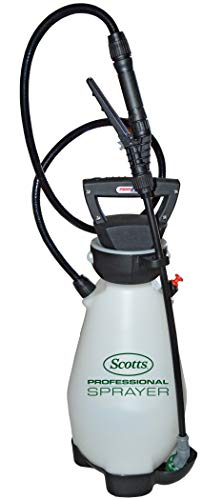
Scotts 2-Gallon Lithium-Ion (Pump Zero)
The Scotts 2-gallon battery sprayer with Pump Zero technology is a simple upgrade from a hand-pumped tank: Scotts rates it for up to 12 full tanks per charge, with a lock-on trigger and in-line filter.
Nozzles and drift
Both types use similar nozzles, and nozzle choice affects droplet size and drift more than the pump does. Fine droplets from high pressure or small orifices drift easily, while coarser droplets stay on target. Battery sprayers with adjustable pressure let you turn pressure down to reduce drift. Our guide to sprayer nozzle types explains which nozzle suits each job.
Calibration
Calibrating a sprayer tells you how much liquid it applies over a known area at your walking pace. It is far more reliable with a battery sprayer because the output is constant. With a manual sprayer, you can improve consistency by pumping to the same number of strokes each time and re-pumping at regular intervals. Our step-by-step guide on how to calibrate a backpack sprayer shows the process.
Safety for both types
Always follow the product label, wear the protective equipment it requires and spray on calm, dry days. Keep children and pets off treated areas until the spray has dried. Never mix more than you need, and store chemicals in their original containers. The U.S. Environmental Protection Agency's pesticide safety guidance is a good reference for homeowners.
For manual compression sprayers, release tank pressure before opening the lid. For battery sprayers, switch off the pump and remove or disconnect the battery before servicing.
When a manual sprayer is the better choice
A manual sprayer still makes sense if you:
- Treat a few weeds in paving or beds only a few times a year.
- Want the lowest possible upfront cost.
- Need a light, simple sprayer for occasional spot jobs.
- Prefer a tool with no batteries to charge or replace.
When a battery sprayer is the better choice
A battery sprayer is the better buy if you:
- Spray your whole lawn or large beds.
- Want consistent output for accurate application.
- Find pumping tiring or uncomfortable.
- Spray regularly through the season.
- Treat larger properties, fence lines or orchards.
Tips for better spraying with either type
- Mix only what you need for the job, following the label rate.
- Walk at a steady pace and keep the nozzle at a consistent height.
- Overlap each pass slightly.
- Use a marker dye or foaming nozzle to see coverage.
- Keep a separate sprayer for herbicides to avoid damaging plants later.
Our guide on how to use a garden sprayer for weed control covers technique in more detail, and how to stop weeds coming back after spraying explains what to do next.
Battery care for longer life
If you choose battery power, a little care keeps the battery healthy. Charge it fully before the first use, avoid leaving it fully drained for long periods, and store it indoors at moderate temperature, ideally partly charged, over winter. Keep the battery contacts clean and dry, and never charge a wet battery. Following the manufacturer's charging instructions is the best way to get several seasons of reliable runtime.
Upgrading without replacing
If you already own a manual sprayer in good condition, keep it as a backup or for small spot jobs, even after buying a battery model. Many gardeners use a 1-gallon manual sprayer for quick patio weeds and a battery sprayer for the lawn. Having two sprayers also makes it easy to keep one dedicated to herbicides and one for fertilizer or insecticides.
Storage between seasons
Whichever type you own, how you store it over winter decides how well it starts in spring. Empty the tank completely, flush clean water through the pump, hose and wand, and leave the lid off until everything is dry. Freezing water left in a pump or wand can crack plastic parts and split seals, so store sprayers in a frost-free garage or shed. For manual sprayers, a light coating of the lubricant recommended by the manufacturer on the pump seals helps stop them drying out. For battery sprayers, remove the battery and keep it indoors. A quick check of the seals, filter and nozzle before the first spray of the season prevents leaks and clogs when you need the sprayer most.
Ready to compare models?
Ready to stop pumping? Compare eight battery sprayers, from 1-gallon handhelds to 4-gallon backpacks, by capacity, pressure and rated runtime.
The verdict
A battery operated pump sprayer is the better choice for most homeowners who spray more than a few times a year. Steady pressure means more even coverage, more accurate application and far less effort. A manual pump sprayer remains a sensible, inexpensive option for occasional spot spraying. Match the sprayer to how often and how much you spray, keep it clean, and follow the label every time.
Frequently Asked Questions
Is a battery operated pump sprayer worth it?
For anyone who sprays more than occasionally, yes. Steady pressure gives more even coverage and more accurate application, and you avoid the hand fatigue of constant pumping. For a few spot treatments a year, a manual sprayer is fine.
Do battery sprayers give better results than pump sprayers?
They usually give more consistent results because pressure, and therefore output, stays steady. That helps you apply products at the label rate.
How long does a battery sprayer run on one charge?
Manufacturers rate common models anywhere from about 2 to 8 hours, or a stated number of tanks or gallons per charge. Actual runtime depends on pressure and nozzle.
Are manual pump sprayers more reliable?
They are simpler, with no battery or electronics, so there is less to go wrong. But seals and pump parts still wear, and both types last longest when cleaned after every use.
Can I convert a manual sprayer to battery power?
Some brands sell battery conversion kits or replacement pumps for specific models. Check compatibility with your sprayer's manufacturer before buying.