
Last updated: October 2026 · Specs are taken from manufacturer listings on Amazon; prices and availability change, so always confirm on the product page.
A battery powered sprayer takes the most tiring part of lawn and garden spraying, the constant pumping, out of the job. A small battery-driven pump keeps pressure steady, so coverage is more even, your hand is free to aim and you finish faster. We compared eight models, from 1-gallon handhelds to 4-gallon backpacks, to find the best battery powered sprayer for different properties and jobs.
Quick Answer
The PetraTools HD4000 is the best battery powered sprayer for most lawns and large gardens: a 4-gallon backpack with adjustable 40-90 PSI pressure, six nozzles and a manufacturer rating of 6-8 hours of runtime per charge. The Chapin 63924 is a well-built alternative with 3-stage filtration and up to 2 hours of continuous spraying, and the Field King 190515 is ideal for consistent herbicide work at a pre-set 40 PSI. For smaller jobs, the Scotts 2-Gallon and PetraTools HD2000-S are easy, no-pump tank sprayers.
Quick Picks
| Best Overall | PetraTools HD4000 4-Gallon Backpack | Check Price |
| Best Build Quality | Chapin 63924 4-Gallon 24V Backpack | Check Price |
| Best for Consistent Herbicide Rates | Field King 190515 Professional 4-Gallon | Check Price |
| Most Powerful | EGO Power+ BSP3500 4-Gallon (Tool Only) | Check Price |
| Best 2-Gallon Tank Sprayer | Scotts 2-Gallon Lithium-Ion (Pump Zero) | Check Price |
| Best 2-Gallon with Shoulder Strap | PetraTools HD2000-S 2-Gallon | Check Price |
| Best Handheld | PetraTools EZ1 1-Gallon | Check Price |
| Best for RYOBI ONE+ Owners | RYOBI ONE+ 18V Chemical Sprayer | Check Price |
How we chose
We did not run spray tests for this guide. We compared what each Amazon listing states at the time of writing: tank capacity, battery voltage and capacity, pressure range or setting, rated runtime or gallons per charge, nozzles included, filtration, carrying system and listed weight. Runtime and gallons-per-charge figures are manufacturer ratings, and we label them that way.
Battery sprayers compared
| Model | Type / capacity | Power | Runtime or output (maker rating) | Best for |
|---|---|---|---|---|
| PetraTools HD4000 | Backpack, 4 gal | 12V 8Ah | 6-8 hr, 200+ gal | Large properties |
| Chapin 63924 | Backpack, 4 gal | 24V | Up to 2 hr | Build quality |
| Field King 190515 | Backpack, 4 gal | 18V 2.1Ah | Up to 4 hr / ~50 gal | Consistent rates |
| EGO BSP3500 | Backpack, 4 gal | 56V (tool only) | See listing | High pressure |
| Scotts 2-Gallon | Tank, 2 gal | Lithium-ion | Up to 12 tanks | Typical yards |
| PetraTools HD2000-S | Tank, 2 gal | 12V | About 2 hr | Small yards |
| PetraTools EZ1 | Handheld, 1 gal | Lithium-ion | Up to 3 hr | Spot spraying |
| RYOBI ONE+ | Handheld tank | 18V ONE+ | 30+ gal | RYOBI owners |
The best battery powered sprayers, reviewed
PetraTools HD4000 4-Gallon Backpack

Best for: Large lawns, acreage and frequent spraying
Key specs (from the Amazon listing):
- 4-gallon backpack, 12V 8Ah battery
- PetraTools rates 6-8 hours runtime and 200+ gallons per charge
- Adjustable pressure 40-90 PSI, 6 nozzles
- Double-padded straps and back pad
PetraTools' HD4000 is a 4-gallon backpack sprayer built around a 12V 8Ah battery. PetraTools rates it for 6-8 hours of runtime and more than 200 gallons per charge, which is far more than most homeowners will spray in a day. Adjustable pressure from 40 to 90 PSI and six included nozzles let you switch between fine spot treatments, broad fan coverage and longer reach.
Double-padded straps and a back pad make carrying a full tank more comfortable. Treat the runtime figure as a manufacturer rating, but even a fraction of it covers big properties.
- Long rated runtime
- Adjustable pressure
- Six nozzles included
- Heavy when full, like any 4-gallon backpack
- Larger than small yards need
Chapin 63924 4-Gallon 24V Backpack
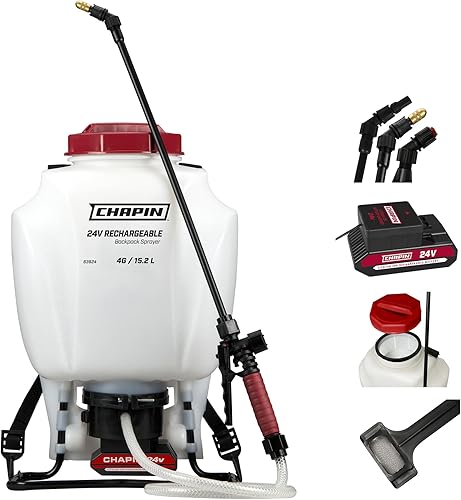
Best for: Homeowners who want a trusted sprayer brand
Key specs (from the Amazon listing):
- 4-gallon backpack, 24V rechargeable battery
- Up to 2 hours continuous spraying
- 3-stage filtration and wide 6-inch tank opening with filter basket
- Adjustable brass, adjustable poly and fan nozzles
Chapin is a long-established sprayer brand, and the 63924 shows it. The 4-gallon backpack runs on a 24V rechargeable battery for up to 2 hours of continuous spraying. A wide 6-inch opening with a filter basket makes filling easy, and 3-stage filtration helps keep nozzles from clogging.
It includes adjustable brass, adjustable poly and fan nozzles, covering spot spraying and broadcast work.
- 3-stage filtration
- Wide fill opening
- Three nozzle types
- Shorter rated runtime than the HD4000
- Backpack weight when full
Field King 190515 Professional 4-Gallon

Best for: Lawn and landscape herbicide applications
Key specs (from the Amazon listing):
- 4-gallon backpack, 18V 2.1Ah Li-ion battery, charges in about 3.5 h
- Up to 4 hours or about 50 gallons per charge (8002 nozzle)
- Pre-set 40 PSI / 0.2 GPM for landscape applications
- No pumping
Field King's 190515 runs at a pre-set 40 PSI and 0.2 GPM, which gives a steady, consistent output that suits landscape herbicide applications and makes calibration easier. Field King rates it for up to 4 hours or about 50 gallons per charge with the 8002 nozzle, and the 18V 2.1Ah battery recharges in about 3.5 hours.
There is no pumping at all, and the fixed pressure removes one variable when you are trying to apply a label rate accurately.
- Consistent pre-set pressure
- Good rated runtime
- Pro-oriented design
- Pressure is not adjustable
- Basic nozzle selection
EGO Power+ BSP3500 4-Gallon (Tool Only)

Best for: EGO owners who need high pressure and reach
Key specs (from the Amazon listing):
- 56V brushless pump, up to 350 PSI
- Pressure/flow knob on the wand
- Cone, foaming, fan and shower nozzles
- Battery and charger not included; listed 16.7 lb
EGO's BSP3500 uses a 56V brushless pump rated up to 350 PSI, far beyond typical battery backpack sprayers, with a pressure and flow knob on the wand. It comes with cone, foaming, fan and shower nozzles, which suits everything from fence lines to trees.
It is sold without battery and charger and is listed at 16.7 lb empty, so it makes most sense if you already own EGO batteries.
- Very high rated pressure
- Pressure/flow control on wand
- Four nozzles including foam
- Battery and charger sold separately
- Heavier than most
Scotts 2-Gallon Lithium-Ion (Pump Zero)

Best for: Typical suburban yards and spot spraying
Key specs (from the Amazon listing):
- 2-gallon tank sprayer, no pumping
- Scotts rates up to 12 full tanks per charge
- Commercial-grade shut-off with lock-on, in-line filter
- 21-inch poly wand with Viton seals
Scotts' 2-gallon sprayer with Pump Zero technology removes the hand pumping from a classic tank sprayer. Scotts rates it for up to 12 full tanks per charge, and it has a commercial-grade shut-off with a lock-on trigger, an in-line filter and a 21-inch poly wand with Viton seals.
It is a natural step up for anyone tired of pumping a 1- or 2-gallon sprayer.
- No pumping
- Lock-on trigger
- In-line filter
- 2-gallon capacity
- Carried by hand
PetraTools HD2000-S 2-Gallon

Best for: Small yards and garden beds
Key specs (from the Amazon listing):
- 2-gallon tank, 12V battery and charger included
- About 2 hours runtime
- 4-ft hose, padded shoulder strap
- Brass adjustable nozzle plus fan nozzle
PetraTools' HD2000-S puts a 12V battery pump on a 2-gallon tank with about 2 hours of runtime, a 4-foot hose and a padded shoulder strap. It includes a brass adjustable nozzle and a fan nozzle.
It is a comfortable middle ground between a handheld and a backpack.
- Shoulder strap
- Brass and fan nozzles
- Battery and charger included
- Smaller tank
- Shoulder carry can tire on long jobs
PetraTools EZ1 1-Gallon

Best for: Patios, beds and quick spot treatments
Key specs (from the Amazon listing):
- 1-gallon handheld, lithium-ion
- Up to 3 hours spray time
- 3 nozzles including jet-to-mist and round mist
The PetraTools EZ1 is a 1-gallon handheld battery sprayer rated for up to 3 hours of spraying, with three nozzles including jet-to-mist and round mist. It is ideal for weeds in paving cracks, small beds and houseplant or greenhouse use.
- Light and compact
- Long rated runtime for its size
- Three nozzles
- 1-gallon tank
- Not for large lawns
RYOBI ONE+ 18V Chemical Sprayer

Best for: RYOBI 18V users with small jobs
Key specs (from the Amazon listing):
- Runs on any RYOBI ONE+ 18V battery
- Rated over 30 gallons per charge
- This listing includes compact battery and charger
RYOBI's ONE+ chemical sprayer runs on any RYOBI 18V ONE+ battery, and RYOBI rates it for over 30 gallons per charge. This listing includes a compact battery and charger, so it works as a starter kit too.
It is a convenient choice if your garage is already full of RYOBI tools.
- Uses ONE+ batteries
- Rated 30+ gallons per charge
- Battery and charger included
- Smaller capacity than backpacks
- Fewer nozzle options
How to choose a battery powered sprayer
Size and type
| Property and job | Suggested type | Why |
|---|---|---|
| Patio cracks, a few beds | 1-gallon handheld | Light, quick, little mixing waste |
| Typical suburban lawn spot spraying | 2-gallon tank | Enough capacity without the weight of a backpack |
| Whole-lawn liquid treatments | 4-gallon backpack | Fewer refills, even coverage |
| Acreage, fence lines, orchards | 4-gallon backpack with long runtime | All-day capacity |
A full 4-gallon backpack weighs over 30 pounds with water, so size up only if you need the capacity. For many suburban yards, a 2-gallon tank sprayer is the sweet spot.
Pressure
Most herbicide and fertilizer labels work well at low to moderate pressure. Higher pressure creates finer droplets that drift more easily. Adjustable pressure, like the 40-90 PSI range on the PetraTools HD4000, gives flexibility, while a pre-set pressure like the Field King's 40 PSI makes consistent application simpler. Very high pressure, like EGO's 350 PSI rating, is useful for reach into trees but is rarely needed for lawn work.
Nozzles
Nozzles control droplet size, pattern and output. Fan nozzles give even broadcast coverage, adjustable cone nozzles handle spot spraying, and foaming nozzles help you see where you have sprayed. Our guide to sprayer nozzle types explains which to use for each job.
Runtime and battery
Check rated runtime against your largest job. If you already own batteries from EGO or RYOBI, a tool-only sprayer can be good value. Otherwise, choose a kit with its own battery and charger.
Filtration and seals
Good filtration prevents clogged nozzles. Chemical-resistant seals such as Viton last longer with herbicides and fertilizers. A wide fill opening makes mixing easier and reduces spills.
Comfort
For backpacks, padded straps, a back pad and a waist belt make a big difference. For tank sprayers, a shoulder strap helps on longer jobs.
Battery vs manual pump sprayers
Manual pump sprayers are cheap and simple, but pressure drops as you spray, so you have to keep pumping and output varies. Battery sprayers hold steady pressure, which improves accuracy and reduces fatigue. Our comparison of battery vs pump sprayer covers the trade-offs in detail.
Accurate application starts with calibration
Herbicide and fertilizer labels give rates per area, so you need to know how much your sprayer puts out as you walk. Calibration takes only a few minutes and prevents both wasted product and weak results. Our step-by-step guide on how to calibrate a backpack sprayer shows you how.
If you apply liquid pre-emergent, accurate calibration is essential; see granular vs liquid pre-emergent for how the two forms compare, and our best pre-emergent for lawns guide for product choices.
Safety and label compliance
Always read and follow the product label; it is the legal guide to how a pesticide may be used. Wear the personal protective equipment the label requires, often gloves, long sleeves and eye protection. Spray on calm days to limit drift, keep people and pets away until the spray has dried, and never spray near water unless the label allows it. The U.S. Environmental Protection Agency's guidance on using pesticides safely is a helpful reference.
Using your sprayer well
- Mix only what you need, following the label rate.
- Walk at a steady pace and keep the nozzle at a consistent height.
- Overlap passes slightly for even coverage.
- Use a marker dye or foaming nozzle to see where you have sprayed.
Our guide on how to use a garden sprayer for weed control covers technique, and how to stop weeds coming back after spraying explains follow-up.
Cleaning and storage
Triple-rinse the tank with clean water after each use, spraying the rinse water over the treated area as the label directs. Clean filters and nozzles, and run clean water through the pump. Keep a separate sprayer for herbicides. Store the sprayer empty and dry, out of freezing temperatures, and keep the battery indoors at partial charge. See how to clean a garden sprayer for a full routine.
Final recommendation
For most lawns and larger gardens, the PetraTools HD4000 is the best battery powered sprayer thanks to its 4-gallon tank, adjustable pressure, six nozzles and long rated runtime. Choose the Chapin 63924 for proven build quality, the Field King 190515 for consistent herbicide rates, the EGO BSP3500 for maximum pressure if you own EGO batteries, the Scotts 2-Gallon or PetraTools HD2000-S for typical yards, the PetraTools EZ1 for spot spraying and the RYOBI ONE+ if you are on that battery platform.
Frequently Asked Questions
What is the best battery powered sprayer?
The PetraTools HD4000 is our top pick for most lawns and large gardens thanks to its 4-gallon tank, adjustable 40-90 PSI pressure and long rated runtime. The Chapin 63924 is a well-built alternative, and the Scotts 2-Gallon is best for smaller yards.
Are battery sprayers better than pump sprayers?
For most people, yes. Battery sprayers deliver steady pressure without pumping, which gives more even coverage and less fatigue. Manual pump sprayers are cheaper, lighter and need no charging.
What size battery sprayer do I need?
A 1-gallon handheld suits spot spraying, a 2-gallon tank suits typical yards, and a 4-gallon backpack suits whole-lawn treatments and larger properties.
Can I use the same sprayer for herbicides and fertilizers?
It is safest to keep a dedicated sprayer for herbicides. Residue can damage plants if you later use the same sprayer for fertilizer or insecticide on desirable plants.
How long do battery sprayer batteries last?
Runtime ratings range from about 2 to 8 hours depending on battery size and pressure. Real-world runtime varies with nozzle and pressure setting.