
Last updated: October 2026 · Written by the LawnVibe editorial team.
One outdoor faucet rarely meets all of a garden's needs. You might want a soaker hose connected to the vegetable bed all summer and still have a free hose for washing the car or filling a watering can. A splitter solves this by turning one faucet into two outlets, each with its own shut-off valve. The best hose splitter for most homes is the DBR Tech heavy duty 2-way splitter, with sturdy construction and independent levers. If corrosion is a concern, a brass model like the LIME splitter lasts longer outdoors. Below we compare five splitters and explain how to use one with timers, drip lines and sprinklers.
Listings change often, so check current details on Amazon before you buy. As an Amazon Associate we earn from qualifying purchases.
Our top picks at a glance
| # | Product | Best for | Link |
|---|---|---|---|
| 1 | DBR Tech Heavy Duty 2-Way Garden Hose Splitter | Running two hoses from one faucet every day | Check price |
| 2 | DBR Tech 2-Way Hose Splitter | Same brand quality in an alternate design | Check price |
| 3 | LIME 2-Way Heavy Duty Brass Hose Splitter | Corrosion resistance and long life | Check price |
| 4 | Sanpaint 2-Way Heavy Duty Y Valve Hose Splitter | Budget two-hose setups | Check price |
| 5 | 2-Way Heavy Duty Hose Splitter | Occasional use | Check price |
Best hose splitter reviews

DBR Tech Heavy Duty 2-Way Garden Hose Splitter
Best for: Running two hoses from one faucet every day
A heavy-duty 2-way splitter from a family-owned brand that says its splitters have years of proven use, with individual shut-off levers for each outlet.
- Heavy-duty metal body
- Independent shut-off for each outlet
- Popular, well-reviewed brand
- Good grip levers
- Adds weight to the faucet; support long hoses
- Not a timer; outlets are manual

DBR Tech 2-Way Hose Splitter
Best for: Same brand quality in an alternate design
Another DBR Tech 2-way splitter for splitting one faucet into two hoses with separate shut-off valves.
- Two outlets with separate valves
- Sturdy build
- Trusted brand
- Check thread fit on older faucets
- Manual operation only

LIME 2-Way Heavy Duty Brass Hose Splitter
Best for: Corrosion resistance and long life
Built with brass and metal materials designed to resist corrosion and leaks, a good choice for faucets that stay connected all season.
- Brass and metal construction
- Corrosion resistant
- Leak-resistant design
- Heavier than plastic splitters
- Levers can be stiff at first
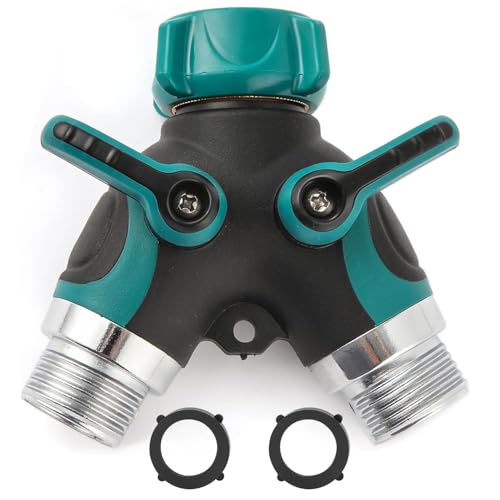
Sanpaint 2-Way Heavy Duty Y Valve Hose Splitter
Best for: Budget two-hose setups
A heavy duty Y-valve splitter that divides one faucet into two hose connections with individual valves.
- Y-valve design
- Individual valves
- Budget-friendly
- Check material of levers
- Less brand history

2-Way Heavy Duty Hose Splitter
Best for: Occasional use
A basic heavy duty 2-way splitter for connecting two hoses to one outdoor tap.
- Simple two-outlet design
- Low cost
- Easy installation
- Unbranded product
- Limited product details; read reviews
How we chose these splitters
We compared build material, valve quality, lever comfort, leak resistance and value. Heavy duty metal and brass splitters ranked higher than plastic ones because a splitter stays on the faucet for months and carries the weight of two hoses. We do not list prices because they change often; each pick links to its current Amazon listing.
Hose splitter vs dual outlet timer
A hose splitter divides water manually. You open or close each lever by hand, and both outlets share whatever the faucet supplies. It is ideal when you want two hoses connected but control them yourself. A dual outlet timer has electronic valves on each outlet with separate schedules, so a sprinkler and a drip line can run automatically at different times. If you want automation, see our roundup of the best dual outlet hose timer options. Many gardeners use both: a timer on the drip side and a manual outlet for hand watering.
Hose splitter buying guide
Material
Brass splitters resist corrosion, handle sun and cold well and seal reliably for years. Zinc alloy and other metals are strong and often lighter. Plastic splitters are cheap but can crack, especially in freezing weather or when hoses pull on them.
Valves and levers
Each outlet should have its own shut-off. Ball valves with quarter-turn levers are easy to open and close fully. Large, rubber-coated levers are easier to grip with wet hands. Check that levers turn smoothly without forcing.
Number of outlets
Two outlets suit most homes. Four-way splitters exist for larger gardens, but each open outlet shares flow, so they work best when only one or two are open at a time.
Connection quality
Look for a swivel inlet that lets you attach the splitter without twisting the hose, and good rubber washers at every connection. Metal threads resist stripping better than plastic.
Weight and support
A metal splitter plus two full hoses puts a lot of weight on the faucet. Support hoses with a hanger or reel, or add a short leader hose between the faucet and splitter to reduce strain.
Which splitter is right for you?
- Most homes: DBR Tech heavy duty 2-way splitter.
- Alternate design from the same brand: DBR Tech 2-way splitter.
- Maximum corrosion resistance: LIME brass splitter.
- Budget setup: Sanpaint Y valve.
- Occasional use: basic 2-way heavy duty splitter.
How to install a hose splitter
- Check the washer in the splitter inlet and add one if missing.
- Screw the splitter onto the faucet by hand until snug.
- Close both levers.
- Connect a hose to each outlet, with washers in each hose coupling.
- Turn the faucet on fully and open one lever at a time to check for leaks.
- Tighten connections by hand if you see drips.
Using a splitter with timers and drip irrigation
You can combine a splitter with automation in several ways. Put a single timer before the splitter to control both outlets together, which is simple but runs them on the same schedule. Put a timer after one outlet, for example on the drip side, and keep the other outlet manual for hand watering. For drip or soaker lines, add a backflow preventer, filter and pressure regulator after the splitter on that outlet only, so the other outlet keeps full pressure. Our guide to the drip irrigation head assembly shows the correct order of parts, and our guide to install hose timer on faucet covers connecting timers.
Water pressure tips
A splitter does not add water; it divides it. When both outlets are open, each gets roughly half the flow, which can shorten a sprinkler's reach. For the best results, run sprinklers one at a time, keep hoses as short as practical and use 5/8 inch or wider hoses for sprinklers. Drip and soaker lines use little water, so they share a faucet comfortably with hand watering.
Common ways to use a splitter
Soaker hose plus hand watering. Leave a soaker hose connected to one outlet all season for a vegetable or flower bed, and keep a regular hose with a nozzle on the other outlet for containers, new plants and quick jobs. Open the soaker side for a long, slow watering early in the morning and close it when done.
Sprinkler plus garden hose. Keep a lawn sprinkler hose on one side and a general-purpose hose on the other, so you never need to swap hoses to water the lawn. Run the sprinkler with the other lever closed for full pressure.
Front and back yard. If one faucet must serve two areas, run a hose to each from the splitter. Label the levers with a paint pen or tag so everyone in the household knows which side goes where.
Garden plus rain barrel or pool. A spare outlet can fill a pool, pond or water trough without disconnecting the garden hose. Remember to close it when the fill is finished.
Drip line plus washing station. A drip system on one outlet and a short hose with a spray nozzle on the other makes a handy station for rinsing harvests, tools and boots near the vegetable garden.
Choosing a durable splitter
A splitter lives in one of the harshest spots in the garden: hanging from a faucet in full sun, often with two water-filled hoses pulling on it. Look closely at the parts that fail first. The inlet threads should be metal and turn smoothly. The valve levers should feel solid and move with a firm quarter turn, not wobble. The body should be thick enough that it does not flex when you tighten a hose. Rubber-coated levers are easier on hands and do not get as hot in the sun. If you live where water is hard, brass resists mineral buildup and corrosion better than cheaper metals, so it keeps its levers moving smoothly for longer. Spending a little more on a well-built splitter usually saves you from replacing a leaking one every season.
Winter care
Water trapped inside a splitter can freeze and crack the body or valves. Before the first hard freeze, remove the splitter, open both levers to drain it and store it indoors. Disconnect and drain hoses too. Our guide on how to store garden hose in winter covers the rest.
Splitters and backflow protection
Whenever a hose may sit in a pool, a bucket of fertilizer solution or a drip system, there is a small risk that dirty water could be drawn back into your home's plumbing if pressure drops. A hose bib vacuum breaker or backflow preventer at the faucet guards against this. Many newer outdoor faucets have one built in; if yours does not, fit one before the splitter so it protects both outlets. Drip irrigation kits often include a backflow device, but adding one at the faucet protects every hose you connect. Local plumbing codes in some areas require backflow protection on hose connections, so it is worth checking. A backflow device is inexpensive, threads on in seconds and is one of the easiest safety upgrades you can make at an outdoor tap.
How long do hose splitters last?
A well-made brass or heavy duty metal splitter can last many seasons if it is drained and stored indoors over winter. Plastic splitters often crack within a season or two, especially if left out in freezing weather or strained by heavy hoses. The levers and seals usually wear before the body does. If a lever starts to stick or a valve weeps even when closed, it is time to replace the splitter rather than keep tightening it. Rinsing grit off the threads before connecting hoses and opening each lever fully a few times at the start of the season helps keep the valves turning freely. If you notice green or white crust around brass parts, scrub it off with a brush and a little vinegar, rinse well and dry the splitter before storing it.
Troubleshooting leaks
Most splitter leaks are at the threads. Replace worn or missing washers, avoid cross-threading by starting connections straight and tighten by hand rather than with pliers. If a lever leaks around its stem or will not close fully, the valve may be worn and the splitter should be replaced. Leaks at the hose couplings themselves can often be fixed with new washers or a replacement end; see our guide on how to fix a leaking garden hose.
Common mistakes
- Running two sprinklers at once and losing pressure.
- Hanging heavy hoses directly from the splitter.
- Leaving the splitter outside over winter.
- Skipping washers at the inlet and outlets.
- Putting a pressure regulator before the splitter, which lowers pressure for both outlets.
The EPA WaterSense program recommends shut-off devices on hoses so water only flows when needed, which a splitter with individual valves makes easy.
The bottom line
The best hose splitter for most homes is the DBR Tech heavy duty 2-way splitter, with sturdy construction and independent shut-offs. Choose the LIME brass splitter for corrosion resistance, the Sanpaint for a budget setup and pair any splitter with a timer or drip assembly on the outlet that needs it. Support the hoses, use one high-flow outlet at a time and bring the splitter indoors before freezing weather.
Frequently Asked Questions
What is the best hose splitter?
For most homes, the DBR Tech heavy duty 2-way splitter is our top pick for its sturdy build and independent shut-offs. Choose a brass splitter like LIME for maximum corrosion resistance.
Does a hose splitter reduce water pressure?
Each open outlet shares the faucet's flow, so running both at once lowers the pressure at each. Using one outlet at a time keeps full pressure.
Can I put a timer on a hose splitter?
Yes. Put the timer before the splitter to control both outlets together, or put a timer after each outlet for separate schedules. A dual outlet timer does both in one unit.
Why does my hose splitter leak?
Usually a missing or worn washer, cross-threading or overtightening. Replace washers and tighten by hand.
Should I leave a hose splitter on in winter?
In freezing climates, remove it, drain it and store it indoors to prevent cracking.