
Last updated: October 2026 · Written by the LawnVibe editorial team.
Read the back label of almost any lawn weed killer and you will see one or both of these names. Triclopyr vs 2,4-D is a question about strengths, not winners: both are selective broadleaf herbicides that leave tolerant lawn grasses alone, but they excel on different weeds. 2,4-D is the classic choice for dandelions and plantain. Triclopyr is the one turf specialists reach for when clover, wild violet, ground ivy and other tough creeping weeds shrug off ordinary products.
This guide explains how the two compare on weed control, grass safety, weather limits and formulations, and why so many lawn products combine them. If you just want a product that handles clover, our guide to the best clover killer compares ready-made options by format and grass type.
Quick Answer
Read the back label of almost any lawn weed killer and you will see one or both of these names. Triclopyr vs 2,4-D is a question about strengths, not winners: both are selective broadleaf herbicides that leave tolerant lawn grasses alone, but they excel on different weeds. 2,4-D is the classic choice for dandelions and plantain.
Key takeaways:
- Triclopyr vs 2,4-D comes down to which weeds you have.
- 2,4-D is a dependable, broad base for dandelions and plantain, especially when combined with dicamba and mecoprop.
- Triclopyr is the specialist for clover, violets and ground ivy, with a little more caution needed on warm-season grasses.
- For most lawns, a ready-made product that combines them, or a dedicated clover formula, is the simplest choice.
Triclopyr vs 2,4-D at a Glance
| Factor | Triclopyr | 2,4-D |
|---|---|---|
| Herbicide family | Pyridine carboxylic acid, synthetic auxin | Phenoxy acid, synthetic auxin |
| Selective for broadleaf weeds | Yes | Yes |
| Strongest on | Clover, wild violet, ground ivy, oxalis, woody vines and brush | Dandelion, plantain, many annual broadleaves |
| Weaker on | Some fast-growing annuals when used alone | Clover, violets and ground ivy when used alone |
| Typical lawn use | Clover and violet products, often in combination | Base ingredient in many two- and three-way lawn mixes |
| Warm-season grass caution | Higher: some species injured | Moderate: varies by species and rate |
| Also used for | Brush and stump control at higher concentrations | Pasture, rights-of-way, grain crops |
Both are systemic. They are absorbed mainly through leaves and move through the plant to growing points, which is why the weeds twist and curl before they die rather than browning instantly.
How Both Herbicides Work
Triclopyr and 2,4-D belong to the same mode-of-action group: synthetic auxins. They mimic a natural plant growth hormone, but unlike the natural hormone, plants cannot regulate them. Susceptible broadleaf plants respond with uncontrolled, distorted growth, stems twist, leaves cup, and the vascular tissue breaks down.
Grasses are much less sensitive to synthetic auxins because of differences in how they absorb, transport and break down these compounds. That built-in difference is what makes both chemicals "selective" for lawn use. It is not absolute protection, though. Rate, temperature, grass species and the stress level of the turf all affect how much tolerance the grass has on a given day.
Where 2,4-D Shines
2,4-D is one of the oldest synthetic herbicides, introduced in the 1940s, and it remains among the most widely used. The National Pesticide Information Center fact sheet gives a good overview of its uses and properties.
In lawns, 2,4-D is very effective on:
- Dandelion
- Broadleaf and buckhorn plantain
- Many annual broadleaves such as henbit seedlings and lambsquarters
It is less reliable on its own against clover, wild violet, ground ivy and oxalis. These weeds either have waxy or thick leaves that limit uptake, or creeping stems and roots that regrow if the herbicide does not travel far enough.
That gap is why 2,4-D rarely appears alone in modern lawn products. The classic "three-way" lawn herbicide pairs it with dicamba and mecoprop (MCPP) to cover a broader list of weeds, and newer blends add triclopyr, fluroxypyr or other partners.
Where Triclopyr Shines
Triclopyr is better known to many homeowners as the active ingredient in brush and stump killers, where it is used at high concentrations on woody plants, vines and poison ivy. At much lower, turf-labeled rates, it is one of the most useful ingredients for difficult lawn weeds.
Turf programs consistently list triclopyr among the strongest options for:
- White clover
- Wild violet, notoriously hard to control; see our guide on how to get rid of wild violet in a lawn
- Ground ivy (creeping Charlie)
- Oxalis and other creeping perennials
This is why products sold as "chickweed, clover and oxalis killers" are popular with homeowners whose general weed killer did not finish the job.
Grass Safety: The Biggest Practical Difference
For cool-season lawns of tall fescue, Kentucky bluegrass and perennial ryegrass, both herbicides are generally well tolerated at labeled rates.
Warm-season lawns need more care. St. Augustinegrass and centipedegrass are sensitive to a number of broadleaf herbicides, and some triclopyr products are not labeled for them at all. Bermudagrass and zoysiagrass tolerance can vary with rate and timing, especially during spring green-up. The practical rule is simple: find your grass on the product label, and if it is not listed, do not use that product on it.
New seedlings are another limitation. Most labels ask you to wait until newly seeded grass has been mowed several times before applying either herbicide, and to wait a set period after application before overseeding.
Volatility, Drift and Weather
Both chemicals come in different formulations, and those formulations behave differently.
- Amine salts are water-soluble and relatively low in volatility. Many homeowner lawn products use them.
- Esters penetrate waxy leaves well and can work better in cooler weather, but they are more prone to vaporizing in heat and moving off target as vapor.
Regardless of formulation, follow the label's temperature limit, typically avoiding applications in the mid-80s°F and above. Spray when the air is calm, use a coarse droplet setting, and keep the spray well away from vegetable gardens, flowers, ornamental shrubs and trees. Tomatoes, grapes and many ornamentals are extremely sensitive to drift from synthetic auxin herbicides. If you are using a backpack or pump sprayer, calibrating it properly helps you apply the right amount; our guide on how to calibrate a backpack sprayer walks through the process.
Speed of Results
Neither herbicide is a contact burner. You will typically see twisting and curling of treated weeds within a day or two, then gradual yellowing and collapse over one to three weeks. Perennials with spreading stems, such as clover and ground ivy, may need a second application after the interval stated on the label. Faster visual effects on some products often come from an added ingredient rather than from triclopyr or 2,4-D themselves.
Timing for Each
The best timing is similar for both: treat weeds while they are actively growing and the lawn is not under drought or heat stress.
- For annual broadleaves like henbit and chickweed, treat young plants in fall or early spring.
- For perennial broadleaves like clover, dandelion, violet and ground ivy, early fall is usually the most effective window, when plants move sugars and the herbicide down to their roots. A mid-spring application is the second option.
Avoid mowing for a couple of days before and after spraying, and check the rainfast time on the label before treating ahead of a storm.
Why Many Products Combine Them
Since each ingredient fills gaps in the other, combining them gives a wider weed list at lower individual rates. Products that pair triclopyr with 2,4-D, or 2,4-D with dicamba and mecoprop, are designed so one application handles dandelions, plantain and clover together.
For homeowners, the practical takeaway is to choose a ready-made lawn product rather than trying to mix separate concentrates yourself. Pre-formulated products have been registered for lawn use at specific ratios and rates, while home tank-mixes of agricultural concentrates are easy to get wrong and may not be permitted by the label.
Weed-by-Weed: Which Ingredient to Look For
Matching the ingredient to the weed saves money and repeat applications. Use this as a starting point, then confirm on the product label:
White clover. Look for triclopyr, or a blend that adds fluroxypyr, dicamba or mecoprop to 2,4-D. Straight 2,4-D usually only sets clover back.
Dandelion. 2,4-D on its own or in a three-way mix performs well. Fall treatment kills the taproot more reliably than spring.
Plantain. 2,4-D is the usual answer for both broadleaf and buckhorn types.
Wild violet. One of the hardest lawn weeds. Triclopyr is the ingredient most often recommended, and two applications several weeks apart are common.
Ground ivy (creeping Charlie). Triclopyr-containing products, applied in fall, give the best results; expect to follow up.
Oxalis. Clover and oxalis formulas that include triclopyr are designed for it, and they also handle chickweed.
Henbit and other winter annuals. Young plants respond to most broadleaf mixes in fall; by spring bloom, they are about to die naturally anyway.
Common Mistakes When Choosing Between Them
- Buying a "weed killer" without reading the active ingredients. Two bottles with similar names can contain very different chemistry.
- Using brush killer on lawns. Triclopyr brush and stump products are formulated at far higher concentrations than lawn products and can damage turf. Use only products labeled for lawns.
- Spraying in hot weather. Both are more likely to injure grass and drift as vapor in heat.
- Expecting either to control crabgrass or nutsedge. They are broadleaf herbicides and do nothing to grassy weeds or sedges.
- Treating newly seeded grass. Young turf is far more sensitive; wait for the label's mowing count or time interval.
Which Should You Choose?
Choose a triclopyr-based lawn product if:
- Clover, wild violet, ground ivy or oxalis are your main problem
- A general weed-and-feed or broadleaf spray has already failed on those weeds
- You have a cool-season lawn, or a warm-season grass that is listed on the label
Choose a 2,4-D-based product, usually a three-way mix, if:
- Dandelions and plantain dominate
- You want an inexpensive, broad-spectrum lawn weed control
- Your grass type is listed and you need fewer clover-specific claims
Choose a combination product if your lawn has a mixed population, which is the reality for most yards.
Some lawns also have grassy weeds such as crabgrass, which neither herbicide controls. For those, look at products built on ingredients like quinclorac or mesotrione; our comparison of quinclorac vs mesotrione explains that pair.
Safety and Label Reading Tips
Both triclopyr and 2,4-D are registered pesticides, and the label is the legal instruction for use. Before buying or spraying:
- Check the active ingredients panel for triclopyr, 2,4-D or both, and their partners.
- Confirm your grass type is listed as tolerant.
- Note the temperature limit, rainfast time and reentry interval.
- Check the waiting period before reseeding or overseeding.
- Store in the original container, locked away from children and pets.
Keep people and pets off treated areas until the spray has dried, or longer if the label says so.
Lawn Weed Killers With Each Ingredient
Check the active ingredients on the label of any product you choose. Details come from Amazon listings; we have not hands-on tested them.
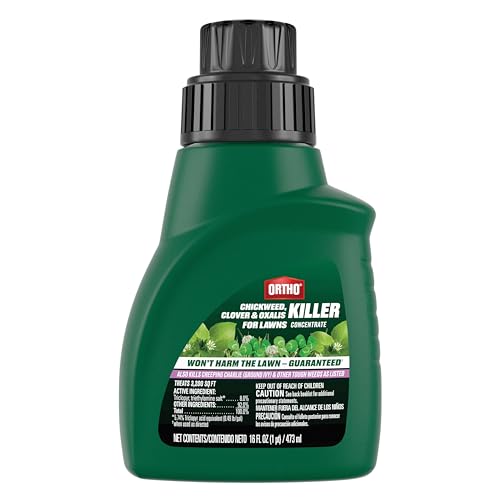
Ortho Chickweed, Clover & Oxalis Killer for Lawns Concentrate, 16 fl. oz.
Best for: Targeted clover control on cool-season and zoysia lawns
A dedicated concentrate that Ortho says controls red and white clover, chickweed, oxalis, creeping Charlie and wild violet to the root. One 16 fl. oz. bottle is rated to treat up to 3,200 sq. ft. when diluted in a tank sprayer.
- Lists red and white clover specifically
- Also targets creeping Charlie and wild violet
- Concentrate format for tank sprayers
- Labeled grasses exclude Bermuda and St. Augustine
- Needs a separate sprayer and careful mixing

Spectracide Weed Stop For Lawns Concentrate Ready-To-Spray, 32 Oz
Best for: Big lawns with clover mixed among many weeds
A hose-end concentrate that Spectracide rates for up to 21,333 sq. ft., listing 460+ weed types including dandelion, clover, chickweed and yellow nutsedge, with visible results in about 3 hours.
- Very large rated coverage
- Labeled for bluegrass, fescue, zoysia, Bermuda and ryegrass
- Fast visible results per manufacturer
- Hose-end spraying is less precise
- Not for zoysia just emerging from dormancy

BioAdvanced Lawn Weed Killer Ready-to-Spray, Broadleaf Formula, 32 oz, Weed Killer Spray
Best for: Mixed or Southern lawns, including some St. Augustine varieties
BioAdvanced lists 200+ weeds including clover, dandelion, dollarweed and chickweed, with coverage up to 8,000 sq. ft. and rainproof protection in 1 hour. It is formulated for both Southern and Northern lawn grasses.
- Rainproof in 1 hour per manufacturer
- Covers dollarweed, a common Southern weed
- Works on many warm- and cool-season grasses
- Only some St. Augustine varieties are listed
- Hose-end application is less targeted

Bonide Chickweed, Clover and Oxalis Killer, 16 oz Concentrate
Best for: Pump-sprayer owners with small to medium lawns
The concentrate version of Bonide’s chickweed, clover and oxalis formula. Bonide says it kills broadleaf weeds in lawns roots and all without killing lawn grasses when used as directed, and lists more than 100 controlled weeds.
- Same weed list as the ready-to-use jug
- Compact 16 oz bottle
- Mix only what you need
- Requires a sprayer and measuring
- Not for use above 90°F
See our full picks in the best clover killer guide.
The Bottom Line on Triclopyr vs 2,4-D
Triclopyr vs 2,4-D comes down to which weeds you have. 2,4-D is a dependable, broad base for dandelions and plantain, especially when combined with dicamba and mecoprop. Triclopyr is the specialist for clover, violets and ground ivy, with a little more caution needed on warm-season grasses. For most lawns, a ready-made product that combines them, or a dedicated clover formula, is the simplest choice. Whichever you pick, spray actively growing weeds in early fall or spring, and fix the thin turf behind the weeds so they do not come back; our guide on why clover takes over lawns explains the usual causes.
More Questions People Ask
Is triclopyr stronger than 2,4-D?
Triclopyr is generally more effective on tough weeds like clover, violets and ground ivy, while 2,4-D works well on many common broadleaf weeds like dandelion.
Is triclopyr safe on St. Augustine grass?
Many triclopyr labels warn against use on St. Augustine and some other warm-season grasses. Check the label.
Can I mix triclopyr and 2,4-D?
Many commercial products already combine them. Only mix separate products if both labels allow it.
How long after spraying 2,4-D can I mow?
Labels often recommend waiting a day or two before and after mowing so the herbicide can be absorbed.
Frequently Asked Questions
Is triclopyr or 2,4-D better for clover?
Triclopyr is generally the stronger of the two on white clover. 2,4-D used alone often only suppresses clover, which is why lawn products aimed at clover usually contain triclopyr or combine 2,4-D with partners such as dicamba, mecoprop or fluroxypyr.
Is triclopyr safe for all lawn grasses?
No. Cool-season grasses such as fescue, bluegrass and ryegrass usually tolerate labeled lawn rates, but several warm-season grasses can be injured. Always check that your grass is listed on the specific product label.
Can you mix triclopyr and 2,4-D?
Many commercial products already combine them, and the combination broadens the range of weeds controlled. Homeowners should use a pre-mixed product labeled for lawns rather than tank-mixing separate concentrates, unless a label specifically permits it.
How long does 2,4-D take to work?
Treated weeds typically twist and curl within a day or two, with full control in one to three weeks depending on the weed and conditions.
Do triclopyr and 2,4-D kill grass?
At labeled lawn rates on tolerant grass species, neither is intended to kill turfgrass because both are selective for broadleaf plants. Overdosing, hot weather or use on a sensitive grass can still cause injury.