

Last updated: October 2026 · Written by the LawnVibe editorial team.
If you are seeing more white flowers and three-part leaves every month, you are not imagining it. Clover taking over a lawn is almost always a symptom, not the disease. White clover is a creeping perennial that spreads by stems running along the soil surface, and it wins wherever grass is weakened. Find what weakened the grass, fix it, and the clover loses its advantage. Spray the clover without fixing the cause, and it usually comes back.
This guide walks through the six most common reasons clover spreads, how to tell which one applies to your yard, and what to do about each. When you are ready to treat existing patches, our comparison of the best clover killer products explains which selective sprays and granules suit which grass types.
Quick Answer
When you are ready to treat existing patches, our comparison of the best clover killer products explains which selective sprays and granules suit which grass types.
Key takeaways:
- Clover taking over your lawn is a message that the grass is struggling, most often from low nitrogen, short mowing, compaction or stress damage.
- Diagnose which of those applies, correct it, and the balance shifts back toward grass.
- Where clover is already thick, a selective clover killer applied in early fall gives you a clean start, and steady feeding, a higher mowing height and overseeding keep it from coming back.
How Clover Spreads So Quickly
Understanding the plant explains most of the problem. White clover (Trifolium repens) grows from stolons, horizontal stems that root at each node where they touch soil. One plant can become a patch several feet across in a season. It also flowers freely, and its hard-coated seed can stay viable in soil for years, so new plants keep appearing even after older patches are removed.
Clover's other trick is underground. Its roots host rhizobium bacteria that pull nitrogen from the air and convert it into a form the plant can use. Turfgrass has no such partnership. In a well-fed lawn this advantage barely matters because the grass is dense and vigorous. In an underfed lawn, it matters a lot.
Finally, clover grows low. Its leaves sit below most mowing heights, so regular mowing barely touches it, while every cut removes a share of the grass's leaf area.
Cause 1: Low Nitrogen
This is the most common reason for clover taking over a lawn. Grass needs regular nitrogen to stay thick and green. When fertility drops, grass thins and turns pale, and clover, which supplies its own nitrogen, carries on growing.
Signs: a lawn that is light green or yellowish overall, slow to recover after mowing, and thin enough to see soil between grass plants. Clover is spread widely rather than concentrated in one area.
Fix: feed on a schedule suited to your grass type. Cool-season lawns of fescue, bluegrass and ryegrass benefit most from fall feeding, with a lighter spring application. Warm-season grasses are fed during their summer growing season. A soil test from your local extension service will tell you how much you actually need, and our guide on the importance of soil testing for healthy lawns explains how to read the results.
Cause 2: Mowing Too Short
Scalping a lawn to make it look neat is one of the fastest ways to invite clover. Short grass has less leaf to photosynthesize, shallower roots and less ability to shade the soil. Clover's low leaves are hardly affected.
Signs: clover worst in areas you mow tight, such as along edges or where the mower dips. Grass browns quickly in hot spells.
Fix: raise the deck. Most cool-season grasses do best at 3 to 4 inches, while warm-season grasses vary by species. Follow the one-third rule, removing no more than a third of the blade at each cut, and keep the blade sharp so tips are cut cleanly rather than torn.
Cause 3: Compacted Soil
Soil that is pressed tight by foot traffic, vehicles or heavy clay has little air space. Grass roots stay shallow and weak. Clover tolerates these conditions better and quickly colonizes paths, play areas and the strip beside driveways.
Signs: a screwdriver is hard to push into moist soil, water puddles or runs off, and clover concentrates in high-traffic zones.
Fix: core aerate in the growing season for your grass, ideally followed by overseeding. Redirect traffic with stepping stones where a path keeps forming. Our guide on how to prevent and treat lawn compaction covers tools and timing in detail.
Cause 4: Bare Patches After Stress
Drought, grub feeding, dog spots, disease or a hard winter can all leave gaps. Clover stolons move sideways into any open soil, and clover seed already in the soil germinates when light reaches it.
Signs: clover arrived suddenly after a dry summer or a pest problem, and it fills the shape of the damaged area.
Fix: overseed bare patches at the right time for your grass, keep the seed moist until it establishes, and address the original stress. If you treat clover with a herbicide first, check the label for the waiting period before seeding.
Cause 5: Watering Habits
Both extremes help clover. Short, frequent watering keeps grass roots shallow and less resilient. Underwatering during drought lets grass go dormant while deep-rooted clover stays green and keeps spreading.
Signs: clover is the greenest thing in the lawn during dry spells, or the lawn needs watering every day to stay green.
Fix: water deeply and less often, aiming for roughly an inch per week from rain and irrigation combined in the growing season, applied in one or two sessions. Early morning watering reduces disease risk.
Cause 6: Soil pH and Shade
Grass grows best in a moderately acidic to neutral soil. When pH drifts too far, nutrients become less available and grass struggles, and clover can tolerate a wider range. Shade weakens most lawn grasses too, especially sun-loving species, leaving room for weeds.
Signs: a soil test shows pH outside the ideal range for your grass, or clover and moss dominate the shaded side of the yard.
Fix: correct pH with lime or sulfur based on soil test recommendations, not guesswork. In shade, switch to a shade-tolerant grass blend or reduce canopy where possible.
Diagnosing Your Clover Problem: A Quick Checklist
Walk the lawn with these questions in mind:
- Where is the clover? Everywhere suggests fertility. Along paths suggests compaction. In old bare spots suggests stress damage. On the shady side suggests light.
- What color is the grass? Pale green points to nitrogen. Dark green grass with clover suggests another cause.
- How high do you mow? Measure from the soil to the cut tip. Under about 2.5 inches for a cool-season lawn is too short.
- When did it start? A sudden jump after a hot summer points to stress gaps. A slow increase over years points to fertility or mowing.
- What does a soil test say? It confirms nutrient and pH issues and stops you from applying products you do not need.
Many lawns have two or three causes at once. That is normal, and fixing the biggest one usually makes the biggest difference.
Stopping Clover Taking Over Your Lawn for Good
A lasting fix has three parts, done in this order:
First, knock back the existing clover. For heavy infestations, a selective broadleaf herbicide labeled for clover and your grass type is the quickest route. Spray when clover is actively growing, ideally in early fall, which is when university turf programs such as Iowa State Extension recommend treating perennial broadleaf weeds. Our roundup of the best clover killer compares concentrates, ready-to-use sprays and granular products.
Second, fix the cause you identified. Feed, raise the mowing height, aerate, adjust watering or correct pH. Without this step, clover returns within a season or two.
Third, thicken the turf. Overseed thin areas once the herbicide's waiting period is over. Dense grass is the best long-term clover control because it leaves no light or space for stolons to root.
For a broader look at cultural and manual options, our guide on how to control clover in your lawn covers hand removal, spot treatment and timing in more depth.
Is It Actually Clover?
Before you treat anything, confirm the plant. Several lawn weeds have three-part leaves and get mistaken for clover:
- Oxalis (wood sorrel) has heart-shaped leaflets and small yellow flowers. It folds its leaves at night.
- Black medic has yellow flowers and a tiny point at the tip of each leaflet.
- White clover has rounded leaflets, often with a pale chevron, and white to pinkish globe-shaped flowers.
The good news is that many clover killers also list oxalis and black medic, but identification still matters because the underlying causes differ. Black medic, for example, is strongly associated with compacted, dry soils.
What Not to Do
- Do not scalp the lawn to "mow the clover out." It only weakens the grass further.
- Do not overwater daily hoping to green up the grass. Shallow roots favor weeds.
- Do not spray in summer heat. Herbicides are less effective on stressed clover and more likely to injure grass above about 85 to 90°F.
- Do not apply lime or sulfur without a soil test. Moving pH the wrong way creates a new problem.
- Do not overseed immediately after spraying unless the label allows it.
When Clover Is Not a Problem
Clover is not always the enemy. It stays green in drought, feeds bees and adds nitrogen to soil. Some homeowners deliberately keep a grass and clover mix, or overseed with microclover, for a lower-input lawn. If clover bothers you only in certain areas, you can treat those zones and leave the rest. The key is choosing on purpose rather than letting the lawn decide for you.
A Year-Round Plan to Keep Clover in Check
Clover control works best as a calendar rather than a one-off fix. For a typical cool-season lawn, the year looks like this:
Early spring. Rake out winter debris and look at where clover survived. Take a soil sample now if you have not tested in the last three years, so results are back before the main feeding windows. Hold off on herbicides until the lawn is actively growing.
Mid to late spring. Apply a light feeding and spot-treat clover patches while temperatures are mild. Set the mower to its higher range and keep it there through summer.
Summer. Water deeply and infrequently, avoid spraying in heat, and accept that some clover will stay green while grass slows down. Note new bare areas to overseed later.
Early fall. This is the main event. Treat clover with a selective product while it is still actively growing, aerate compacted areas, and overseed thin spots after the label's waiting period. Feed cool-season grass to rebuild density before winter.
Late fall. Make a final feeding if your program calls for it and keep mowing at a normal height until growth stops.
Warm-season lawns shift the feeding and seeding to late spring and summer, but the logic is the same: build dense grass while it is growing strongly, and treat clover when clover is active and the grass is not under stress. Keep a simple note of what you applied and when; after two seasons the pattern of what works in your yard becomes obvious.
Products That Help Control Clover
If cultural fixes are not enough, these products can help. Details come from Amazon listings; always follow the label. We have not hands-on tested them.
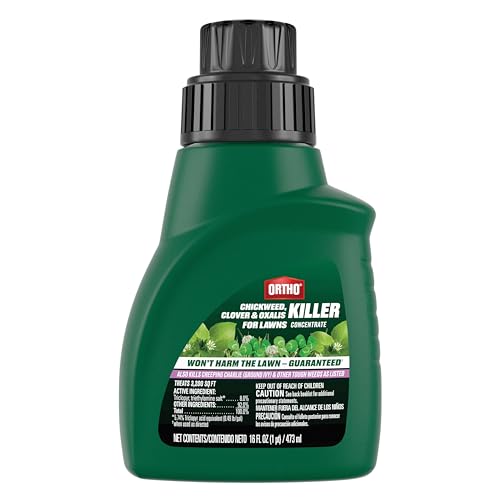
Ortho Chickweed, Clover & Oxalis Killer for Lawns Concentrate, 16 fl. oz.
Best for: Targeted clover control on cool-season and zoysia lawns
A dedicated concentrate that Ortho says controls red and white clover, chickweed, oxalis, creeping Charlie and wild violet to the root. One 16 fl. oz. bottle is rated to treat up to 3,200 sq. ft. when diluted in a tank sprayer.
- Lists red and white clover specifically
- Also targets creeping Charlie and wild violet
- Concentrate format for tank sprayers
- Labeled grasses exclude Bermuda and St. Augustine
- Needs a separate sprayer and careful mixing
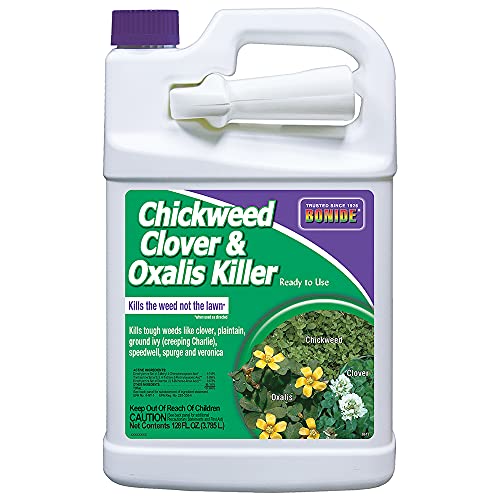
Bonide Chickweed, Clover & Oxalis Killer, 128 oz Ready-to-Use Spray
Best for: Spot-treating clover patches with no mixing
Bonide describes this 128 oz ready-to-use spray as killing chickweed, clover, dandelions and ground ivy roots and all without killing lawn grasses when used as directed, with more than 100 weeds listed on the label.
- No measuring or mixing
- Large gallon jug for repeat spot treatments
- Clear guidance on temperature and drift
- Slower for whole-lawn coverage
- Avoid spraying above 90°F
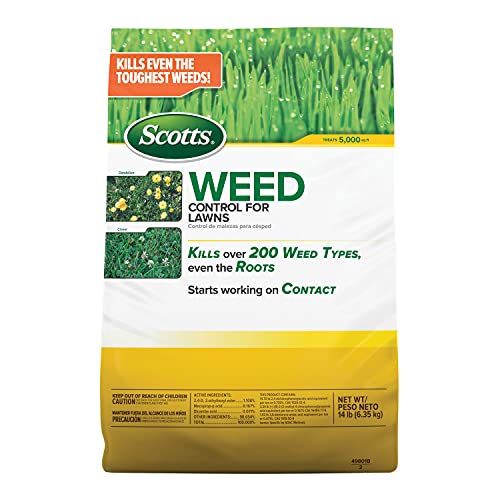
Scotts Weed Control for Lawns, 14 lbs.
Best for: Spreader users who prefer not to spray
A 14 lb. granular weed control that Scotts says covers 5,000 sq. ft. and controls 200+ weeds including clover, dandelion, dollarweed, ground ivy and oxalis. Apply in spring or early fall when weeds are actively growing.
- No drift onto garden beds
- Easy with a broadcast spreader
- Long list of controlled weeds
- Not for Floratam St. Augustine, dichondra, carpetgrass or bentgrass
- Granules need damp leaves to stick

Scotts Turf Builder Weed & Feed3, 14.29 lbs.
Best for: Underfed lawns where clover is moving in
Scotts calls Turf Builder Weed & Feed3 its most powerful weed and feed, claiming up to 2X more dandelion and clover control than its previous formula, while it feeds to thicken lawns and crowd out weeds. The bag covers 5,000 sq. ft.
- Kills clover and fertilizes in one step
- Feeding addresses the low-nitrogen cause
- Covers 5,000 sq. ft.
- Treats the whole lawn, not just weedy spots
- Timing must suit both feeding and weed control
Compare all options in our best clover killer guide.
The Bottom Line on Clover Taking Over a Lawn
Clover taking over your lawn is a message that the grass is struggling, most often from low nitrogen, short mowing, compaction or stress damage. Diagnose which of those applies, correct it, and the balance shifts back toward grass. Where clover is already thick, a selective clover killer applied in early fall gives you a clean start, and steady feeding, a higher mowing height and overseeding keep it from coming back.
More Questions People Ask
Why does clover grow in my lawn?
Clover thrives where grass is thin, nitrogen is low, mowing is too short or soil is compacted.
Will clover go away on its own?
Rarely. Improving lawn density, fertility and mowing height helps grass outcompete it over time.
Does clover mean my soil is bad?
It often signals low nitrogen or compaction, not necessarily bad soil overall. A soil test shows what to fix.
Can I pull clover by hand?
Small patches can be pulled when soil is moist, but runners often regrow. Combine with lawn improvement.
Frequently Asked Questions
Does clover mean my lawn needs nitrogen?
Often, yes. Clover fixes its own nitrogen through root nodule bacteria, so it competes well where grass is underfed. A pale, thin lawn with spreading clover is a classic sign of low fertility, though a soil test is the only way to confirm it.
Why did clover appear suddenly this year?
Clover often surges after a stress event such as summer drought, grub damage, heavy foot traffic or a season without fertilizer. Those conditions open gaps in the turf, and clover's creeping stems fill them quickly.
Does mowing short cause clover?
Mowing too low helps clover because it stresses grass and lets light reach the soil surface, while clover's low leaves are barely touched by the mower. Raising the mowing height is one of the cheapest fixes.
Can compacted soil cause clover?
Yes. Grass roots struggle in compacted soil, and clover tolerates it better. Areas along paths, play spaces and driveways often show clover first for this reason.
Will fertilizing get rid of clover?
Fertilizing alone rarely eliminates established clover, but it helps grass outcompete it over a season or two. Combining feeding with a selective clover killer and overseeding gives the fastest turnaround.