
If you want a greener, healthier lawn, knowing when and how to fertilize is essential. Many people throw fertilizer on their grass without a plan, but this can waste money and even damage your lawn. A well-made fertilizer schedule helps you feed your lawn at the right times, with the right products, for the best results.
This article will show you step-by-step how to create a lawn fertilizer schedule that fits your climate, grass type, and goals. You’ll learn why timing matters, how nutrients work, and get practical advice to avoid common mistakes. With simple explanations, clear examples, and professional guidance, you’ll soon be able to build a schedule that makes your lawn thrive.
Why A Fertilizer Schedule Matters
Feeding your lawn is not just about spreading fertilizer. Timing and frequency are key. A good schedule improves grass growth, color, and resistance to disease. If you fertilize too often or at the wrong time, you can cause problems like burning grass, encouraging weeds, or polluting water. Many beginners don’t realize that grass needs different nutrients in spring, summer, and fall. Creating a schedule helps you:
- Use the right fertilizer for the season
- Save money by avoiding waste
- Prevent over-fertilizing and runoff
- Get consistent, predictable results
A schedule also makes lawn care easier. You know exactly when to fertilize, so you don’t have to guess. This is especially important for non-native English speakers who want simple, clear instructions.
Understanding Lawn Fertilizer Basics
Before making a schedule, it’s important to understand how fertilizers work. Lawn fertilizers usually contain three main nutrients:
- Nitrogen (N): Makes grass grow and gives it a rich green color.
- Phosphorus (P): Helps roots develop strong and deep.
- Potassium (K): Protects against stress, disease, and drought.
You’ll often see these as N-P-K numbers on fertilizer bags. For example, “24-0-6” means 24% nitrogen, 0% phosphorus, and 6% potassium.
Types Of Fertilizer
There are two main types of lawn fertilizer:
- Granular: Dry pellets you spread on the lawn. These are slow-release or quick-release.
- Liquid: Dissolved in water and sprayed. Usually faster acting.
Both types work well, but granular is easier for most homeowners. Slow-release products feed your lawn over time, while quick-release give fast results.
Choosing The Right Fertilizer
Different lawns need different fertilizers. The best choice depends on your grass type, soil, and climate. For example, cool-season grasses like Kentucky bluegrass and fescue need more nitrogen in fall. Warm-season grasses like Bermuda and zoysia need more in summer. Always check the label and match it to your lawn’s needs.
Identifying Your Grass Type And Climate
Your fertilizer schedule depends on your grass type and local weather. Not all lawns are the same. Knowing these helps you time your feedings correctly.
Grass Types
There are two main groups:
- Cool-season grasses: Grow best in spring and fall. Examples: Kentucky bluegrass, fescue, ryegrass.
- Warm-season grasses: Grow best in late spring and summer. Examples: Bermuda, zoysia, St. Augustine.
If you’re unsure what you have, check your local garden center or ask a lawn care professional. The color, texture, and growth pattern give clues.
Climate Zones
Your climate affects how often and when you fertilize. The United States has several climate zones:
- Northern: Cold winters, mild summers. Cool-season grasses dominate.
- Transition: Mix of cool- and warm-season grasses.
- Southern: Hot summers, mild winters. Warm-season grasses dominate.
Knowing your climate zone helps you plan the right months for fertilizing.
Soil Testing: The Starting Point
Many people skip soil testing, but it’s one of the most important steps. A soil test shows what nutrients your lawn really needs. Without it, you might waste money on products your grass doesn’t need.
How To Test Your Soil
- Buy a soil test kit from a garden center.
- Take samples from several spots in your lawn.
- Follow the instructions, mix the soil, and send it to a lab or use the kit’s results.
The report will show levels of nitrogen, phosphorus, potassium, and pH. If your soil is too acidic or alkaline, fertilizer won’t work as well. Adjusting pH can be as important as fertilizing.
Example Soil Test Results
Here’s a sample comparison of soil test results for two lawns:
| Test Area | Nitrogen (N) | Phosphorus (P) | Potassium (K) | pH |
|---|---|---|---|---|
| Lawn A | Low | Medium | High | 6.8 |
| Lawn B | Medium | Low | Low | 7.2 |
If your soil is low in nitrogen, you’ll need a fertilizer with a higher first number. If phosphorus is low, choose a product with more phosphorus. Adjusting based on these numbers is a smart way to avoid mistakes.
Credit: johnsonsgarden.com
Building Your Lawn Fertilizer Schedule
Now you’re ready to build a schedule. The goal is to apply fertilizer when your grass is actively growing. Feeding at the right times helps roots, blades, and color.
Steps To Make A Schedule
- Identify your grass type and climate zone.
- Test your soil and note any nutrient deficiencies.
- Choose the right fertilizer based on grass type and soil results.
- Plan applications for the best months.
- Record each feeding and track results.
Let’s break these down further.
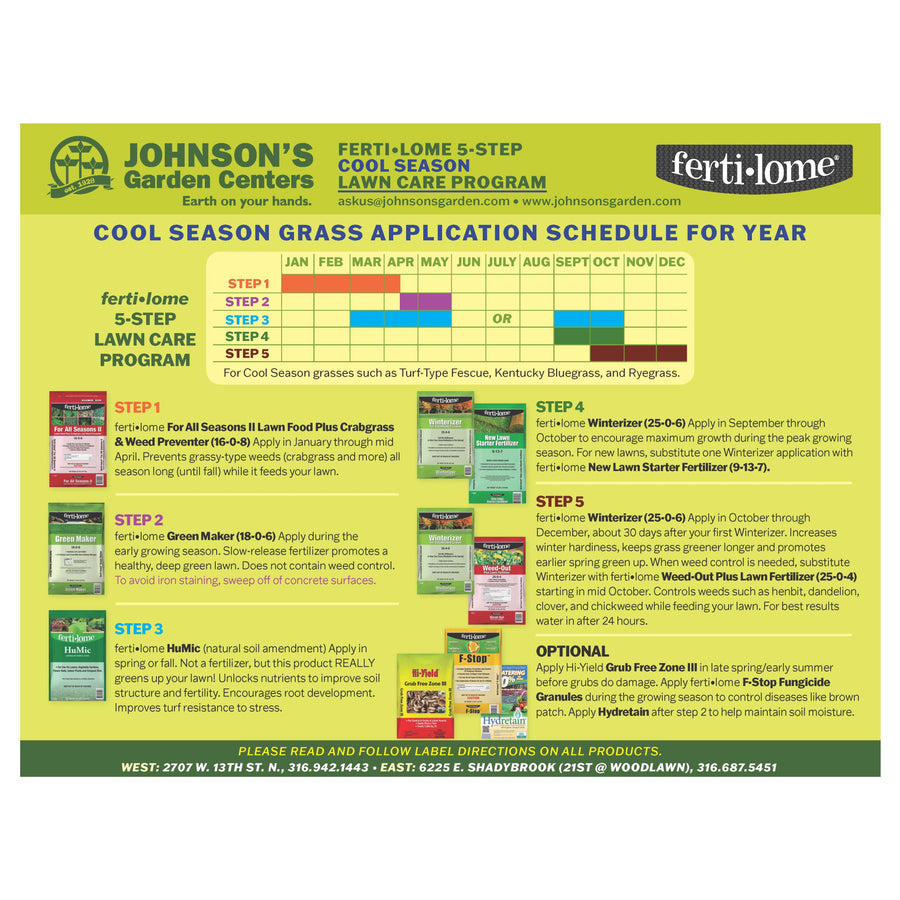
Sample Schedule For Cool-season Grasses
Cool-season grasses grow strongest in spring and fall. Here’s a typical schedule:
- Early Spring (March-April): Apply a slow-release fertilizer with high nitrogen.
- Late Spring (May-June): Light feeding, especially if growth slows.
- Early Fall (September): Main feeding; use high-nitrogen product.
- Late Fall (October-November): Apply winterizer fertilizer with balanced N-P-K.
You may skip summer feeding unless your lawn is under stress, as cool-season grasses slow down when it’s hot.
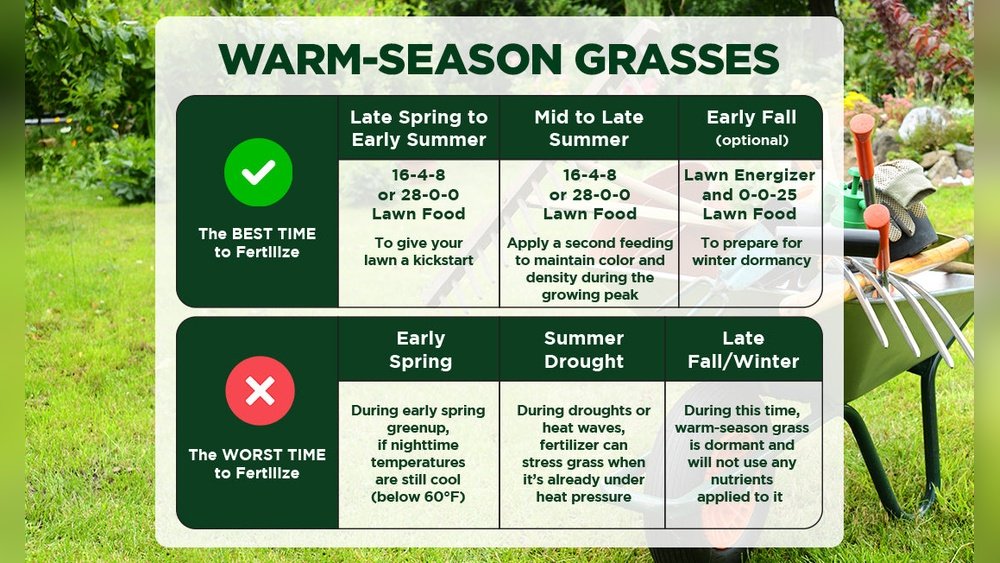
Sample Schedule For Warm-season Grasses
Warm-season grasses thrive in summer. Here’s a common schedule:
- Late Spring (April-May): First feeding as grass starts growing.
- Early Summer (June-July): Main feeding; use high-nitrogen fertilizer.
- Mid-Summer (July-August): Optional feeding if growth slows.
- Early Fall (September): Light feeding before growth slows.
Avoid fertilizing in winter, as warm-season grasses go dormant.
Example Schedule Comparison
Let’s compare a typical schedule for both grass types:
| Season | Cool-Season Grasses | Warm-Season Grasses |
|---|---|---|
| Spring | March/April, May/June | April/May |
| Summer | Skip or light feeding | June/July, July/August |
| Fall | September, October/November | September |
| Winter | Winterizer (optional) | Skip |
Frequency And Amounts
How often should you fertilize? Most lawns do well with 3-4 feedings per year. Too much fertilizer can cause rapid growth, disease, or environmental problems. Always follow the product instructions for how much to apply.
A good rule is to use 1 pound of nitrogen per 1,000 square feet per application. For slow-release products, you can stretch intervals to 8-10 weeks. Quick-release fertilizers may need more frequent applications.
How To Apply Fertilizer Correctly
Making a schedule is just the first step. Applying fertilizer the right way is equally important. Many beginners miss key steps, leading to uneven growth or burnt spots.
Tools Needed
- Broadcast spreader: For granular fertilizer, gives even coverage.
- Drop spreader: Good for small lawns or tight areas.
- Sprayer: For liquid fertilizer.
Always calibrate your spreader. This means adjusting it so you apply the correct amount. Walk at a steady pace and overlap slightly to avoid stripes.
Application Tips
- Apply when grass is dry, but water after spreading to help nutrients soak in.
- Avoid fertilizing before heavy rain, as this can cause runoff.
- Keep fertilizer off sidewalks and driveways to prevent pollution.
- Wear gloves and wash hands after handling products.
Common Mistakes
Many people over-fertilize, thinking “more is better. ” This can burn grass and pollute water. Under-fertilizing leads to weak, pale lawns. Others forget to water after application, which reduces effectiveness.
Another mistake is fertilizing dormant grass. Always feed when the lawn is actively growing. If you’re unsure, look for new shoots and healthy color.

Credit: johnnysturf.com
Adjusting Your Schedule For Real Life
No schedule works perfectly every year. Weather, lawn health, and other factors affect timing. Flexibility is important.
Monitoring Lawn Health
Check your lawn after each feeding. Look for:
- Color improvement
- Growth rate
- Signs of disease
- Weed invasion
If your grass stays pale or grows slowly, you may need more nutrients. If it grows too fast or gets patchy, reduce feedings.
Dealing With Weather Changes
Rain, drought, and temperature swings affect fertilizer timing. If there’s a drought, hold off on fertilizing until rain returns. If heavy rain is expected, wait to prevent runoff.
Example Adjustments
Suppose your lawn normally gets a spring feeding in April, but this year is unusually cold. Delay until temperatures reach 55°F (13°C) for cool-season grass. If summer is dry, skip the mid-summer feeding.
Balancing Organic And Synthetic Fertilizers
You can use organic or synthetic fertilizers. Each has pros and cons.
Organic Fertilizers
Made from natural sources like compost, manure, or plant materials. They release nutrients slowly and improve soil health.
- Pros: Safe, eco-friendly, improves soil.
- Cons: Slower results, may need more frequent applications.
Synthetic Fertilizers
Made from chemicals. They work fast and are easy to apply.
- Pros: Quick results, precise N-P-K ratios.
- Cons: Can cause runoff, doesn’t improve soil long-term.
Some people use a mix of both. For example, organic in spring, synthetic in summer. Choose what fits your goals and budget.
Organic Vs Synthetic: Quick Comparison
Here’s a side-by-side view:
| Factor | Organic | Synthetic |
|---|---|---|
| Speed | Slow-release | Fast-acting |
| Soil Improvement | Yes | No |
| Environment | Eco-friendly | Potential runoff |
| Cost | Often higher | Usually lower |
| Application Frequency | More often | Less often |
Making A Schedule For Your Lawn: Step-by-step Example
Let’s walk through a real example. Suppose you have a cool-season lawn in Chicago, Illinois.
- Grass type: Kentucky bluegrass
- Climate zone: Northern
- Soil test: Low nitrogen, medium phosphorus, high potassium, pH 6.8
You want a green lawn for summer and strong roots for winter. Here’s your schedule:
- March: Apply slow-release, high-nitrogen fertilizer.
- May: Light feeding, balanced N-P-K.
- September: Main feeding, high-nitrogen.
- November: Winterizer fertilizer, balanced N-P-K.
Record each application in a notebook or phone app. After each feeding, check color and growth. If you notice poor results, revisit your soil test.
Adjustments
If spring is dry, wait until rain returns. If you see weeds, consider adding a pre-emergent weed control with your spring fertilizer. If your lawn grows too fast, reduce the next feeding.
Practical Insights Beginners Often Miss
Many beginners overlook two key ideas:
- Grass only needs nutrients when actively growing. Feeding dormant or stressed lawns wastes fertilizer.
- Soil pH affects fertilizer effectiveness. If your soil is too acidic or alkaline, nutrients don’t absorb well. Adjust pH with lime (for acid) or sulfur (for alkaline).
Also, most people forget to track their applications. Keeping simple records helps spot problems and improve results year to year.
Another common oversight is skipping watering after fertilizing. Water helps carry nutrients into the roots. If you don’t water, fertilizer stays on the surface and can burn the grass.
Environmental Considerations
Fertilizer can help your lawn, but it can also harm the environment if misused. Runoff from excess fertilizer pollutes lakes and rivers. Always follow recommended rates and keep products off hard surfaces.
Consider using phosphorus-free fertilizers if your soil has enough phosphorus. Some states, like Minnesota, ban phosphorus in lawn fertilizers to protect water quality.
If you want more details on environmental impact, the EPA provides helpful information at EPA Nutrient Pollution.
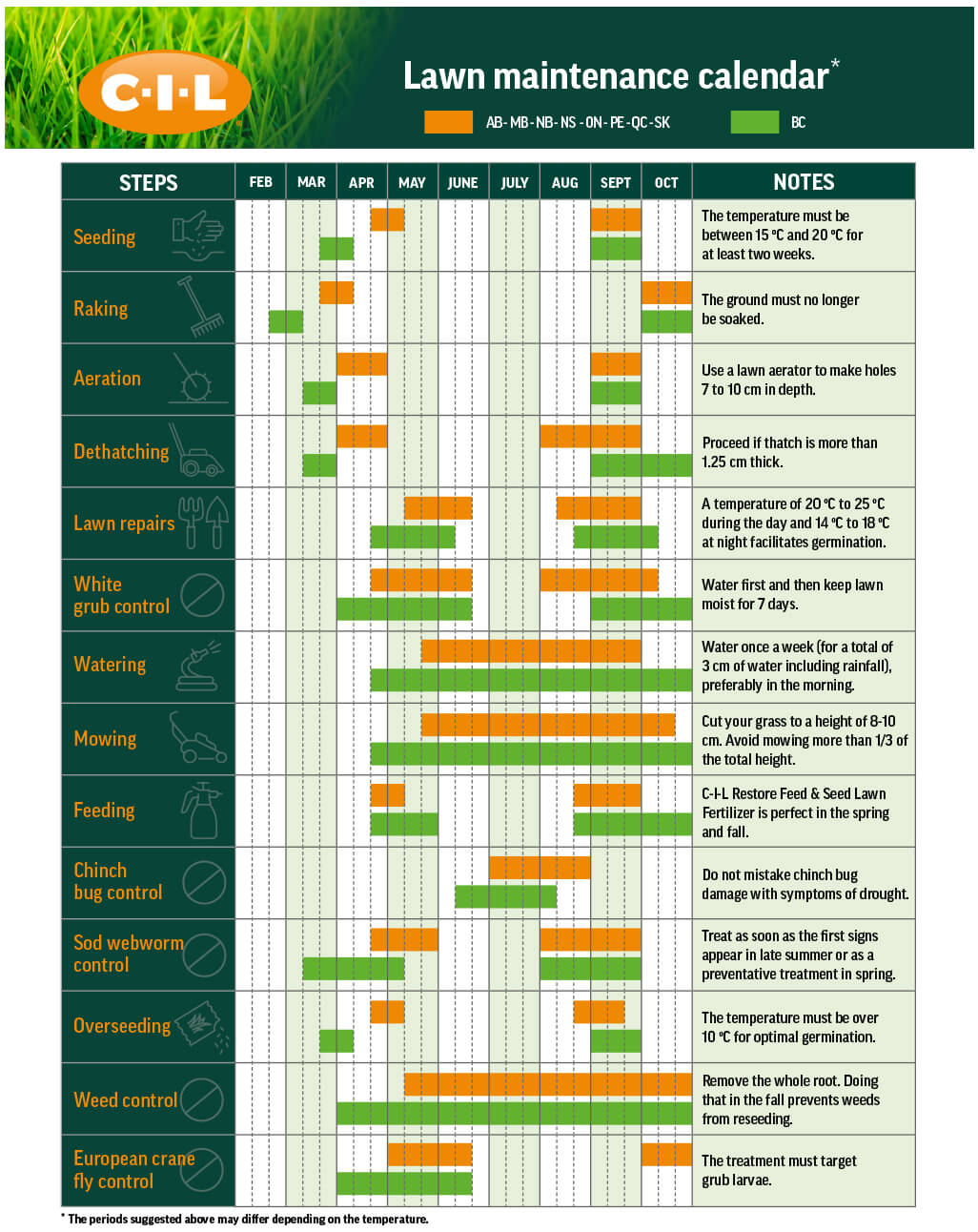
Tracking And Improving Your Schedule
A fertilizer schedule is not “set and forget. ” Good lawn care means tracking results and making improvements.
Keeping Records
Write down:
- Date of each feeding
- Product used
- Application rate
- Weather conditions
- Lawn health after 2 weeks
After a year, look for patterns. Did your lawn improve? Did weeds increase? Use this feedback to adjust next year’s schedule.
Using Technology
Many apps help track lawn care. Some even remind you when to fertilize and suggest products based on your region. If you prefer paper, a simple notebook works fine.
Credit: www.cillawnandgarden.com
Common Questions About Lawn Fertilizer Schedules
Many people have questions when starting a lawn fertilizer schedule. Here are answers to the most frequent ones.
Frequently Asked Questions
How Do I Know What Fertilizer My Lawn Needs?
Start with a soil test. This shows which nutrients are missing. Match the fertilizer’s N-P-K numbers to your lawn’s needs. If your soil is low in nitrogen, choose a product with a higher first number. If you’re unsure, ask your local garden center for advice.
Can I Use The Same Schedule Every Year?
You can, but it’s better to adjust based on results. If your lawn looks healthy, stay with your plan. If you see problems like yellow spots or weeds, change your schedule. Weather and soil changes can affect nutrient needs.
Is It Safe To Fertilize During Rainy Weather?
It’s best to avoid fertilizing just before heavy rain. Rain can wash fertilizer off your lawn into drains and rivers. Light rain after fertilizing is good, but wait for dry weather if storms are expected.
What If I Miss A Scheduled Feeding?
Missing one feeding won’t ruin your lawn. Simply resume your schedule at the next planned date. Don’t double up on fertilizer—this can damage grass. Consistency matters more than perfection.
How Can I Prevent Fertilizer From Burning My Grass?
Always follow product instructions for how much to apply. Use a spreader for even coverage. Water your lawn after fertilizing to help nutrients soak in. Avoid fertilizing when grass is stressed or dormant.
—
Building a lawn fertilizer schedule is one of the smartest moves for healthier, greener grass. By understanding your grass type, climate, and soil, you can feed your lawn at the right times for the best results. Remember to test your soil, choose the right fertilizer, and track your applications.
Adjust your schedule for weather and lawn health, and don’t forget the importance of watering. With these steps, your lawn will be stronger, more beautiful, and easier to care for year after year. Making a schedule is not just for experts—it’s for anyone who wants a better lawn.
Start today, and you’ll see the difference in every blade of grass.