

Last updated: October 2026 · Specs are taken from manufacturer listings on Amazon; prices and availability change, so always confirm on the product page.
Crabgrass, goosegrass and poa annua are far easier to prevent than to kill. A pre-emergent herbicide forms a thin chemical barrier in the top layer of soil that stops weed seeds from developing roots after they germinate. Get the product and the timing right, and you prevent most of next summer's grassy weeds before you ever see them. This guide compares the best pre-emergent for lawns by active ingredient, coverage and application window.
Quick Answer
For most lawns, The Andersons Barricade (prodiamine) is the best pre-emergent: long-lasting control of crabgrass, poa annua and many broadleaf weeds from a single granular application, and it covers up to 12,880 sq ft per 40 lb bag. If you are late and crabgrass may already be sprouting, choose a dithiopyr product such as Yard Mastery 0-0-7 with Dimension or Preen Lawn Crabgrass Control, which can still work for a few weeks after emergence. Want to spray? Quali-Pro Prodiamine 65 WDG is the most economical liquid option. Prefer organic? Espoma corn gluten meal helps, but expect weaker, less consistent results.
Quick Picks
| Best Overall | The Andersons Barricade (prodiamine) 40 lb | Check Price |
| Best for Late Applications | Yard Mastery 0-0-7 with Dimension (dithiopyr) 45 lb | Check Price |
| Best Easy-to-Find Late Option | Preen Lawn Crabgrass Control 15 lb | Check Price |
| Best Fertilizer-Free Scotts Option | Scotts Halts Crabgrass & Grassy Weed Preventer 10 lb | Check Price |
| Best Weed-and-Feed Style Combo | Scotts Turf Builder Halts with Lawn Food | Check Price |
| Best for Lawns and Landscape Beds | Hi-Yield Turf & Ornamental Weed & Grass Stopper 12 lb | Check Price |
| Best Value Liquid (Prodiamine 65 WDG) | Quali-Pro Prodiamine 65 WDG 5 lb | Check Price |
| Best Organic Option | Espoma Organic Weed Preventer (corn gluten meal) | Check Price |
How we chose
We compared products using what can be verified from their Amazon listings and labels at the time of writing: active ingredient, formulation, labeled weeds, application seasons, coverage per bag and practical limits such as overseeding restrictions. We did not run our own field trials for this guide. Where a listing does not state the active ingredient clearly, we say "see label" instead of guessing. Always read and follow the product label; it is the legal guide for rates and use sites.
Pre-emergent herbicides compared
| Product | Active ingredient | Form | Coverage per bag | Best for |
|---|---|---|---|---|
| The Andersons Barricade | Prodiamine | Granular (DG) | Up to 12,880 sq ft | Season-long prevention |
| Yard Mastery 0-0-7 Dimension | Dithiopyr | Granular | Up to 15,000 sq ft | Late applications, large lawns |
| Preen Lawn Crabgrass Control | See label | Granular | 5,000 sq ft | Late applications, small lawns |
| Scotts Halts | See label | Granular | Per bag label | Fertilizer-free schedules |
| Scotts Turf Builder Halts | See label | Granular + fertilizer | 5,000 sq ft | Cool-season spring feeding |
| Hi-Yield Weed & Grass Stopper | See label | Granular | 5,000 sq ft | Lawns and beds |
| Quali-Pro Prodiamine 65 WDG | Prodiamine | Water-dispersible granule (spray) | Large, label rate | Sprayer users |
| Espoma Weed Preventer | Corn gluten meal | Granular organic | 1,250 sq ft (weed rate) | Organic programs |
The best pre-emergents for lawns, reviewed
The Andersons Barricade (prodiamine) 40 lb

Best for: Cool- and warm-season lawns that need season-long crabgrass and poa annua prevention
Key specs (from the Amazon listing):
- 0.48% prodiamine, dispersible granule (DG) that dissolves on watering
- Prevents crabgrass, poa annua, goosegrass, henbit and other grassy/broadleaf weeds
- Spring and fall applications; covers up to 12,880 sq ft
- Prevention only – does not kill existing weeds
Barricade's active ingredient, prodiamine, is one of the longest-lasting pre-emergents available to homeowners, which is why it is the default choice for many lawn-care pros. The Andersons uses a dispersible granule (DG) carrier that breaks apart when watered, moving the herbicide into the top layer of soil where weed seeds germinate.
It prevents crabgrass, poa annua, goosegrass, henbit and a long list of other grassy and broadleaf weeds. Because it is purely preventive, it will not kill weeds that are already up, so timing matters. Apply in early spring before soil warms, and again in fall if you fight winter annuals.
- Long residual control from one application
- DG granules disperse quickly after watering
- Labeled for spring and fall use
- Does nothing to existing weeds
- Prevents grass seed from establishing – plan around overseeding
Yard Mastery 0-0-7 with Dimension (dithiopyr) 45 lb

Best for: Lawns where crabgrass may already be germinating
Key specs (from the Amazon listing):
- Dithiopyr (Dimension) pre-emergent on a 0-0-7 potash carrier
- Covers up to 15,000 sq ft
- Crabgrass and broadleaf weed prevention; spring or fall windows
Dithiopyr, sold under the Dimension brand, is the pre-emergent to reach for when you are running late. Besides preventing crabgrass, it can control very young crabgrass seedlings for a short window after they emerge, which gives you more forgiveness on timing than prodiamine.
Yard Mastery puts it on a 0-0-7 carrier, adding potassium without pushing extra nitrogen. The 45 lb bag covers up to 15,000 sq ft, which makes it good value for larger lawns.
- Early post-emergent activity on young crabgrass
- Large coverage per bag
- Potash carrier, no nitrogen surge
- Shorter residual than prodiamine in many conditions
- Bag size is overkill for small yards
Preen Lawn Crabgrass Control 15 lb

Best for: Homeowners with small lawns who missed the early window
Key specs (from the Amazon listing):
- Can be applied up to 4 weeks after crabgrass emerges (early post-emergent window)
- Prevents crabgrass and 40+ common lawn weeds
- Labeled for many cool- and warm-season grasses including bermuda
- Covers 5,000 sq ft
Preen Lawn Crabgrass Control is labeled to be applied up to four weeks after crabgrass emerges, which is the same early post-emergent advantage dithiopyr products are known for. It prevents crabgrass and more than 40 common lawn weeds and is labeled for a wide range of cool- and warm-season grasses including bermuda.
The 15 lb bag covers 5,000 sq ft, a good size for typical suburban lawns.
- Wide application window
- Covers many grass types
- Easy homeowner product
- Smaller coverage than pro bags
- Still needs watering in
Scotts Halts Crabgrass & Grassy Weed Preventer 10 lb

Best for: Lawns already on a fertilizer schedule
Key specs (from the Amazon listing):
- Fertilizer-free pre-emergent – one application for the season
- Fall use labeled for winter weeds like poa annua, henbit, chickweed
- Rain, snow or freezing after application won’t affect performance (per listing)
Scotts Halts is a straightforward crabgrass and grassy-weed preventer without fertilizer, which makes it useful if you feed your lawn separately or want to avoid an early-spring nitrogen push. Scotts labels it for spring crabgrass prevention and fall use against winter weeds such as poa annua, henbit and chickweed.
Check the bag for the current active ingredient and rate, and calibrate your spreader to the label setting.
- No fertilizer – flexible scheduling
- Spring and fall uses on the label
- Widely available
- Less residual than prodiamine products
- Smaller coverage per bag
Scotts Turf Builder Halts with Lawn Food

Best for: Cool-season lawns that need an early spring feeding anyway
Key specs (from the Amazon listing):
- Pre-emergent plus fertilizer in one pass
- Covers 5,000 sq ft
- Needs 1/4-1/2 inch of water within 2-3 days after application
- Not for newly seeded areas
Scotts Turf Builder Halts combines crabgrass prevention with fertilizer, so one pass handles the first spring feeding and weed prevention. It is convenient for northern lawns that green up in early spring.
The trade-off is timing: the best time for crabgrass prevention and the best time to fertilize do not always line up, especially in the South. Do not use it on newly seeded areas.
- One application, two jobs
- Good for cool-season spring routines
- Simple to use
- Fertilizer timing may not suit warm-season grass
- Not for new seedings
Hi-Yield Turf & Ornamental Weed & Grass Stopper 12 lb

Best for: Homeowners who want one product for turf and ornamental beds
Key specs (from the Amazon listing):
- For established lawns and ornamental landscape beds
- Can be applied up to 4 weeks later than other pre-emergents
- 12 lb treats up to 5,000 sq ft
Hi-Yield's Turf & Ornamental Weed & Grass Stopper is labeled for established lawns, ornamental turf and landscape beds, which makes it handy if crabgrass creeps from your lawn into mulched beds. Hi-Yield notes it can be applied up to four weeks later than many other pre-emergents.
As always, check the label for the plants it is safe around before using it in flower beds.
- Works in lawns and many ornamental beds
- Forgiving timing
- Affordable
- Coverage limited to 5,000 sq ft per bag
- Read the plant-safety list carefully
Quali-Pro Prodiamine 65 WDG 5 lb
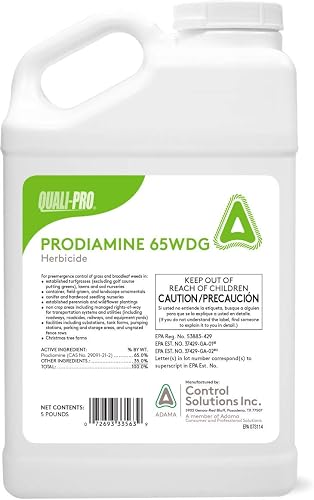
Best for: Experienced DIYers with a sprayer and large lawns
Key specs (from the Amazon listing):
- Prodiamine 65 WDG concentrate – mixed with water and sprayed
- Tank-mixes with fertilizers and iron
- Labeled against poa annua, henbit, chickweed, spurge, foxtail, goosegrass
- Pro-grade product: read the label rates carefully
Prodiamine 65 WDG is the concentrated form of the same active ingredient in Barricade. You mix a small amount with water and spray it, which makes it extremely economical per thousand square feet and easy to tank-mix with liquid fertilizer or iron.
It is a professional-grade product, so rates are small and precise. You need a calibrated sprayer and a careful reading of the label. If you have never calibrated a sprayer, start with a granular product.
- Lowest cost per square foot
- Even coverage when sprayed well
- Tank-mixes with fertilizer and iron
- Requires accurate measuring and calibration
- Not beginner-friendly
Espoma Organic Weed Preventer (corn gluten meal)

Best for: Organic lawns, kid and pet areas where you want to avoid synthetic herbicides
Key specs (from the Amazon listing):
- 100% corn gluten meal – organic option that also supplies nitrogen
- Pre-emergent rate is 20 lb per 1,000 sq ft (covers 1,250 sq ft per bag)
- Apply early spring with drop or broadcast spreader
- Results are milder and less consistent than synthetic pre-emergents
Corn gluten meal works by inhibiting root formation in germinating seeds, and it also releases nitrogen as it breaks down. Espoma's version is 100% corn gluten meal with no fillers.
Results are milder and less consistent than synthetic pre-emergents, and the application rate is heavy: Espoma lists 20 lb per 1,000 sq ft for weed prevention. It works best as part of an organic program that also focuses on dense, healthy turf. Our article does corn gluten kill weeds in lawn looks at what to realistically expect.
- Organic and fertilizes as it works
- No synthetic herbicide
- Easy to spread
- Weaker, less predictable control
- High rate means more bags
How to choose the best pre-emergent for your lawn
Start with the active ingredient
| Active ingredient | Strength | Watch out for |
|---|---|---|
| Prodiamine | Very long residual; strong on crabgrass and poa annua | No effect on emerged weeds; blocks seeding for months |
| Dithiopyr | Pre-emergent plus early post on young crabgrass | Residual can be shorter than prodiamine |
| Pendimethalin | Widely available, reliable crabgrass prevention | Stains surfaces yellow on some formulations; check label |
| Corn gluten meal | Organic, adds nitrogen | Weaker and less consistent; heavy rates |
If you want one application to last as long as possible, prodiamine is the usual choice. If you often apply late, dithiopyr's early post-emergent activity is valuable. Our comparison of prodiamine vs dithiopyr goes deeper.
Match the product to your grass type
Most pre-emergents are labeled for common cool-season grasses (Kentucky bluegrass, tall fescue, perennial ryegrass, fine fescue) and warm-season grasses (bermuda, zoysia, centipede, St. Augustine), but rates and restrictions vary. Check the label for your grass, and be especially careful with newly sodded or recently seeded lawns.
Granular or liquid
Granular products go down with a broadcast or drop spreader and are the easiest choice for most homeowners. Liquid concentrates such as prodiamine 65 WDG are cheaper and very even when sprayed correctly, but you need a calibrated sprayer. See granular vs liquid pre-emergent for the trade-offs.
Plan around seeding
Pre-emergents do not know the difference between crabgrass seed and grass seed. If you plan to overseed or patch bare spots, read pre-emergent and grass seed before you spread anything, and see our guide to overseeding in fall.
Timing: the part that makes or breaks results
A pre-emergent only works if the barrier is in place before weed seeds germinate. For crabgrass, that usually means applying when soil temperatures at about two inches deep are approaching 55°F and before they hold there for several days. Many university extension services publish soil temperature maps and recommend watching for forsythia bloom as a natural cue. Applying too early can let the barrier fade before the end of germination; applying too late misses the first flush.
In warm-season areas with poa annua problems, a late-summer to early-fall application targets winter annual weeds as soil cools. Some homeowners also use a split application, half the yearly rate in early spring and half about eight weeks later, to extend control where the label allows it.
How to apply pre-emergent correctly
- Measure your lawn so you buy and spread the right amount.
- Calibrate your spreader to the label setting, and spread half the rate in one direction and half crosswise for even coverage.
- Keep granules off hard surfaces; sweep them back onto the lawn so they do not wash into drains.
- Water it in with about 1/4 to 1/2 inch of irrigation or rain within the label's window.
- Avoid disturbing the soil afterward. Core aeration and dethatching can break the barrier.
For a full walkthrough, read our guide on how to apply pre-emergent to your lawn.
Common mistakes to avoid
- Applying after crabgrass is visible and expecting a prodiamine product to fix it.
- Seeding too soon after a pre-emergent application.
- Skipping the water-in step, which leaves the barrier inactive.
- Uneven spreading that leaves stripes of weeds.
- Ignoring thin turf. Pre-emergents help, but dense, healthy grass is the best long-term weed defense.
Safety and the environment
Read the label for re-entry intervals for children and pets, keep products out of drains and waterways, and store bags dry and out of reach. The U.S. EPA explains how pesticide labels work and why they are legally binding on its pesticide labels page. If you want an organic route, corn gluten meal and a strong mowing and fertility program are the place to start; our guide on stopping weeds in a lawn organically covers that approach.
Final recommendation
For the most reliable season-long prevention, choose The Andersons Barricade (prodiamine) and apply it on time. If timing is uncertain or you are already late, go with a dithiopyr product such as Yard Mastery 0-0-7 Dimension or Preen Lawn Crabgrass Control. Spray users get the best value from Quali-Pro Prodiamine 65 WDG, and organic lawns can use Espoma corn gluten meal with realistic expectations. Whatever you choose, water it in and keep it away from areas you plan to seed.
Frequently Asked Questions
What is the best pre-emergent for lawns?
For season-long crabgrass and poa annua prevention, prodiamine products such as The Andersons Barricade are the top choice. If you are applying late, a dithiopyr product such as Yard Mastery's Dimension 0-0-7 or Preen Lawn Crabgrass Control is more forgiving.
When should I apply pre-emergent to my lawn?
In spring, apply before soil temperatures at about 2 inches deep stay around 55°F for several days, which is when crabgrass begins to germinate. Many people use forsythia bloom as a reminder. For winter annuals like poa annua, apply in late summer to early fall. Our guide on how to apply pre-emergent to a lawn walks through the steps.
Can I seed my lawn after applying pre-emergent?
Usually not for several months. Most pre-emergents also stop grass seed from establishing. See pre-emergent and grass seed for timing and the few products that allow seeding.
Does pre-emergent need to be watered in?
Yes. Most labels call for about 1/4 to 1/2 inch of rain or irrigation within a few days to activate the barrier in the soil.
Is granular or liquid pre-emergent better?
Both work when applied at the label rate. Granular is easier for most homeowners; liquid is cheaper per square foot and very even if your sprayer is calibrated. We compare them in granular vs liquid pre-emergent.
Will pre-emergent kill existing crabgrass?
No, with one partial exception: dithiopyr can control very young crabgrass seedlings for a short time. Established weeds need a post-emergent herbicide or hand removal.