
Last updated: October 2026 · Written by the LawnVibe editorial team.
Knowing how to check a gas grill for leaks is one of the most important safety skills for any grill owner. The test takes five minutes: mix soapy water, turn on the propane tank with all burners off and the lid open, then brush the solution onto the tank valve, regulator, hose and connections. If bubbles grow, gas is escaping. Turn off the tank, tighten or replace the part and test again before lighting.
This guide follows widely published grilling safety guidance from fire safety organizations and grill manufacturers. Always follow your grill's manual. If you are buying a new grill, our guide to the best gas grill under $1,000 compares popular models.
Why Leak Testing Matters
Propane is heavier than air and can collect near the ground, around the grill cabinet or under a closed lid. A leak can cause a flash fire when you light the grill. Hoses crack, fittings loosen with vibration and spiders or insects can block tubes over the winter. The National Fire Protection Association recommends checking the gas tank hose for leaks before using the grill for the first time each year. A quick test eliminates most of this risk.
When to Check Your Gas Grill for Leaks
Test at the start of every grilling season, each time you connect a new or refilled propane tank, after moving or reassembling the grill, after replacing the regulator, hose or burners, and whenever you notice a gas smell. New grills should be tested before the first burn-off; see how to season a new gas grill.
What You Need
You need dish soap, water, a small bowl or spray bottle, a brush or sponge, and a wrench if fittings need tightening. Work outdoors in good light and keep any ignition sources, including cigarettes, well away.
Step 1: Make the Soapy Water Solution
Mix dish soap with water in a bowl or spray bottle. A fairly strong solution, often described as roughly equal parts soap and water, produces visible bubbles. It should be thick enough to cling to fittings.
Step 2: Prepare the Grill
Make sure all burner control knobs are in the off position and open the grill lid. Check that the propane tank is connected and the connection nut is hand-tight according to the manual.
Step 3: Turn On the Gas Supply
Open the propane tank valve slowly, usually one full turn or as the manual directs. Do not light the grill. For natural gas grills, open the supply valve.
Step 4: Apply the Solution
Brush or spray the soapy water onto every point where gas could escape: the tank valve and its connection to the regulator, the regulator body, the full length of the hose including both ends, the connection to the manifold or valve block, and any visible fittings. Also check the welded seams of the tank if it is old or rusty.
Step 5: Watch for Bubbles
Watch each area for a minute. Bubbles that grow or keep forming indicate a leak. A few bubbles that pop immediately from applying the solution are normal; look for bubbles that keep expanding.
Step 6: Turn Off the Gas and Fix Any Leak
If you find a leak, close the tank valve immediately. Tighten the connection if it is loose, then retest. If the leak is in the hose, regulator or tank valve, replace the part with a manufacturer-approved replacement rather than trying to patch it. A leaking tank should be taken to a propane supplier or exchange location; do not use it.
Step 7: Retest Before Lighting
After repairs, repeat the test. Only light the grill when no bubbles appear. Then rinse the soapy residue off the fittings with water.
Signs Your Gas Grill Might Be Leaking
Watch for the smell of rotten eggs, which comes from an odorant added to propane, a hissing sound near the tank or hose, a tank that seems to empty unusually fast, uneven or yellow flames, flames near the control knobs, or frost forming on the tank or hose when the grill is not running. Any of these warrants an immediate leak test. Our guide on how to tell when a propane tank is empty helps you separate a low tank from a leak.
What to Do If You Smell Gas
If you smell gas while the grill is off, close the tank valve and perform a leak test. If you smell gas while cooking, turn off the burners and the tank valve. If the smell continues, move away from the grill and contact the fire department. If the leak is at the tank and you cannot stop it, or there is a fire, move away and call emergency services. Never try to locate a leak with a flame.
Gas Grill Safety and Replacement Parts
These items help you fix leaks and keep the gas system safe. Details come from Amazon listings; confirm compatibility with your grill. We have not hands-on tested them.
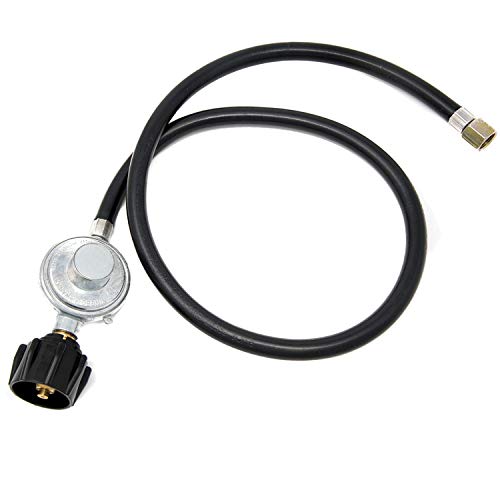
GasOne 3-Foot Universal QCC1 Propane Regulator and Hose
Best for: Replacing a cracked hose or faulty regulator
A universal QCC1 propane regulator and hose for many grills; confirm compatibility with your model.
- Universal QCC1 fitting
- 3-foot hose
- Check fit and pressure rating for your grill

DOZYANT Propane Tank Gauge, 2 Pack
Best for: Monitoring fuel level
An inline propane gauge for 5 to 40 lb tanks that the maker says also helps indicate leaks.
- Shows tank level
- Inline install
- Not a replacement for the soap test

Klein Tools ET120 Combustible Gas Leak Detector
Best for: Pinpointing small leaks
A handheld combustible gas leak detector with a flexible probe.
- Pinpoints leaks
- Flexible gooseneck
- Supplement to, not replacement for, soap test

Brushtech Spring Stem Gas Grill Venturi Brush
Best for: Clearing spider nests in burner tubes
A flexible spring-stem brush for cleaning burner venturi tubes.
- Flexible stem
- Prevents flashback blockages
- Single-purpose tool

Flame King 20 lb Steel Propane Tank with OPD
Best for: Keeping a backup tank
A 20 lb steel propane cylinder with overfill protection device; ships empty.
- OPD valve
- Spare for long cooks
- Ships empty; fill at a supplier
Time for a new grill? See our best gas grill under $1,000 picks.
Common Leak Points on Gas Grills
| Location | Common Cause | Typical Fix |
|---|---|---|
| Tank valve connection | Loose coupling or worn seal | Tighten by hand or replace seal |
| Regulator | Damaged or aged regulator | Replace with approved part |
| Hose | Cracks, abrasion, critter damage | Replace hose and regulator assembly |
| Manifold fittings | Loose fittings | Tighten carefully |
| Tank | Damaged or rusted valve | Exchange or retire tank |
Inspecting Burners and Venturi Tubes
Leak testing covers the gas supply, but also check the burners and venturi tubes for blockages. Spiders and insects sometimes build nests inside tubes, which can cause gas to flow backward and burn near the control panel, known as a flashback. Clean tubes with a venturi brush and replace damaged burners; see our guide to replace gas grill burners.
Natural Gas Grill Leak Checks
Natural gas grills use the same soapy water method at the quick-connect fitting, hose and valve connections. If you suspect a leak in the household gas line itself, turn off the supply and contact your gas utility or a licensed professional.
Propane Tank Safety Tips
Store propane tanks upright and outdoors, never in a garage, basement or indoors. Keep tanks away from heat sources. Transport tanks upright and secured, and do not leave them in a hot vehicle. Use tanks with an overfill protection device. Check the tank's date and condition, and exchange old or damaged tanks.
Connecting a Propane Tank Correctly
Many leaks come from a poorly attached tank. Before connecting, make sure the tank valve and all burner knobs are off. Remove the plastic dust cap from the tank valve. Align the regulator coupling straight onto the valve and turn it clockwise by hand until it stops; most modern couplings are designed for hand tightening and should not need tools. Avoid cross-threading by keeping the coupling square to the valve. Then open the tank valve slowly and perform the soapy water test at the connection.
Understanding the Regulator and Bypass Mode
The regulator reduces tank pressure to a safe level for the burners. Many regulators include an excess flow safety feature. If you open the tank valve quickly or with burner knobs on, the regulator may restrict flow, which leaves you with low, weak flames that look like a gas problem. To reset it, turn off all burners and the tank valve, disconnect the regulator, wait about a minute, reconnect, open the tank valve slowly and light as instructed. This is not a leak, but it is worth knowing so you do not mistake it for one.
How Often to Replace Grill Hoses and Regulators
There is no single replacement interval for every grill, but hoses and regulators do age. Replace them if you see cracks, stiffness, swelling, abrasion, chew marks, rusted fittings or if a leak test fails. Many owners replace the hose and regulator assembly every few years as preventive maintenance, especially if the grill lives outdoors year-round. Always use a replacement designed for your grill model.
Leak Testing After Winter Storage
Grills that sit for months are more likely to have problems. Insects can nest in burner tubes, hoses can crack from cold and fittings can loosen. At the start of the season, remove the grill cover, inspect the hose and regulator, clean out burner tubes and perform a full leak test before the first burn-off. Our guide on how to clean a gas grill properly pairs well with this spring check.
Checking an Older Propane Tank
Propane cylinders have a manufacture date stamped on the collar and must be requalified or replaced after a set period under U.S. rules, commonly 12 years from manufacture for many grill tanks, with requalification periods after that. Exchange services generally handle this for you. Do not use a tank that is dented, heavily rusted or has a damaged valve, and never try to repair a tank valve yourself.
Electronic Gas Leak Detectors
Handheld combustible gas detectors can help pinpoint small leaks and are useful if you work on gas appliances often. For most homeowners, the soapy water test is simple, inexpensive and reliable at grill connections. A detector is a supplement, not a replacement, for the bubble test, and any persistent gas smell should still be treated seriously.
Teaching Everyone in the Household
Make sure everyone who uses the grill knows how to turn off the tank valve, what propane smells like, never to light a grill with the lid closed and what to do if they smell gas. Post a short checklist inside the grill cabinet so it is easy to follow every season.
Quick Leak Test Checklist
Burners off and lid open. Soapy water mixed. Tank valve opened slowly. Solution applied to valve, regulator, hose ends, hose length and manifold fittings. Watch for growing bubbles for a minute. Close the tank valve if a leak appears, tighten or replace the part and retest. Rinse off soap, then light the grill following the manual.
Keep Records of Maintenance
Note the date of each leak test, tank exchange and part replacement on a card in the grill cabinet or in your phone. A simple record helps you spot recurring problems and remember when hoses and regulators were last replaced.
Common Mistakes When Checking a Gas Grill for Leaks
Common mistakes include testing with the burners on, skipping the test with a new tank, using a lighter or match to find leaks, ignoring small bubbles, patching hoses with tape, storing tanks indoors and continuing to use a grill that smells of gas.
Final Thoughts on How to Check a Gas Grill for Leaks
A soapy water leak test takes only a few minutes and should be part of every grilling season and tank change. Look for growing bubbles at the valve, regulator, hose and fittings, tighten or replace parts and retest before lighting. If you are upgrading to a new grill, start with our best gas grill under $1,000 guide.
More Questions People Ask
Is it safe to use a grill that smells like gas?
No. Turn off the burners and the tank valve, and do a leak test before using it again. Persistent gas smells need professional attention.
Why does my propane tank make a hissing noise?
A hiss with the valve closed can mean a faulty valve or relief valve venting due to heat. Move the tank to a shaded open area away from ignition sources and contact a propane supplier.
Can a propane grill leak when not in use?
Yes, if the tank valve is left open and a connection is loose. Always close the tank valve after cooking.
Should I replace the hose if it passes the leak test?
If it passes and shows no cracks, stiffness or damage, it can stay in service. Replace it at the first sign of wear.
Frequently Asked Questions
How do you check a gas grill for leaks?
With burners off and the lid open, turn on the tank valve, then brush or spray a soapy water solution on the hose, regulator and connections. Growing bubbles show a leak.
How often should I leak-test my gas grill?
At the start of each grilling season, whenever you connect a new tank, after moving or servicing the grill, and anytime you smell gas.
What do I do if my grill is leaking gas?
Turn off the tank valve, do not light the grill, and tighten or replace the leaking part. If the leak continues, have the grill serviced. If you smell gas and the grill is on fire, move away and call the fire department.
Can I use dish soap for a gas leak test?
Yes. A mix of dish soap and water, roughly equal parts or a strong soapy solution, works well for spotting bubbles.
Why does my gas grill smell like gas when it is off?
A gas smell with burners off often means a leak at the tank valve, regulator or hose, or that the tank valve was left open with a loose connection. Close the tank valve and perform a leak test.