
Last updated: October 2026 · Written by the LawnVibe editorial team.
A good diverter is what turns a plain barrel into a reliable rainwater system. The best rain barrel diverter kit fits your downspout exactly, filters out leaves and sends water back down the spout once the barrel is full, so you never get an overflow against the foundation. For most homes our top pick is the Anivia diverter, which fits both common downspout sizes and has an adjustable valve. Below we compare nine kits for houses, sheds and greenhouses, explain how to choose the right size and walk through installation.
Listings change often, so check the current details on Amazon before you buy. As an Amazon Associate we earn from qualifying purchases.
Our top picks at a glance
| # | Product | Best for | Link |
|---|---|---|---|
| 1 | Anivia Downspout Diverter Kit (fits 2×3 and 3×4) | Most homes with standard rectangular downspouts | Check price |
| 2 | WADEO Rainwater Collection Downspout Diverter | Standard downspouts where you want a longer barrel hose | Check price |
| 3 | EBaokuup Stainless Steel Raindrop Diverter | Homeowners who want a metal diverter that resists sun damage | Check price |
| 4 | JUMBO Rooftop Rainwater Diverter (2×3 in) | Smaller downspouts on sheds, garages and porches | Check price |
| 5 | HEITIGN Greenhouse Rainwater Collection Kit | Greenhouses, sheds and small gutters | Check price |
| 6 | Besuerte Rainwater Diverter for 2×3 Downspouts | Low-cost setups on standard 2×3 downspouts | Check price |
| 7 | Rain Barrel Diverter Kit with Filter | First-time rain barrel owners | Check price |
| 8 | Atyhao Greenhouse Gutter Downpipe Kit | Very small gutters on greenhouses and cold frames | Check price |
| 9 | VEVOR 53 Gallon Collapsible Rain Barrel | Pairing with a diverter when you need a barrel too | Check price |
Best rain barrel diverter kit reviews

Anivia Downspout Diverter Kit (fits 2×3 and 3×4)
Best for: Most homes with standard rectangular downspouts
Fits the two most common residential downspout sizes and includes an adjustable valve and a built-in filter, so you can send water to the barrel or straight down the spout.
- Fits 2×3 and 3×4 inch downspouts
- Adjustable valve for barrel or bypass
- Built-in debris filter
- Includes hose to the barrel
- Requires cutting the downspout
- Filter needs regular cleaning in leaf season

WADEO Rainwater Collection Downspout Diverter
Best for: Standard downspouts where you want a longer barrel hose
A similar design to our top pick, with an adjustable valve, filter and a connecting hose to the barrel, sized for 2×3 and 3×4 inch downspouts.
- Fits common 2×3 and 3×4 downspouts
- Adjustable flow valve
- Filter keeps leaves out of the barrel
- Plastic body; avoid over-tightening
- Needs a downspout cut for installation

EBaokuup Stainless Steel Raindrop Diverter
Best for: Homeowners who want a metal diverter that resists sun damage
A stainless steel collector with a colander-style screen that sits in a 3×4 inch downspout and catches water flowing down the inner wall.
- Stainless steel construction
- Built-in strainer screen
- Resists UV damage better than plastic
- Sized for 3×4 inch downspouts
- Metal can be harder to trim to fit
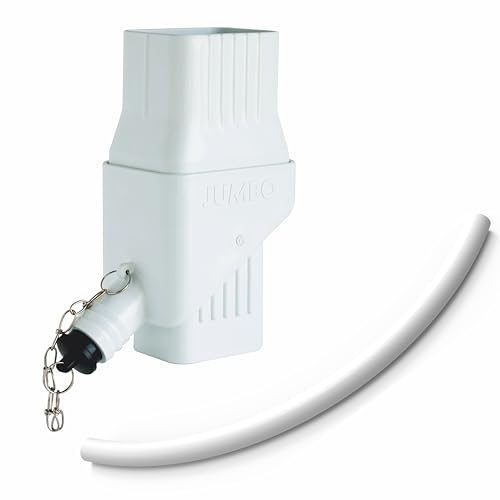
JUMBO Rooftop Rainwater Diverter (2×3 in)
Best for: Smaller downspouts on sheds, garages and porches
A paintable white diverter sized for 2×3 inch downspouts, a common size on smaller roofs and outbuildings.
- Made for 2×3 inch downspouts
- Paintable to match trim
- Compact profile
- Not for 3×4 or round downspouts
- Smaller roofs fill barrels more slowly

HEITIGN Greenhouse Rainwater Collection Kit
Best for: Greenhouses, sheds and small gutters
A lightweight downpipe kit designed for greenhouse gutters, with the fittings needed to route roof water into a water butt or barrel.
- Designed for greenhouse gutters
- Lightweight and easy to install
- All fittings included
- For small greenhouse downpipes, not house gutters
- Check pipe diameter before buying

Besuerte Rainwater Diverter for 2×3 Downspouts
Best for: Low-cost setups on standard 2×3 downspouts
A compact, lightweight diverter for 2×3 inch downspouts, a simple way to start collecting rain without a large investment.
- Compact and lightweight
- Fits 2×3 downspouts
- Simple installation
- Only for 2×3 downspouts
- Basic filter compared with premium models

Rain Barrel Diverter Kit with Filter
Best for: First-time rain barrel owners
A white plastic diverter kit with a built-in filter that fits most standard gutter downspouts and connects to a barrel inlet.
- Built-in debris filter
- Fits most standard downspouts
- Compact white body blends with gutters
- Plastic construction
- Check fit for your downspout size

Atyhao Greenhouse Gutter Downpipe Kit
Best for: Very small gutters on greenhouses and cold frames
A tiny, lightweight downpipe and elbow kit for mini greenhouse gutters, for directing water into a small water butt.
- Very lightweight
- Fits small greenhouse gutters
- Inexpensive
- Not for house downspouts
- Small capacity flow

VEVOR 53 Gallon Collapsible Rain Barrel
Best for: Pairing with a diverter when you need a barrel too
A collapsible PVC barrel with spigots and an overflow kit. It folds flat for winter storage, which suits cold climates.
- 53 gallon capacity
- Folds flat for storage
- Spigots and overflow included
- Less rigid than plastic barrels
- Needs a flat, firm base
How we chose these diverters
We focused on what makes a diverter work well day to day: a correct fit for common downspout sizes, a filter or screen to keep leaves out of the barrel, an easy way to bypass the barrel in winter and simple installation with basic tools. We separated kits for standard house downspouts from small kits made for greenhouse and shed gutters, because they are not interchangeable. We do not list prices because they change often; each pick links to the current Amazon listing.
How a rain barrel diverter works
A diverter sits inside or in line with the downspout. Rain flowing down the inner wall of the downspout is caught by the diverter and sent through a short hose into the barrel. When the barrel fills, water backs up the hose to the level of the diverter, and the rest of the rain continues down the downspout as usual. That is why the diverter must be installed at, or slightly above, the height of the barrel inlet. Compared with simply cutting the downspout and pointing it into the barrel, a diverter keeps the downspout working, handles overflow automatically and keeps more debris out of the stored water.
Rain barrel diverter buying guide
Downspout size and shape
This is the most important factor. Most homes in the US use rectangular downspouts measuring about 2×3 inches or 3×4 inches. Some older homes and outbuildings use round downspouts, and greenhouses usually have much smaller gutters. Measure the outside of your downspout before buying and check the listing carefully. A diverter that is the wrong size will leak or let water bypass it.
Filter or screen
A built-in filter or screen stops leaves, seeds and roof grit from entering the barrel, which keeps the water cleaner and reduces clogging of spigots, soaker hoses and drip lines. Filters need cleaning, especially in fall. If your roof sits under trees, choose a diverter with an easy-to-reach screen and consider adding gutter guards too.
Adjustable or winter bypass
Many diverters let you close the path to the barrel so water goes straight down the spout. This is useful in winter, when you drain the barrel to prevent freeze damage, and when the barrel is full or being cleaned.
Material
Most diverters are plastic, which is light, inexpensive and easy to cut and install. Stainless steel diverters resist UV and weather better and can last longer, but they cost more and can be harder to trim. Paintable models blend with house trim.
Hose length
The connecting hose runs from the diverter to the barrel. Make sure it is long enough for where you want to place the barrel, and keep it as short and straight as possible so it does not kink.
Matching the barrel
Check that your barrel has an inlet or can accept the diverter's hose fitting. Some diverter kits include a hole saw size recommendation or a fitting for the barrel wall. If you are buying a barrel too, a model with an overflow port and linking ports gives you more flexibility.
Types of diverters
In-line diverters replace a short section of the downspout. You cut out a piece and fit the diverter in its place, and a hose runs to the barrel. Most of the kits on this list are this type, and they are the most common choice for houses.
Side-mount or drill-in diverters fit through a hole drilled in the side of the downspout. They are quicker to install but usually handle less flow and can be harder to seal.
Strainer or colander diverters sit inside the downspout opening and combine a debris screen with a collection outlet. They are simple and work well when leaves are a problem.
Greenhouse downpipe kits are scaled down for the small gutters found on greenhouses, sheds and cold frames. They are not designed for full-size house downspouts.
How much water a diverter can collect
A useful rule of thumb is that one inch of rain on 1,000 square feet of roof produces roughly 600 gallons. A single downspout usually drains only part of the roof, but even a few hundred square feet can fill a standard 50 to 60 gallon barrel in one moderate storm. That is why overflow handling matters so much, and why a diverter that sends excess water back down the spout is safer than an open barrel under a cut downspout. If your barrel fills every time it rains, consider linking a second barrel or adding a larger tank.
Choosing a barrel to pair with your diverter
The diverter is only half of the system. A good barrel for most gardens is opaque to block algae, holds 50 to 80 gallons, has a screened inlet, a spigot a few inches above the bottom and an overflow port near the top. Collapsible barrels like the VEVOR model fold flat for winter storage, which helps in cold climates and small spaces. Rigid plastic barrels are sturdier and easier to raise on a stand for better gravity pressure. Whatever you choose, set it on a level, solid base, since a full 55 gallon barrel weighs over 400 pounds. If you are planning a larger system, our guide to the rainwater harvesting system for garden compares barrels, linked barrels and tanks.
Using the water in your garden
Water collected through a diverter is ideal for ornamental beds, shrubs, containers and houseplants, since it has no chlorine and very few dissolved salts. For vegetables, apply it to the soil rather than the leaves and wash produce well. A raised barrel can feed a short soaker hose or a low-pressure drip kit by gravity, and a small pump lets you use a hose wand or sprinkler. Keep the barrel covered and screened against mosquitoes, and clean it once or twice a year, as explained in our guide on how to clean a rain barrel.
Which diverter is right for you?
- Most homes with 2×3 or 3×4 downspouts: Anivia or WADEO.
- Longest-lasting option: EBaokuup stainless steel (3×4).
- Sheds, garages and porches with 2×3 downspouts: JUMBO or Besuerte.
- Greenhouses and cold frames: HEITIGN or Atyhao kits.
- First rain barrel setup: the basic diverter kit with filter, plus a collapsible barrel if you need one.
How to install a rain barrel diverter
- Place the barrel on a level, raised base next to the downspout.
- Mark the downspout at the height recommended in the instructions, usually level with or just above the barrel inlet.
- Cut the downspout with a hacksaw, or drill it if the kit uses a side-mount design.
- Insert the diverter and secure it with the included screws or clamps.
- Connect the hose from the diverter to the barrel inlet.
- Test it by running a garden hose into the gutter and watching water fill the barrel and then continue down the spout.
For the complete process, including building a base and routing overflow, see our guide on how to connect rain barrel to downspout.
Diverter vs first flush diverter
A standard diverter sends water to the barrel and handles overflow. A first flush diverter is a different device that discards the first, dirtiest water from each storm before any reaches the barrel. Many gardeners use both: the first flush device catches dust, pollen and droppings washed off the roof at the start of a storm, and the standard diverter fills the barrel with the cleaner water that follows. If you water vegetables with rainwater, a first flush device is worth adding.
Caring for your diverter
- Clean the screen after storms in fall and spring.
- Check the hose for kinks and debris.
- Switch to bypass and drain the barrel before freezing weather.
- Inspect seals and screws each spring, and replace cracked parts.
- Keep gutters clean so less debris reaches the diverter.
Our guide to rainwater harvesting system maintenance gives a full seasonal checklist, and if the barrel stops filling, see rainwater harvesting system repair.
Diverters for greenhouses and sheds
Greenhouses make excellent rainwater collectors: their large, clean roofs shed a lot of water, and the plants inside benefit from chlorine-free water. The challenge is that greenhouse gutters are usually much smaller than house gutters, often a narrow plastic or aluminum channel with a small round downpipe. Standard house diverters will not fit. Choose a kit designed for greenhouse downpipes, measure the pipe diameter before ordering and place the water butt where it is easy to reach with a watering can. On sheds and garages, check whether the downspout is a small 2×3 rectangular size or round, and buy accordingly. A barrel at a shed is a handy supply for nearby beds and for rinsing tools. Because greenhouse and shed roofs are smaller than a house roof, they fill barrels more slowly, so a single barrel is usually enough. In hot weather, keep greenhouse barrels shaded and use the water regularly, since warm standing water encourages algae. Screen every opening against mosquitoes, and drain both the barrel and the small downpipe kit before the first hard freeze in cold climates.
Common mistakes
- Buying the wrong downspout size.
- Installing the diverter below the barrel inlet, so water never backs up properly.
- Long, kinked hoses that slow filling.
- Never cleaning the filter, which blocks flow in leaf season.
- Leaving the barrel full over winter in cold climates.
- Skipping a level base, which lets a full barrel lean and strain the diverter hose.
- Forgetting overflow when the diverter is in bypass and the barrel lid is open.
The EPA encourages rain barrels as a simple way to reduce stormwater runoff from roofs.
The bottom line
The best rain barrel diverter kit for most homes is one that fits your 2×3 or 3×4 downspout exactly, has a built-in filter and offers a bypass for winter, like the Anivia or WADEO. Choose stainless steel for longevity, a 2×3 model for sheds and garages and a dedicated greenhouse kit for small gutters. Install it level with the barrel inlet, keep the screen clean and drain the system before freezing weather.
Frequently Asked Questions
What is the best rain barrel diverter kit?
For most homes with standard rectangular downspouts, a diverter with an adjustable valve and built-in filter, like our top pick, is the best choice.
What size downspout do I have?
Most homes have 2×3 or 3×4 inch rectangular downspouts. Measure the outside width and depth with a tape measure before buying.
Do diverters stop rain barrels from overflowing?
Yes. When the barrel is full, water backs up to the diverter and continues down the downspout instead of overflowing the barrel.
Can I use a diverter on a greenhouse?
Yes. Greenhouse gutters are smaller, so choose a kit made for small downpipes, such as our greenhouse picks.
Do I need to remove the diverter in winter?
In freezing climates, switch it to bypass or remove the hose and drain the barrel so ice does not damage the parts.