
Last updated: October 2026 · Written by the LawnVibe editorial team.
If you own a riding mower or lawn tractor and want to aerate a big lawn without renting a machine, two brand names come up again and again: Agri-Fab and Brinly. Both are long-established American lawn attachment makers, and both offer tow-behind plug aerators, tow-behind spike aerators and push spike aerators. This Agri-Fab vs Brinly lawn aerator comparison breaks down how their models differ in width, tine design, depth and practicality, so you can pick the right one for your lawn.
Rather than declaring a single winner, we compare the brands model by model, because the best choice depends on your lawn size, obstacles and whether you need core or spike aeration. We did not run hands-on tests; this comparison is based on published specifications, product descriptions and general aeration guidance.
| # | Product | Best for | Link |
|---|---|---|---|
| 1 | Agri-Fab 48 inch Tow-Behind Lawn Plug Aerator | Large, open lawns | Check price |
| 2 | Brinly 40 inch Tow-Behind Plug Aerator | Lawns with obstacles | Check price |
| 3 | Brinly SAT2-40BH-P 40 inch Tow-Behind Spike Aerator | Light aeration before overseeding | Check price |
| 4 | Brinly 18 inch Premium Push Spike Aerator | Small lawns without a tow vehicle | Check price |
| 5 | Brinly 20 inch Premium Push Spike Aerator | Faster push aeration | Check price |
| 6 | Agri-Fab 45-0365 16 inch Push Spike Aerator | Smaller lawns | Check price |
| 7 | Agri-Fab 45-0294 40 inch Tow-Behind Dethatcher | Removing thatch before aerating | Check price |
| 8 | Agri-Fab Tow-Behind Spiker Seeder Drop Spreader | Spiking and seeding in one pass | Check price |
Agri-Fab vs Brinly at a Glance
| Feature | Agri-Fab | Brinly |
|---|---|---|
| Tow plug aerator width | 48 inches | 40 inches |
| Plug tines | 32 galvanized knives | 24 heat-treated steel spoons |
| Listed plug depth | Up to about 3 inches | Up to about 3 inches |
| Tow spike aerator | Not compared here | 40 inch with transport wheels |
| Push spike aerator | 16 inch, 5 wheels, 7 inch spikes | 18 and 20 inch, 3-D tine stars |
| Other lawn tools | Tow dethatcher, spiker seeder | Lawn rollers, spreaders |
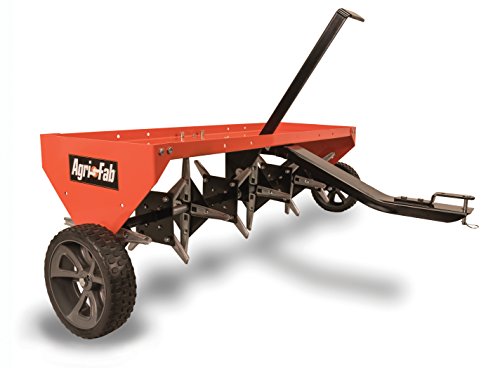
Agri-Fab 48 inch Tow-Behind Lawn Plug Aerator
Best for: Large, open lawns
A 48 inch tow-behind aerator with 32 galvanized knives that pulls plugs up to 3 inches deep, using a universal hitch.
- Widest plug aerator in this comparison
- 32 galvanized knives
- Up to 3 inch plugs
- Bulky to store
- Less nimble around obstacles

Brinly 40 inch Tow-Behind Plug Aerator
Best for: Lawns with obstacles
24 heat-treated, 16-gauge steel plugging spoons with a narrower plug design remove plugs up to 3 inches.
- Heat-treated spoons
- Narrower design for manoeuvring
- Universal hitch
- More passes on large lawns
- Needs added weight
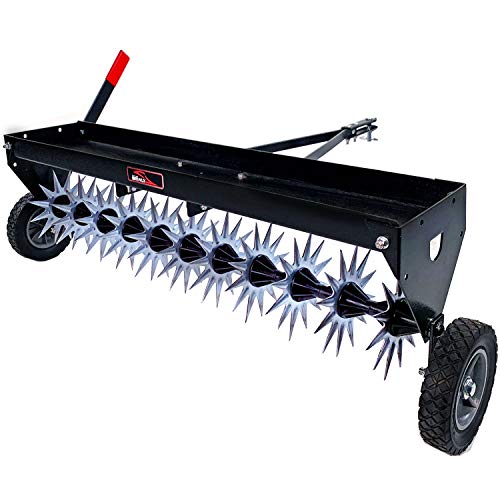
Brinly SAT2-40BH-P 40 inch Tow-Behind Spike Aerator
Best for: Light aeration before overseeding
11 tine stars with 12 spike tips each penetrate up to 2 inches, with transport wheels for crossing pavement.
- Transport wheels
- 3-D tines
- Quick, light aeration
- Spike not core
- Less effective on heavy compaction

Brinly 18 inch Premium Push Spike Aerator
Best for: Small lawns without a tow vehicle
Five 8 inch 3-D galvanized tine stars with 12 tips each penetrate up to 2 inches, with a rigid weight tray.
- 3-D galvanized tines
- Weight tray
- No tow vehicle needed
- Pushing effort
- Spike aeration only

Brinly 20 inch Premium Push Spike Aerator
Best for: Faster push aeration
A wider 20 inch push spike aerator with reinforced side panels, 3-D galvanized tine stars and transport wheels.
- 20 inch working width
- Reinforced frame
- Transport wheels
- Heavier to push when weighted
- Spike only

Agri-Fab 45-0365 16 inch Push Spike Aerator
Best for: Smaller lawns
Five aerating wheels with 7 inch spikes and a steel weight tray, giving up to 2-1/2 inches of aeration depth.
- Long 7 inch spikes
- Steel weight tray
- Simple design
- Narrower 16 inch width
- Pushing effort
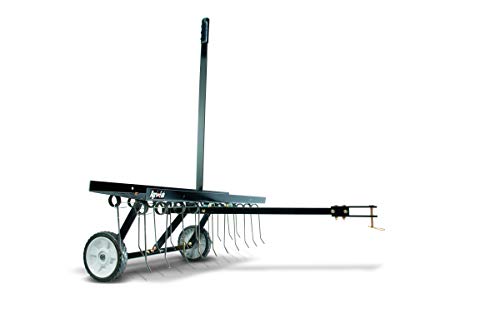
Agri-Fab 45-0294 40 inch Tow-Behind Dethatcher
Best for: Removing thatch before aerating
A 40 inch tow-behind dethatcher with 20 spring steel tines and a heavy-gauge steel deck, covered by a 3-year limited warranty per the listing.
- 20 spring tines
- Steel deck
- Pairs with aerators
- Dethatches, does not aerate
- Some assembly required

Agri-Fab Tow-Behind Spiker Seeder Drop Spreader
Best for: Spiking and seeding in one pass
A 32 inch tow-behind spiker with a 100 lb capacity drop spreader for seed and fertilizer, useful for overseeding after aeration.
- Spikes and spreads together
- 100 lb hopper
- Good for overseeding
- Spike depth is shallow
- Not a core aerator
Tow-Behind Plug Aerators: Agri-Fab 48 Inch vs Brinly 40 Inch
Plug aerators are the most important comparison, because core aeration is the method university extension services usually recommend for compacted lawns. Kansas State University Research and Extension explains why in its guide to aerating your lawn.
Agri-Fab's 48 inch plug aerator uses 32 galvanized knives and is listed as pulling plugs up to 3 inches deep. Its main advantage is width. On a large, open lawn, 48 inches per pass means fewer laps and less time on the mower. It uses a universal hitch for lawn tractors and riding mowers.
Brinly's 40 inch plug aerator uses 24 heat-treated, 16-gauge steel plugging spoons and is also listed as removing plugs up to 3 inches. Brinly describes its plug design as narrower than typical spoons, which can help penetration. The narrower 40 inch frame is easier to manoeuvre around trees, beds and play equipment.
Which to choose? For wide, open lawns where speed matters, Agri-Fab's extra width is a real benefit. For lawns with many obstacles, narrow gates or tighter turns, Brinly's 40 inch model is easier to handle. In both cases, depth depends heavily on soil moisture and the weight you add to the tray.
Spike Aerators: Tow and Push Options
Spike aerators push solid tines into the soil rather than removing plugs. They are useful for light aeration and for preparing soil before overseeding, but they do not relieve heavy compaction as well as core aerators.
Brinly's SAT2-40 tow spike aerator has 11 tine stars, each 8 inches in diameter with 12 spike tips, listed as penetrating up to 2 inches. Transport wheels let you move it across driveways and paths without dragging the spikes.
Push spike aerators are where the brands differ most in design. Brinly's 18 and 20 inch push spike aerators use five 8 inch 3-D galvanized tine stars with 12 tips each, a weight tray and transport wheels. Agri-Fab's 45-0365 is a 16 inch walk-behind with five aerating wheels carrying 7 inch spikes and a steel weight tray, listed at up to 2-1/2 inches of aeration depth. Brinly covers more width per pass, while Agri-Fab's longer spikes may help in some soils.
For a broader look at spike models, see our guide to the best spike aerator.
Beyond Aerators: Related Lawn Tools
Both brands sell other tow-behind lawn tools, which matters if you want a matching set of attachments. Agri-Fab's 40 inch tow-behind dethatcher uses 20 spring steel tines to pull thatch from the lawn, and its tow-behind spiker seeder combines spikes with a seed and fertilizer drop spreader. Using a dethatcher before aeration and a spiker seeder after can be a useful renovation sequence. Brinly is also known for lawn rollers and spreaders.
How to Get the Best Results From Either Brand
Whichever brand you choose, technique matters more than the logo. Aerate when grass is actively growing: early fall or spring for cool-season grasses, late spring to early summer for warm-season grasses. Water the lawn a day or two before so the soil is moist but not soggy. Load the weight tray with concrete blocks or sandbags, staying within the manufacturer's limits and your mower's towing guidance.
Mark sprinkler heads and shallow lines, then aerate in overlapping passes, making a second pass at an angle on compacted lawns. Lift or raise the aerator before turning sharply, since dragging tines through turns can tear the lawn. Leave the soil plugs to break down. Follow with overseeding and fertilizing while the holes are open. Our guides on how to core aerate a lawn yourself and how to overseed a lawn after aerating cover the details.
If your plug aerator is not penetrating, the usual causes are dry soil and too little weight. Our troubleshooting guide on how to fix a core aerator that is not penetrating the soil explains more.
Choosing by Lawn Size and Layout
Half an acre to one acre
Either brand's tow-behind plug aerator handles this size well. If the lawn is mostly open, the Agri-Fab 48 inch saves time. If it is broken up by trees, beds and paths, the Brinly 40 inch is easier to steer between obstacles. A push spike aerator is possible at this size but is hard work.
One acre and more
Width becomes more valuable as lawns grow. The Agri-Fab 48 inch reduces the number of passes noticeably. On very large properties, consider making two passes in different directions for better coverage rather than buying a wider machine.
Under a quarter acre
A tow-behind aerator is usually unnecessary on small lawns, and you may not own a riding mower to pull it. A push spike aerator from either brand, or a manual core tool, is more practical. For small-lawn options, see our guide to the best lawn aerator for small yards.
Core or Spike: Which Do You Need?
Choose a plug (core) aerator if your soil is compacted, water puddles or runs off, or grass is thin in high-traffic areas. Removing plugs relieves compaction and lets roots grow deeper. Choose a spike aerator if your soil is in reasonable condition and you mainly want to open the surface before overseeding or fertilizing, or if you aerate often and want a lighter, quicker pass. Many owners use a plug aerator once a year and a spike aerator for in-between seeding jobs.
Assembly, Storage and Towing
Both brands ship tow-behind aerators that need assembly, so plan an hour or so with basic tools. Once assembled, plug aerators take up a fair amount of floor space; wider models need more room. Lifting the weight tray off before storage makes the aerator easier to move.
When towing, follow your mower's towing limits and keep speeds low, especially on slopes. Total weight, including blocks in the tray, should stay within what your mower is designed to pull. Remove weights before transporting the aerator across driveways or roads, and use transport wheels where fitted so spikes do not damage pavement.
Agri-Fab vs Brinly: Pros and Cons Summary
Agri-Fab strengths: the widest tow plug aerator in this comparison for faster coverage, longer individual spikes on its push spike aerator, and a broader range of related tow-behind tools such as dethatchers and spiker seeders.
Agri-Fab trade-offs: the 48 inch plug aerator is bulkier to store and less nimble around obstacles; the push spike aerator is narrower than Brinly's.
Brinly strengths: a more manoeuvrable 40 inch plug aerator with heat-treated spoons, a tow spike aerator with transport wheels and wider push spike aerators with 3-D galvanized tines.
Brinly trade-offs: the narrower plug aerator takes more passes on large open lawns.
Maintenance for Either Brand
Clean soil off tines, knives and spoons after every use, because dried soil can clog plugging tines and promote rust. Check tines for bending, especially after hitting hidden stones or roots, and replace damaged ones. Grease or oil moving parts and check hitch pins, bolts and wheel bearings each season. Store the aerator dry, ideally under cover, and remove weights from the tray to avoid stressing the frame. Our guide on how to clean a lawn aerator after use covers the routine.
Renting Instead of Buying
If you aerate only once a year and do not own a tow vehicle, renting a gas core aerator can be simpler. If you already own a riding mower, buying either brand's tow-behind aerator often pays off within a few seasons.
Working Safely With Tow-Behind Aerators
Keep children and pets away while towing, and never ride on or stand on the aerator. Stop the mower before adding or removing weights, and keep hands clear of tines. Avoid steep slopes with a loaded aerator, since added weight affects mower traction and braking.
Common Questions When Choosing
Many buyers wonder whether a wider aerator always means better results. Not necessarily. Penetration depth matters more than width for relieving compaction, and depth depends on soil moisture and tray weight as much as the design. Another common question is whether galvanized or heat-treated tines matter. Galvanizing resists rust, while heat treatment improves strength; both help a tool last longer in hard soil.
Which Should You Buy?
- For large, open lawns where speed matters: the Agri-Fab 48 inch plug aerator.
- For lawns with trees, beds and tight turns: the Brinly 40 inch plug aerator.
- For light aeration before overseeding on big lawns: the Brinly SAT2-40 tow spike aerator.
- For small to medium lawns without a tow vehicle: the Brinly 18 or 20 inch push spike aerator, or the Agri-Fab 45-0365.
- For full lawn renovation: pair an aerator with the Agri-Fab tow dethatcher and spiker seeder.
For more tow-behind and push options from other brands, see our main guide to the best lawn aerator.
Frequently Asked Questions
Is Agri-Fab or Brinly better for tow-behind plug aeration?
Both make capable tow-behind plug aerators. Agri-Fab's 48 inch model covers more ground per pass with 32 knives, while Brinly's 40 inch model is narrower with 24 heat-treated plugging spoons and a slimmer plug design. Wider suits big open lawns; narrower suits lawns with more obstacles.
How deep do Agri-Fab and Brinly plug aerators go?
Both brands list plug depths of up to about 3 inches, depending on soil moisture and how much weight you add to the tray.
Do these aerators need extra weight?
Yes. Tow-behind and push aerators rely on weight to penetrate. Adding concrete blocks or sandbags to the tray and aerating moist soil improves depth.
Which brand has better push spike aerators?
Brinly's 18 and 20 inch push spike aerators use 3-D galvanized tine stars and transport wheels, while Agri-Fab's 16 inch model uses five wheels of 7 inch spikes and a steel weight tray. Brinly offers more width; Agri-Fab offers longer individual spikes.
Can I use these aerators with any riding mower?
Both brands use universal hitch designs for most riding mowers and lawn tractors. Check your mower's hitch and towing guidance before buying.