

Last updated: October 2026 · Written by the LawnVibe editorial team.
Is clover good for your lawn? For many yards the short answer is yes, with conditions. White clover pulls nitrogen out of the air, stays green when grass goes dormant in a dry spell, holds up surprisingly well to dog urine, and feeds bees. On the other side, it wears out faster than turfgrass under heavy play, stains clothes, attracts stinging insects when it flowers, and gives a patchy look that some people simply do not want.
So the real question is not whether clover is "good" or "bad" but whether it fits the job your lawn has to do. This guide walks through what clover actually does in a lawn, where it falls short, and how to decide between keeping it, encouraging it, or removing it. If you have already decided it has to go, our guide to the best clover killer compares selective products by format and grass type.
Quick Answer
For many yards the short answer is yes, with conditions. White clover pulls nitrogen out of the air, stays green when grass goes dormant in a dry spell, holds up surprisingly well to dog urine, and feeds bees. On the other side, it wears out faster than turfgrass under heavy play, stains clothes, attracts stinging insects when it flowers, and gives a patchy look that some people simply do not want.
Key takeaways:
- Is clover good for your lawn?
- For a low-input, pet-friendly or pollinator-friendly yard, it is one of the most useful plants you can have: it feeds the grass, stays green in dry weather and resists urine spots.
- For a heavily used play lawn, a yard where stings are a real risk, or a homeowner who wants a uniform turf look, its drawbacks outweigh those benefits.
- Many people land in the middle: a healthy grass lawn with some clover, kept in balance by mowing height and moderate feeding.
What Clover Is Doing in Your Lawn
The clover found in most North American lawns is white clover (Trifolium repens), a low, creeping perennial legume. It spreads by stolons, stems that run along the soil surface and root at each node, and by seed from its round white flower heads. The Wikipedia entry on Trifolium repens gives a good overview of its biology and long history as a pasture and lawn plant.
Two features explain almost everything about clover's behaviour in turf:
- It is a legume. Its roots host Rhizobium bacteria in small nodules. Those bacteria convert atmospheric nitrogen into compounds the plant can use, so clover does not depend on fertilizer the way grass does.
- It creeps. Because it roots along its stems, a single plant can fill a bare patch over a season and recover quickly when parts of it are damaged.
That combination is why clover thrives exactly where grass struggles: low-nitrogen soil, thin turf and short mowing. Our article on why clover is taking over your lawn looks at those causes in more detail.
A Short History: Clover Used to Be the Goal
It surprises many people that clover was once a standard ingredient in lawn seed. Through the first half of the twentieth century, mixes commonly included white clover because it kept lawns green and helped feed the grass.
That changed in the decades after broadleaf herbicides such as 2,4-D came into widespread use. Those products kill clover along with dandelions, and marketing gradually shifted toward the idea of a pure, uniform grass lawn. Clover went from being a feature to being labeled a weed. The plant did not change; the expectations did.
The Benefits of Clover in a Lawn
Free nitrogen for the grass around it
This is the headline benefit. Clover supplies its own nitrogen, and some of it becomes available to nearby grass as clover roots, stems and clippings decompose. Lawns with a healthy share of clover often look greener on less fertilizer. It will not replace a feeding program on a lawn with high expectations, but it can reduce how much you need to apply.
Green color in dry spells
Clover roots are relatively deep for such a small plant, and it tends to stay green during short dry periods when cool-season grasses such as Kentucky bluegrass slip into dormancy and turn straw-colored. A mixed lawn often looks better in late summer than an all-grass one on the same watering schedule.
Resistance to dog urine spots
Dog urine burns grass mainly because of its concentrated nitrogen. Clover, which already lives on nitrogen it makes itself, is far less likely to show those familiar yellow spots with dark green rings. Many pet owners add clover to high-use patches for exactly this reason.
Food for pollinators
Clover flowers are a valuable nectar and pollen source for honeybees and native bees, and a lawn with flowering clover supports insects that a pure turf lawn does not. If supporting pollinators is a goal, letting clover bloom for part of the season is one of the simplest things you can do.
Low growth and less mowing
Common white clover stays fairly low, and microclover varieties stay lower still. A grass-clover lawn usually still needs mowing, but clover itself does not demand frequent cutting, and the mix tends to look tidy at a slightly higher mowing height.
Fills gaps and competes with other weeds
Because clover creeps into thin areas, it occupies space that would otherwise go to crabgrass or other weeds. It is not a weed control program, but dense ground cover of any kind leaves fewer openings.
Cheap to establish
Clover seed is small and a little goes a long way. Overseeding an existing lawn with clover costs far less than reseeding with premium grass, and it establishes in conditions where grass seed often fails.
The Drawbacks of Clover
It does not handle heavy traffic as well as grass
Clover tolerates moderate foot traffic, but it does not stand up to repeated, concentrated wear the way well-chosen turfgrass does. A goal mouth, a dog run along the fence or a path to the shed will wear down in clover faster than in tall fescue or Bermudagrass. For active play lawns, a mix where grass does most of the work is more practical than a clover-dominant yard.
Bees on the flowers
The same flowers that help pollinators can be a problem for barefoot children or anyone allergic to stings. You can reduce flowering by mowing on a regular schedule before bloom, but you cannot have a lawn full of clover flowers and no bees.
Grass stains and slippery when wet
Clover leaves are juicy and stain clothing more readily than grass. Clover-heavy areas can also be slick after rain or irrigation, which matters on slopes and play spaces.
Uneven appearance
Common white clover has a different leaf shape, color and texture from grass, and it grows in patches. If you want a uniform, striped, golf-course look, clover will always read as an interruption. Microclover narrows that difference but does not eliminate it.
It spreads into beds
Creeping stems do not respect edges. Clover will move into flower and vegetable beds where it competes with plants you want. A solid edge and mulch help keep it in the lawn.
Patchy die-back
Individual clover patches can thin out after a few years, especially in hot, humid summers or after a cold winter without snow cover. Lawns that rely heavily on clover may need occasional overseeding to stay even.
It complicates weed control
If you rely on broadleaf herbicides to control dandelions or plantain, those same products will usually damage or kill clover. Keeping clover means spot-treating weeds or using non-chemical methods instead of blanket spraying.
Clover Lawn Pros and Cons at a Glance
| Factor | Clover's strength | Clover's weakness |
|---|---|---|
| Fertility | Makes its own nitrogen, helps feed grass | Reduces the need for fertilizer only partly |
| Drought | Stays green through short dry spells | Can thin out in long heat and humidity |
| Pets | Resists dog urine spots | Flowers attract bees |
| Traffic | Recovers by creeping | Wears faster than grass under heavy use |
| Looks | Soft, even green when microclover is used | Patchy look with common white clover |
| Weed control | Fills thin areas | Damaged by most broadleaf weed killers |
| Maintenance | Less fertilizer, fewer mowing demands | Needs edging to stay out of beds |
Microclover vs Common White Clover
Microclover is a group of selected white clover varieties with smaller leaves, a lower growth habit and fewer flowers. It was bred to blend into turf rather than grow in separate patches.
Choose microclover if you want most of clover's benefits while keeping a lawn that looks mostly like grass. It is usually sold as part of a grass seed mix or as a small addition to overseed an existing lawn.
Common white clover is fine if you want a lower-cost, lower-input yard and do not mind a looser look and more flowers. It is also a good choice for areas you rarely use, such as side yards or slopes that are hard to mow.
Neither is a full replacement for grass in a high-traffic lawn. Both work best as partners to turfgrass rather than substitutes for it.
When Keeping Clover Makes Sense
Clover is likely a good fit if several of these apply to your yard:
- You want to use less fertilizer or water
- You have dogs and recurring urine spots
- You want to support pollinators
- The lawn gets light to moderate use
- You prefer a natural look over a uniform one
- You are working with poor, sandy or low-nitrogen soil and want ground cover that does not need constant feeding
In these situations, a grass-clover mix often looks better through the year with less work than a grass-only lawn on the same budget.
When Removing Clover Makes Sense
Clover is a poor fit, and removal is reasonable, when:
- The lawn is a heavily used play or sports area
- Someone in the household is allergic to bee stings and the clover flowers freely
- You want a uniform, manicured appearance
- Clover is spreading aggressively into garden beds
- You plan a broadleaf weed program and do not want to manage around clover
If that describes your lawn, start with cultural changes: raise the mowing height, feed the grass, and overseed thin spots so grass reclaims the space. Our guide on removing clover without chemicals covers those methods. When cultural control is not enough, a selective herbicide labeled for clover and your grass type is the next step; the ingredient comparison in triclopyr vs 2,4-D explains why some products work on clover and others only set it back.
How to Add Clover to an Existing Lawn
If you decide you want more clover, not less, the process is simple.
- Pick the type. Microclover for a grass-like look, common white clover for a lower-cost, looser lawn.
- Time it well. Spring and early fall are the usual windows, when soil is moist and temperatures are moderate.
- Mow short once and rake. Cutting the grass lower than usual and raking out thatch gives the tiny seeds contact with soil.
- Spread lightly and evenly. Clover seed is very small. Follow the seed supplier's rate per 1,000 square feet and mix the seed with sand or a carrier to spread it evenly.
- Keep it moist. Water lightly and often until seedlings are established, usually a couple of weeks.
- Skip broadleaf herbicides. Avoid weed-and-feed and broadleaf sprays before and after seeding, since they will kill clover seedlings.
- Go easy on nitrogen. High-nitrogen feeding favours grass and can crowd out new clover. Once established, a mixed lawn generally needs less fertilizer than an all-grass one.
How to Live With Clover Without Letting It Take Over
A balanced lawn is often the best outcome. A few habits keep clover as a helpful minority rather than the dominant plant:
- Mow at the upper end of the recommended height for your grass. Taller grass shades clover and keeps it in check.
- Feed the grass moderately, especially in fall for cool-season lawns.
- Overseed thin spots with grass each fall so clover is not the only plant filling gaps.
- Edge beds and use mulch so creeping stems do not invade them.
- Mow before heavy bloom in areas where bees are a concern.
- Spot-treat weeds rather than spraying the whole lawn, so clover survives where you want it.
Common Myths About Clover in Lawns
"Clover means the lawn is unhealthy." Clover often signals low nitrogen or thin grass, but it is not a disease, and its presence does not harm the grass. In a sense it is helping correct the low-nitrogen problem.
"Clover kills grass." Clover competes for space, but it does not poison or choke healthy grass. It wins only where grass is already weak.
"Clover is only a weed." Whether a plant is a weed depends on whether you want it. For much of lawn history, clover was deliberately sown.
"You can have clover without bees." Only if you mow before it flowers. Blooming clover will attract pollinators.
Products for Managing Clover Either Way
Whether you remove clover or keep it under control, these options can help. Details come from Amazon listings; we have not hands-on tested them.
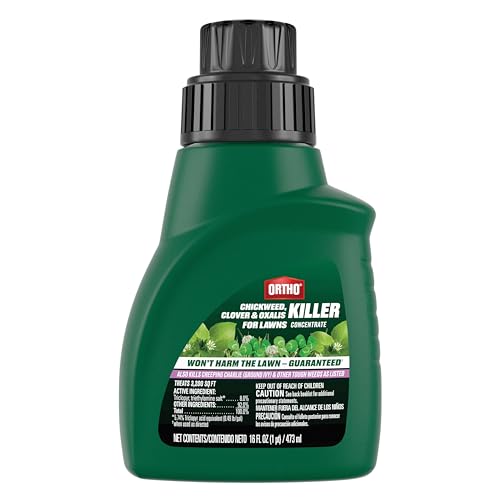
Ortho Chickweed, Clover & Oxalis Killer for Lawns Concentrate, 16 fl. oz.
Best for: Targeted clover control on cool-season and zoysia lawns
A dedicated concentrate that Ortho says controls red and white clover, chickweed, oxalis, creeping Charlie and wild violet to the root. One 16 fl. oz. bottle is rated to treat up to 3,200 sq. ft. when diluted in a tank sprayer.
- Lists red and white clover specifically
- Also targets creeping Charlie and wild violet
- Concentrate format for tank sprayers
- Labeled grasses exclude Bermuda and St. Augustine
- Needs a separate sprayer and careful mixing

Ortho WeedClear Lawn Weed Killer Ready-to-Spray, 32 fl. oz.
Best for: Lawns where clover shares space with crabgrass
Ortho rates this hose-end spray for up to 5,000 sq. ft. and lists crabgrass, foxtail, dandelion, clover, chickweed and creeping Charlie among its targets, all with a single application on young, actively growing weeds.
- Adds crabgrass and foxtail control
- Simple hose-end on/off switch
- Wide list of labeled lawn grasses
- Smaller coverage than some hose-end rivals
- Best on young weeds
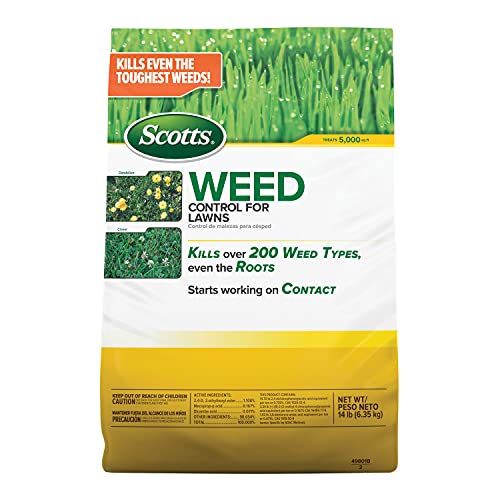
Scotts Weed Control for Lawns, 14 lbs.
Best for: Spreader users who prefer not to spray
A 14 lb. granular weed control that Scotts says covers 5,000 sq. ft. and controls 200+ weeds including clover, dandelion, dollarweed, ground ivy and oxalis. Apply in spring or early fall when weeds are actively growing.
- No drift onto garden beds
- Easy with a broadcast spreader
- Long list of controlled weeds
- Not for Floratam St. Augustine, dichondra, carpetgrass or bentgrass
- Granules need damp leaves to stick

Scotts Turf Builder Weed & Feed3, 14.29 lbs.
Best for: Underfed lawns where clover is moving in
Scotts calls Turf Builder Weed & Feed3 its most powerful weed and feed, claiming up to 2X more dandelion and clover control than its previous formula, while it feeds to thicken lawns and crowd out weeds. The bag covers 5,000 sq. ft.
- Kills clover and fertilizes in one step
- Feeding addresses the low-nitrogen cause
- Covers 5,000 sq. ft.
- Treats the whole lawn, not just weedy spots
- Timing must suit both feeding and weed control
If you decide to remove it, see our best clover killer guide.
The Bottom Line: Is Clover Good for Your Lawn?
Is clover good for your lawn? For a low-input, pet-friendly or pollinator-friendly yard, it is one of the most useful plants you can have: it feeds the grass, stays green in dry weather and resists urine spots. For a heavily used play lawn, a yard where stings are a real risk, or a homeowner who wants a uniform turf look, its drawbacks outweigh those benefits.
Many people land in the middle: a healthy grass lawn with some clover, kept in balance by mowing height and moderate feeding. If you decide the clover has to go, fix the thin, underfed turf first so it does not simply return, and if you need a product, the best clover killer guide compares selective options that target clover while sparing your grass.
More Questions People Ask
Is clover bad for lawns?
Not necessarily. Clover fixes nitrogen and stays green, but some homeowners dislike its look or the bees it attracts.
Does clover choke out grass?
In thin, low-nitrogen lawns it can spread into gaps; in a dense, well-fed lawn grass usually holds its own.
Is a clover lawn low maintenance?
Clover lawns need less fertilizer and water than many grass lawns, but they handle heavy traffic less well.
Will clover attract bees?
Flowering white clover attracts bees. Mowing before it flowers reduces this.
Frequently Asked Questions
Is clover good or bad for a lawn?
It depends on what you want from the yard. Clover adds nitrogen, stays green in dry spells and feeds pollinators, but it handles heavy wear poorly, can stain clothing and breaks up the uniform look of an all-grass lawn. Many homeowners keep a grass-clover mix as a middle ground.
Does clover really fertilize the grass around it?
Clover forms a partnership with Rhizobium bacteria in root nodules that convert nitrogen from the air into a form plants can use. Some of that nitrogen reaches neighbouring grass as clover roots and leaves break down, which is why mixed lawns often need less fertilizer.
What is microclover?
Microclover refers to selected low-growing white clover varieties with smaller leaves and fewer flowers. It blends into turf more evenly than common white clover and is usually sown as a small percentage of a grass seed mix.
Will clover take over my whole lawn?
Clover spreads fastest where grass is thin, underfed or mowed very short. In a dense, well-fed lawn it usually stays a minor part of the mix rather than taking over.
Is clover safe for dogs and kids?
White clover is commonly grown in pet and play areas. The main practical concern is bees visiting the flowers, so mow before bloom if bare feet and stings are a worry, and avoid treating clover areas with products that are not labeled for use around pets.