
A green, healthy lawn is the pride of many homeowners. But behind every lush yard is a careful plan—especially when it comes to fertilizer. One nutrient that often creates confusion is phosphorus. Used correctly, phosphorus can help grass grow stronger and roots dig deeper. Used incorrectly, it can harm both your lawn and the environment. So, when is the right time to apply phosphorus to your lawn? This guide answers that question in detail, giving you everything you need to know to keep your grass thriving while avoiding costly mistakes.
Why Phosphorus Matters For Your Lawn
Phosphorus is one of three main nutrients in lawn fertilizers, along with nitrogen and potassium. It’s often represented as the middle number on fertilizer bags (for example, 10-20-10). But why does this element matter so much for your grass?
Phosphorus is essential for root development. When grass is young or recovering from damage, phosphorus helps build strong root systems. This makes your lawn more resistant to drought, disease, and heavy foot traffic. It also plays a role in energy transfer within plants, helping them use sunlight to grow.
Without enough phosphorus, grass may look weak, thin, or have a dark green or purplish color. Over time, a phosphorus deficiency can mean poor growth and less resilience. However, too much phosphorus is not just a waste—it can pollute rivers and lakes, causing algae blooms that damage water quality.
Understanding Your Lawn’s Phosphorus Needs
Not every lawn needs extra phosphorus. In fact, many modern soils already have enough. Before adding any fertilizer, it’s important to know what your grass actually requires. Applying phosphorus blindly can hurt both your wallet and the environment.
The Role Of Soil Testing
The only reliable way to know if your lawn needs phosphorus is through a soil test. These tests measure the amount of available phosphorus in the soil, along with pH and other nutrients. Many state universities and local extension offices offer affordable soil testing services.
Here’s how the process usually works:
- Collect small soil samples from several spots in your yard.
- Mix them together in a clean container.
- Send the mixed sample to a lab or extension office.
- Receive a report that shows your soil’s phosphorus level (usually in parts per million, or ppm).
If your soil test shows low phosphorus (often below 20 ppm), your lawn will benefit from fertilizer. If it’s higher, you may not need to add any at all.
Interpreting Soil Test Results
Soil test reports can look confusing at first. Here’s a simple breakdown of what the numbers mean for phosphorus:
- Low (usually below 10–20 ppm): Your lawn will likely benefit from added phosphorus.
- Medium (20–35 ppm): Some benefit, but less urgent. Apply only if growing new grass.
- High (above 35 ppm): No need to add more; extra phosphorus won’t help.
Every lab uses slightly different numbers, so check the key or recommendations on your report.
Phosphorus Deficiency Signs
Besides soil testing, watch for these signs of phosphorus shortage:
- Slow or stunted growth, even with regular watering
- Grass blades with a blue-green or purplish tint
- Weak, thin turf that struggles to recover from stress
These symptoms alone aren’t enough to diagnose a problem, but they’re clues that a soil test is a good idea.

Credit: getlawnbright.com
When To Apply Phosphorus To Your Lawn
Timing matters just as much as quantity. Applying phosphorus at the wrong time can waste money, harm the environment, and fail to help your grass.
Best Times For Application
The most effective times to apply phosphorus are:
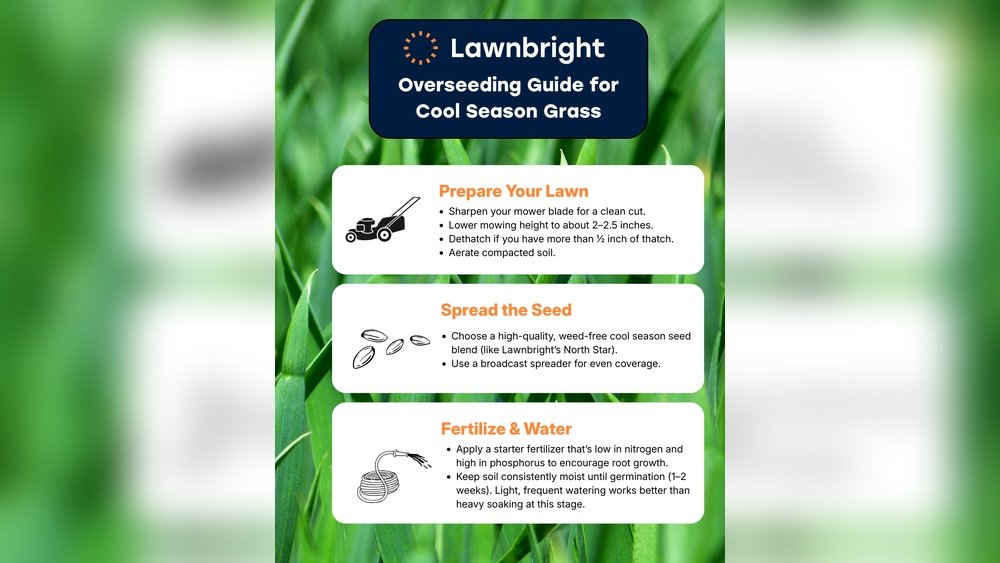
- When planting new grass seed: Young grass needs phosphorus to build roots. Apply before or at the same time as seeding.
- During lawn renovation: If you’re overseeding or repairing damaged areas, phosphorus helps new roots establish.
- After soil test shows a deficiency: If your established lawn is low in phosphorus, apply when grass is actively growing—usually spring or early fall.
Applying phosphorus to an established, healthy lawn with adequate soil levels is not necessary and can be harmful.
Avoiding The Wrong Times
Never apply phosphorus when:
- The ground is frozen or saturated (risk of runoff)
- Heavy rain is expected within 24–48 hours (nutrients can wash away)
- Your lawn is dormant (not actively growing)
Applying at these times increases the chance of phosphorus moving into storm drains and waterways, where it causes environmental problems.
Types Of Phosphorus Fertilizers
Not all fertilizers are created equal. Some are rich in phosphorus, while others contain little or none. Understanding the labels and types can help you pick the right product for your lawn’s needs.
Reading Fertilizer Labels
Every fertilizer bag has three numbers (for example, 10-20-10). These stand for nitrogen-phosphorus-potassium (N-P-K) percentages by weight.
- The first number is nitrogen (N)
- The second is phosphorus (P)
- The third is potassium (K)
So a 10-20-10 fertilizer contains 20% phosphorus by weight.
Common Phosphorus Fertilizers
Here are a few common products and their typical N-P-K values:
| Product Name | N-P-K Ratio | Best Use |
|---|---|---|
| Superphosphate | 0-20-0 | New seeding, deficiency correction |
| Triple Superphosphate | 0-46-0 | Rapid phosphorus boost |
| Starter Fertilizer | 10-20-10 | Seeding or sodding |
| Bone Meal | 3-15-0 | Organic option, slower release |
Choose a fertilizer based on your soil test and the specific needs of your lawn.
Granular Vs. Liquid Fertilizers
- Granular fertilizers are easy to spread and provide slow, steady nutrient release.
- Liquid fertilizers work faster but require more frequent applications and careful mixing.
For most home lawns, granular products are easier to use and less likely to burn grass.
How Much Phosphorus Should You Apply?
Too much phosphorus is not just wasteful—it’s risky for the environment. The correct amount depends on your soil test results and whether you’re starting a new lawn or maintaining an existing one.
General Application Rates
Here are some common recommendations for phosphorus application:
- New lawns (seeding/sodding): 1–1.5 pounds of actual phosphorus (P2O5) per 1,000 square feet
- Established lawns: 0.5–1 pound of phosphorus (P2O5) per 1,000 square feet, only if soil test shows deficiency
These numbers refer to actual phosphorus content, not the total weight of fertilizer. To figure out how much product to use, you’ll need to do a little math:
- Find the phosphorus percentage (the middle number) on your fertilizer bag.
- Divide the recommended pounds of phosphorus by this percentage.
- Multiply by 100 to get the total pounds of fertilizer needed per 1,000 square feet.
Example: If you’re using a 10-20-10 fertilizer (20% phosphorus) and need to apply 1 pound of phosphorus:
1 ÷ 0. 20 = 5 pounds of fertilizer per 1,000 square feet
Why Accurate Measurement Matters
Applying too much can cause phosphorus to build up in the soil, where it becomes an environmental hazard. Many states now regulate or ban phosphorus fertilizers for lawns unless a soil test proves they are needed. Always check local rules before applying.
Step-by-step Guide: Applying Phosphorus To Your Lawn
A careful approach helps you get the best results with minimal risk. Here’s a simple, step-by-step process:
- Test your soil: Always start here. Get an accurate phosphorus reading before adding any fertilizer.
- Choose the right product: Use a fertilizer with the correct phosphorus percentage for your needs.
- Calculate the amount needed: Use the formula above to avoid over-application.
- Apply at the right time: Best during new seeding, overseeding, or when soil tests show a deficiency.
- Spread evenly: Use a broadcast or drop spreader to avoid uneven patches.
- Water lightly: After applying, water just enough to help nutrients reach the root zone.
- Clean up hard surfaces: Sweep up any fertilizer that lands on driveways or sidewalks to prevent runoff.
Special Tips For New Lawns
- Mix phosphorus into the soil before seeding or laying sod. Surface application is less effective since phosphorus moves slowly in soil.
- Don’t double up: More is not better. Stick to recommended rates for best results.
Mistakes To Avoid
- Skipping the soil test
- Guessing the amount of fertilizer
- Applying before heavy rain
- Ignoring local fertilizer laws
Environmental Impact: Why Responsible Application Matters
Phosphorus is a double-edged sword. While lawns need some, too much can have serious consequences for lakes, rivers, and drinking water.
The Problem With Runoff
When phosphorus washes off your lawn, it travels into storm drains and nearby waterways. Once there, it acts as a fertilizer for algae, causing blooms that can:
- Choke out fish and plants
- Create bad smells and toxins
- Make water unsafe for swimming or drinking
Many states have responded by restricting or banning phosphorus fertilizers for lawns unless there’s a proven deficiency.
How To Reduce Runoff Risk
- Never apply fertilizer before rain or on frozen ground
- Avoid spreading fertilizer on sidewalks and driveways
- Plant grass strips near streams or ponds to filter runoff
- Use only the amount your soil test recommends
Even small changes can make a big difference for local water quality.
Phosphorus Laws And Local Regulations
Laws on phosphorus use are changing in many parts of the US. Some areas have strict rules, while others only offer guidelines.
Common Rules
- No phosphorus fertilizer unless a soil test shows deficiency
- Ban on use near water bodies, typically within 15–25 feet
- Restricted timing, such as no fertilizer during winter months
Check your state or city’s rules before buying or applying phosphorus fertilizer. The Environmental Protection Agency (EPA) and local extension offices are good sources for up-to-date regulations.
How To Stay Compliant
- Keep a copy of your soil test results
- Buy only fertilizers labeled as “phosphorus-free” or “low-phosphorus” if your soil is adequate
- Follow all product instructions carefully
If you’re unsure, ask a local extension agent for help.
Comparing Phosphorus Needs: New Vs. Established Lawns
The needs of your lawn change over time. Here’s a side-by-side look:
| Lawn Type | Phosphorus Requirement | Best Timing | Comments |
|---|---|---|---|
| Newly Seeded/Sodded | High (if soil is low) | At or just before planting | Critical for root development |
| Established, Healthy | Low to none (unless deficient) | Only after soil test shows need | Excess can cause environmental harm |
| Renovated/Overseeded | Moderate (if soil is low) | At time of renovation | Helps new grass establish |
Phosphorus And Different Grass Types
All grass species need phosphorus, but how much depends on the type and climate.
Cool-season Grasses
Types like Kentucky bluegrass, fescue, and ryegrass need strong roots to survive cold winters. They often benefit most from phosphorus at seeding or after damage.
Warm-season Grasses
Bermudagrass, zoysiagrass, and St. Augustine grass also use phosphorus for root growth, but often need less after establishment—especially in sandy soils where nutrients move faster.
Sod Vs. Seed
- Sod: Needs phosphorus in the soil before installation.
- Seed: Apply phosphorus at or just before seeding.
Soil Type And Climate Factors
- Sandy soils: Nutrients can wash away more easily; test soil more often.
- Clay soils: Hold phosphorus longer; may need less frequent application.
- Rainy climates: Higher risk of runoff, so avoid applying before storms.
Credit: www.northsalemny.gov
Phosphorus-free And Low-phosphorus Fertilizers
If your soil is already rich in phosphorus, you can switch to fertilizers with little or no phosphorus. Many modern products are designed for this purpose.
Examples Of Phosphorus-free Fertilizers
Look for bags labeled 24-0-6, 30-0-4, or similar. These products provide nitrogen and potassium without adding more phosphorus. They are ideal for established lawns with adequate soil levels.
When To Use Low-phosphorus Options
- Your soil test shows medium to high phosphorus
- You live near a lake, river, or drinking water source
- Local rules limit phosphorus use
These products help keep your lawn green and healthy without unnecessary risk.
Non-obvious Insights For Lawn Owners
Most people understand the basics, but a few details often go unnoticed:
- Phosphorus binds tightly to soil particles. Unlike nitrogen, it doesn’t move easily through the soil. This means surface application is less effective for deep root zones—mixing it in before planting is best for new lawns.
- Soil pH affects phosphorus availability. If your soil is too acidic (below pH 6) or too alkaline (above pH 7.5), phosphorus becomes harder for grass to absorb—even if there’s plenty in the soil. Adjusting soil pH can sometimes solve phosphorus problems without adding more fertilizer.
- Organic matter helps. Adding compost or other organic material improves soil structure and phosphorus availability, making your fertilizer more effective.
- Phosphorus can build up over time. Unlike nitrogen, which washes away, phosphorus stays in the soil for years. This is why yearly applications are rarely needed for established lawns.
- Starter fertilizers are not always needed. Many sod suppliers pre-treat sod with phosphorus. If so, an extra application may be unnecessary.
Monitoring And Maintaining Healthy Phosphorus Levels
A single application of phosphorus can last for years in most soils. But it’s smart to monitor your lawn for ongoing health.
How Often To Test Soil
- For new lawns, test before planting and again after the first growing season.
- For established lawns, test every 3–5 years unless you see problems.
Signs It’s Time To Re-test
- Slow spring green-up
- Poor recovery after aeration or heavy use
- Discolored or patchy turf
Adjusting Other Lawn Care Practices
Proper mowing, watering, and aeration all help your grass use nutrients efficiently. Avoid cutting more than one-third of the blade at a time, water deeply but not too often, and aerate compacted soil once a year.
Common Myths About Phosphorus In Lawns
Many homeowners have heard conflicting advice about fertilizer. Let’s clear up some common myths:
- Myth: You need to fertilize with phosphorus every year.
Fact: Most established lawns don’t need yearly phosphorus. Over-application causes more harm than good.
- Myth: Phosphorus gives grass a quick green color.
Fact: Nitrogen is the main nutrient for green growth. Phosphorus helps roots, not color.
- Myth: More fertilizer is always better.
Fact: Extra phosphorus doesn’t help once soil levels are adequate and can pollute water.
- Myth: All fertilizers contain phosphorus.
Fact: Many modern products are phosphorus-free, especially in states with environmental regulations.
- Myth: You can guess your lawn’s needs by looking at it.
Fact: Only a soil test gives reliable information.
Real-world Examples: Success And Failure
Success Story
A homeowner in Minnesota wanted to revive a patchy lawn. Instead of buying a general fertilizer, she tested her soil and found low phosphorus. She applied a starter fertilizer just before seeding. Grass filled in quickly, roots held strong through a dry summer, and she didn’t need to reapply for years.
By using only what was needed, she saved money and protected a nearby lake.
Failure Story
Another lawn owner in Ohio skipped soil testing and used a high-phosphorus fertilizer every spring. After several years, water runoff from his yard caused algae blooms in a local pond. Eventually, state rules banned phosphorus use in his area, and he had to pay for costly soil remediation.
These stories show why careful planning makes a big difference—for both your grass and your community.
Frequently Asked Questions
What Is The Best Time Of Year To Apply Phosphorus To My Lawn?
The best time to apply phosphorus is when planting new grass seed or sod, or during lawn renovation. For established lawns, only apply if a soil test shows a deficiency, and do so in early spring or early fall when grass is actively growing.
How Can I Tell If My Lawn Needs Phosphorus?
The only sure way is with a soil test. Visual symptoms like slow growth or purple-tinged grass may hint at a deficiency, but they can also result from other issues. Test your soil every 3–5 years for accurate results.
Can Too Much Phosphorus Harm My Lawn Or The Environment?
Yes. Excess phosphorus does not help your lawn and can pollute rivers and lakes by causing algae blooms. This damages water quality and wildlife. Many areas now restrict phosphorus use for this reason.
Are There Alternatives To Chemical Phosphorus Fertilizers?
Yes. Organic sources like bone meal and compost can add phosphorus, but you still need to test your soil first. Organic matter also improves soil health and nutrient availability.
Where Can I Find More Information About Phosphorus Regulations?
Check with your state extension office or environmental agency for the latest rules. The Environmental Protection Agency provides resources on lawn fertilizer and water protection at EPA Nutrient Pollution.
A healthy lawn starts with good information and responsible choices. By understanding when and how to apply phosphorus, you’ll help your grass thrive—and keep your neighborhood’s environment safe for everyone.
Credit: www.uidaho.edu