
Last updated: October 2026 · Written by the LawnVibe editorial team.
Potted plants are the first to suffer in hot weather. A small pot in full sun can dry out in a day, and hanging baskets even faster. Drip irrigation solves this by delivering a measured amount of water to every container on a schedule, whether you are home or not. The best drip irrigation for pots depends on where your containers are: for outdoor pots near a faucet, the Raindrip R560DP is our top pick because it includes a timer and is built for containers; for balconies and indoor plants without a tap, a reservoir pump or solar system does the job. Below we compare eight systems and show how to set them up for healthy, evenly watered pots.
Listings change often, so check current details on Amazon before you buy. As an Amazon Associate we earn from qualifying purchases.
Our top picks at a glance
| # | Product | Best for | Link |
|---|---|---|---|
| 1 | Raindrip R560DP Container Drip Kit with Timer | Patios with up to about 20 pots and baskets | Check price |
| 2 | Starrey 100 ft 1/4″ Drip Kit (24 Nozzles) | Larger container collections | Check price |
| 3 | Starrey 50 ft 1/4″ Drip Kit (12 Nozzles) | A dozen pots on a balcony or porch | Check price |
| 4 | Adjustable 360° Drip Emitters on 5.5″ Stakes (25-Pack) | Upgrading or expanding any 1/4″ system | Check price |
| 5 | LetPot Wi-Fi Automatic Watering System for Potted Plants | Indoor and outdoor pots with app control | Check price |
| 6 | Sainlogic Automatic Plant Waterer for 15 Pots | Houseplant collections and travel | Check price |
| 7 | HEKIWAY 49 ft Solar Drip Kit for 15 Pots | Balconies without power or faucet | Check price |
| 8 | JIYANG Solar Automatic Drip Kit (20-30 Pots) | Larger off-grid container groups | Check price |
Best drip irrigation for pots reviews
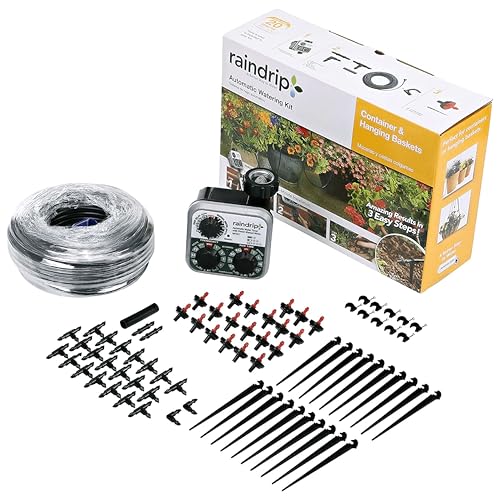
Raindrip R560DP Container Drip Kit with Timer
Best for: Patios with up to about 20 pots and baskets
A container-focused kit with a programmable timer and 20 drippers, designed for pots and hanging baskets on a faucet.
- Timer included
- Built for containers and baskets
- Waters up to about 20 plants
- Established irrigation brand
- Not for in-ground beds
- Limited expansion compared with bulk kits

Starrey 100 ft 1/4" Drip Kit (24 Nozzles)
Best for: Larger container collections
Includes 100 ft of 1/4 inch tubing, 24 nozzles, connectors, stakes, ties and end caps, with quick-connect assembly.
- 24 nozzles for many pots
- Quick tool-free assembly
- Everything in one box
- Check nozzle type for indoor use
- Lesser-known brand

Starrey 50 ft 1/4" Drip Kit (12 Nozzles)
Best for: A dozen pots on a balcony or porch
A smaller Starrey kit with 12 adjustable 360 degree copper nozzles and 50 ft of tubing for mid-sized container groups.
- 12 adjustable nozzles
- Compact 50 ft size
- Easy to install
- Limited for big collections
- Nozzles spray in 360 degrees; aim carefully

Adjustable 360° Drip Emitters on 5.5" Stakes (25-Pack)
Best for: Upgrading or expanding any 1/4" system
A set of 25 adjustable drippers mounted on 5.5 inch arrow stakes for 1/4 inch tubing, letting you dial in flow for each pot.
- Adjustable flow per pot
- Stakes hold firmly in containers
- Works with standard 1/4" tubing
- Emitters only; tubing sold separately
- Adjustable heads can drift if bumped

LetPot Wi-Fi Automatic Watering System for Potted Plants
Best for: Indoor and outdoor pots with app control
A pump-based automatic watering kit with Wi-Fi and app control, drawing from a reservoir so it can water pots without a faucet.
- Wi-Fi and app control
- Works without a faucet
- Indoor or outdoor use
- Reservoir needs refilling
- Needs power and Wi-Fi

Sainlogic Automatic Plant Waterer for 15 Pots
Best for: Houseplant collections and travel
A self-watering pump system for up to 15 pots with a humidity monitor display, aimed at indoor plants and people who travel.
- Waters up to 15 pots
- Display and monitoring features
- Good for vacations
- Reservoir capacity limits run time
- Indoor-focused

HEKIWAY 49 ft Solar Drip Kit for 15 Pots
Best for: Balconies without power or faucet
A solar-powered pump kit that waters about 15 pots from a bucket or reservoir, with multiple timing options.
- Solar powered
- No outlet or faucet needed
- Multiple timing modes
- Output depends on sun
- Needs a water reservoir

JIYANG Solar Automatic Drip Kit (20-30 Pots)
Best for: Larger off-grid container groups
A solar pump unit supporting roughly 20 to 30 pots with 12 timing modes and an anti-siphon device.
- Supports more pots than most solar kits
- 12 timing modes
- Anti-siphon device
- Low light reduces output
- Container use only
How we chose these systems
We grouped container watering into three types: faucet-fed drip kits, reservoir-and-pump systems and solar-powered kits. Within each type we compared how many pots it handles, whether a timer is included, how adjustable the flow is and how practical it is for patios, balconies or indoors. We also included an emitter upgrade pack, because the right emitters make any container system work better. We do not list prices because they change often. If you want a broader micro drip kit for a greenhouse or large patio, see our roundup of the best micro drip irrigation kit options.
Three ways to water pots automatically
Faucet-fed drip kits
These connect to an outdoor tap, usually through a timer, filter and pressure regulator, and run 1/4 inch tubing to each pot. They can water dozens of containers, never run out of water and cost little to run. They are the best choice for patios, porches and decks with a faucet nearby.
Reservoir and pump systems
A small pump sits in a bucket or built-in reservoir and pushes water through tubing to each pot on a schedule. They work indoors and on balconies with no faucet. Some connect to Wi-Fi so you can control them from your phone. The reservoir must be refilled, so capacity limits how long you can be away.
Solar-powered kits
These use a small solar panel to power the pump, so they need no outlet. They are ideal for balconies, rooftops and garden corners far from power. Output depends on sunlight, so they water less on cloudy days, which often matches what plants need anyway.
Drip for pots buying guide
Number of pots
Count your containers and choose a kit that covers them with a few spares. Many container kits handle 12 to 30 pots. Faucet kits can be expanded more easily than pump systems.
Adjustable emitters
Pots of different sizes and plants with different needs require different amounts of water. Adjustable drippers let you open them wider for large, thirsty containers and close them down for small pots or succulents. Stake-mounted emitters stay in place better than loose drippers.
Timer
A timer is what makes the system automatic. Some faucet kits include one; otherwise add a hose timer at the tap. Pump and solar systems have built-in timing modes.
Indoor or outdoor
Indoor systems should be quiet, compact and easy to hide, and pots should sit on saucers to catch drips. Outdoor systems need UV-resistant tubing and, for faucet kits, a filter and regulator.
Which system is right for you?
- Outdoor pots near a faucet: Raindrip R560DP with timer.
- Big container collection: Starrey 100 ft kit.
- A dozen pots: Starrey 50 ft kit.
- Upgrade any system: adjustable stake emitters.
- App control, no faucet: LetPot Wi-Fi system.
- Houseplants and travel: Sainlogic 15-pot waterer.
- Balcony with no power: HEKIWAY or JIYANG solar kits.
How to set up drip for pots
- Group containers by size and sun exposure.
- Connect the system: timer, filter and regulator at the faucet, or place the pump in a reservoir.
- Run tubing along the base of the pots, keeping branches short.
- Insert one or more emitters into each pot, staked near the edge.
- Run the system and adjust each emitter so water drains from the bottom of every pot.
- Set the schedule and check pots for a few days.
How much water do pots need?
Pot size, plant type, sun and wind all affect water use. Small pots and hanging baskets in full sun may need water every day in summer, sometimes twice. Large containers hold more soil and dry more slowly. Terracotta dries faster than plastic or glazed ceramic. A good rule is to water until a little drains from the bottom, then wait until the top inch of soil is dry before the next watering. Our guide to drip emitter size suggests flow rates for different pot sizes.
Choosing pots that work with drip
The containers themselves affect how well drip works. Pots with drainage holes are essential, because drip delivers water steadily and excess must escape. Terracotta breathes and dries quickly, which suits herbs and succulents but means more frequent watering for vegetables. Plastic and glazed pots hold moisture longer, so they need shorter run times. Very large containers hold more water and buffer against hot days, which is why many gardeners move thirsty crops like tomatoes into bigger pots. Self-watering containers with built-in reservoirs can be combined with drip: the drip line tops up the reservoir, and the plant draws water as it needs it.
Watering vegetables in containers
Container vegetables such as tomatoes, peppers, cucumbers and herbs are among the best candidates for drip because consistent moisture prevents problems like blossom end rot and bitter fruit. Give large fruiting plants two or three emitters around the stem, and increase run time as the plant grows and starts to set fruit. Leafy greens and herbs need less water but dislike drying out, so short daily runs suit them. Mulch the surface of large pots with straw or bark to slow evaporation.
Going on vacation
Before a trip, run the system for a few days and check every pot. For reservoir systems, calculate how long the reservoir lasts by noting how far the level drops each day, and use a larger bucket if needed. Move pots out of full afternoon sun, group them together to create a more humid microclimate, and fit fresh batteries or confirm the solar panel gets good sun. A smart system lets you check and adjust remotely.
Tips for hanging baskets
Hanging baskets dry out fastest of all. Run a dedicated 1/4 inch line up the hanger or bracket, use a slightly higher-flow dripper, and consider lining the basket with a moisture-holding liner. Water in the morning so plants start the day hydrated.
Making the system look tidy
Drip tubing on a patio or porch does not have to look messy. Run tubing along the back of planters, under railings or along the base of walls, and use black 1/4 inch tubing, which is less visible than clear tubing and resists algae. Secure it with small clips or stakes so it does not shift. Bring each branch into the pot from behind and stake the emitter near the edge. At the end of each run, use an end cap or goof plug rather than a loose open tube. On a balcony, a tidy reservoir system tucked behind a large planter can water a whole collection with almost nothing visible. A neat installation is also less likely to be kicked, tripped over or pulled loose.
Indoor drip systems
Indoors, place pots on saucers or trays, start with short run times and increase gradually. Overwatering is a bigger risk indoors than outdoors, so check soil moisture often for the first week. Keep the reservoir covered to reduce algae and mosquitoes, and clean it every few weeks.
Seasonal adjustments
Containers need very different amounts of water through the year. In spring, short runs every two or three days are often enough while temperatures are mild. In summer heat, many pots need daily watering, and small pots or baskets in full sun may need two short runs, morning and early afternoon. In fall, cut back as growth slows and evenings cool. In winter, outdoor containers in cold climates should be drained and the system stored, while indoor systems need much less water because plants grow slowly in low light. Check soil moisture whenever the weather changes, and adjust the schedule rather than relying on a single setting all year. A cheap moisture meter pushed into a few representative pots takes the guesswork out of these changes.
Faucet kit setup tips
For faucet-fed kits, always add a filter and pressure regulator after the timer, or emitters will clog and fittings may pop off. Our guide to the drip irrigation head assembly shows the correct order of parts, and our guide to install hose timer on faucet covers timers.
Maintenance
- Clean filters and pump intakes regularly.
- Flush lines monthly.
- Check every emitter while the system runs.
- Refill reservoirs before they run dry, and rinse them every few weeks.
- Wipe solar panels so they charge fully.
- Bring tubing, pumps and timers indoors before freezing weather.
If emitters stop dripping, see our guide to clogged drip irrigation.
Common mistakes
- Giving every pot the same emitter regardless of size.
- Skipping the filter on faucet kits.
- Letting reservoirs run dry, which can damage pumps.
- Overwatering indoor plants on long run times.
- Long 1/4 inch runs that starve the last pots.
- Ignoring weather changes and watering the same amount all season.
The EPA WaterSense program notes that targeted, drip-style watering wastes far less water than spraying, especially for containers.
The bottom line
The best drip irrigation for pots depends on your water source. Near a faucet, the Raindrip R560DP with its included timer is the simplest choice, and Starrey kits scale up to bigger collections. Without a faucet, a LetPot or Sainlogic pump system works indoors and a HEKIWAY or JIYANG solar kit works on balconies. Use adjustable emitters, size water to each pot and check soil moisture for the first week.
Frequently Asked Questions
What is the best drip irrigation for pots?
For outdoor pots near a faucet, the Raindrip R560DP is our top pick because it includes a timer and is built for containers. For pots without a faucet, choose a reservoir pump or solar system.
How do I water pots automatically without a faucet?
Use a pump-based system that draws from a bucket or reservoir, powered by an outlet, battery or solar panel.
How many drippers does a pot need?
Small pots usually need one. Large containers and half barrels often need two or three placed around the edge.
Can I use drip irrigation for indoor plants?
Yes, with reservoir-and-pump systems designed for indoor use. Place pots on saucers and start with short run times.
How often should drip water containers?
Often daily in summer heat, less in cool weather. Check that water drains from the bottom and the soil stays evenly moist.