
Last updated: October 2026 · Written by the LawnVibe editorial team.
Soaker hoses are one of the easiest and cheapest ways to water garden beds well. Water seeps slowly through the hose wall straight into the soil, roots get a deep drink, leaves stay dry and almost nothing is lost to wind or evaporation, especially under mulch. The best soaker hose for gardens seeps evenly along its length, lies neatly where you put it and holds up to a few seasons of sun and handling. Our top pick is the Gilmour 75 ft flat weeper hose. Below we compare seven options, including heavy-duty and multi-pack hoses, a complete kit and a timer to automate the whole system.
Listings change often, so check current details on Amazon before you buy. As an Amazon Associate we earn from qualifying purchases.
Our top picks at a glance
| # | Product | Best for | Link |
|---|---|---|---|
| 1 | Gilmour 75 ft Flat Weeper Soaker Hose | Vegetable beds, flower beds and borders | Check price |
| 2 | Zixixiz 100 ft Heavy-Duty 1/2″ Soaker Hose (Brass Connectors) | Long beds and shrub borders | Check price |
| 3 | Customizable 1/2″ x 50 ft Soaker Hose System with 25 ft Leader Hose | Raised beds and custom layouts | Check price |
| 4 | LAVEVE Flat Soaker Hose 150 ft (3 x 50 ft) | Several beds watered separately | Check price |
| 5 | Hlinker Flat Soaker Hose 100 ft (2 x 50 ft) with Stakes | DIY automated garden irrigation | Check price |
| 6 | Linchoc Home 100 ft 5/8″ Soaker Hose | Foundation plantings and long borders | Check price |
| 7 | RAINPOINT Programmable Hose Timer | Automating any soaker hose | Check price |
Best soaker hose for gardens reviews

Gilmour 75 ft Flat Weeper Soaker Hose
Best for: Vegetable beds, flower beds and borders
A flat weeper hose from a long-established hose brand that lies neatly along beds and seeps water slowly along its length.
- Flat profile lies neatly under mulch
- Seeps evenly along the length
- Trusted hose brand
- 75 ft covers several beds
- Flat hoses can twist if not staked
- Needs low pressure for even output
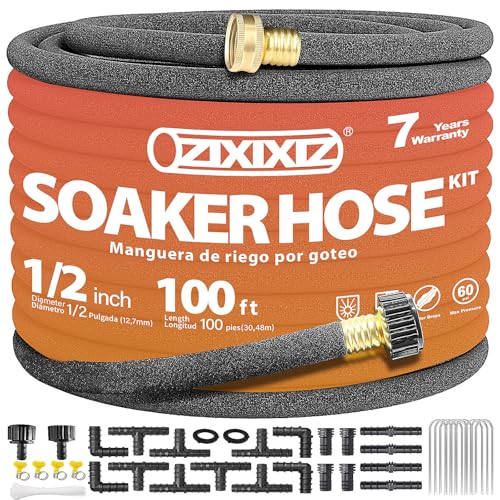
Zixixiz 100 ft Heavy-Duty 1/2" Soaker Hose (Brass Connectors)
Best for: Long beds and shrub borders
A 100 foot, 1/2 inch soaker hose with 3/4 inch solid brass connectors, built for leak-resistant connections and long runs.
- Solid brass connectors
- 100 ft length
- Heavy-duty construction
- Long runs can water unevenly at the far end
- Heavier to move than flat hoses

Customizable 1/2" x 50 ft Soaker Hose System with 25 ft Leader Hose
Best for: Raised beds and custom layouts
A soaker hose system that includes a 50 ft weeping hose plus a 25 ft solid garden hose and reinforced fittings, so you can route water from the faucet to the bed and cut to fit.
- Includes a solid leader hose
- Customizable layout
- Reinforced fittings
- Cutting and fitting takes some setup
- Unbranded kit

LAVEVE Flat Soaker Hose 150 ft (3 x 50 ft)
Best for: Several beds watered separately
Three 50 ft flat soaker hoses that can be used in separate beds or linked, for lawn edges, flower beds, vegetables and landscaping.
- Three 50 ft hoses
- Flexible flat design
- Link or use separately
- Linking all three may reduce output at the end
- Flat hoses need staking

Hlinker Flat Soaker Hose 100 ft (2 x 50 ft) with Stakes
Best for: DIY automated garden irrigation
Two linkable 50 ft flat soaker hoses with stakes, designed to pair with a timer for automated watering.
- Stakes included
- Linkable sections
- Pairs well with a hose timer
- Newer brand
- Check pressure guidance on the listing

Linchoc Home 100 ft 5/8" Soaker Hose
Best for: Foundation plantings and long borders
A wider 5/8 inch soaker hose in 100 feet, aimed at foundation areas and long garden borders where more flow helps.
- 5/8 inch diameter for more flow
- 100 ft length
- Good for foundation beds
- Wider hose is bulkier
- Output can still drop on very long runs

RAINPOINT Programmable Hose Timer
Best for: Automating any soaker hose
A programmable hose timer with long run times and rain delay, ideal for the slow, long watering soaker hoses need.
- Run times up to nearly 4 hours
- Rain delay
- Easy programming
- Batteries need checking
- Remove before freezing weather
How we chose these hoses
We focused on true soaker or weeping hoses, which seep water through porous walls, rather than sprinkler hoses with small holes that spray upward. We compared hose type, diameter, length options, connector quality and how easy each is to lay out and link. We included one kit with a solid leader hose and one timer, because they make soaker systems work better. We do not list prices because they change often. For a full guide to using soaker hoses, see our hub on soaker hose for garden beds.
Soaker hose vs sprinkler hose
The terms are often mixed up online. A soaker hose sweats or weeps water through its walls along its whole length, delivering water at soil level. A sprinkler hose is a flat hose with small holes that spray water into the air, more like a long, low sprinkler. Soaker hoses are far more efficient for beds because water goes straight into the soil and leaves stay dry. Sprinkler hoses can be useful for narrow lawn strips but lose more water to evaporation. Check product descriptions carefully: if a hose is described as having holes that spray, it is a sprinkler hose.
Soaker hose buying guide
Flat vs round
Flat soaker hoses lie neatly in straight rows, are easy to hide under mulch and coil compactly for storage. They can twist if not staked. Round soaker hoses, often made from recycled rubber, are typically more durable and easier to curve around plants and shrubs, but bulkier to store.
Diameter
Most soaker hoses are 1/2 inch, which suits typical beds. 5/8 inch hoses carry more water, useful for longer runs and foundation plantings. Whatever the size, keep runs short for even output.
Length
Measure each bed and plan the layout before buying. Many manufacturers recommend keeping a single run to about 100 feet or less, because output falls toward the far end on longer runs. Two or three shorter hoses in separate beds water more evenly than one long chain. Our guide to soaker hose layout shows spacing and patterns.
Connectors
Brass connectors resist leaks and stripping better than plastic. A solid leader hose between the faucet and the bed keeps the soaker section inside the planted area.
Pressure
Soaker hoses work best at low pressure. Full household pressure can cause spraying and bursting. Use the flow-restrictor disc that comes with many hoses, or add a pressure regulator at the faucet.
Which hose is right for you?
- Most beds and borders: Gilmour 75 ft flat weeper.
- Long beds and heavy use: Zixixiz 100 ft with brass connectors.
- Raised beds and custom layouts: customizable kit with leader hose.
- Several separate beds: LAVEVE 3 x 50 ft pack.
- Automated DIY setup: Hlinker linkable 100 ft.
- Foundation plantings: Linchoc 100 ft 5/8 inch.
- Automate everything: RAINPOINT hose timer.
How to set up soaker hoses in garden beds
- Lay the hose in the sun for a few minutes so it is flexible.
- Run it along rows or snake it through the bed, a few inches from plant stems.
- Space lines about 12 inches apart in sandy soil and 18 to 24 inches in clay.
- Pin it down with landscape staples.
- Connect a solid leader hose from the faucet with a pressure regulator or flow disc.
- Turn the water on slowly and check for spraying or dry spots.
- Cover with mulch once you are happy with the layout.
For timers, filters and the full faucet assembly, see our guide to soaker hose timer setup.
How long to run a soaker hose
Run times depend on soil, weather and the hose itself. Many beds need 30 to 60 minutes, two or three times a week in summer. The best guide is soil moisture: an hour after watering, the soil should be moist 6 to 8 inches down. Our guide on how long to run soaker hose walks through finding the right time for your garden.
Soaker hoses under mulch
Covering soaker hoses with 2 to 3 inches of mulch is one of the best things you can do. Mulch hides the hose, holds it in place, slows evaporation, keeps roots cool and protects the hose from sunlight, which otherwise breaks it down. Wood chips suit shrub and perennial beds; straw and shredded leaves suit vegetables and annuals.
Soaker hoses for different garden areas
Vegetable gardens. Run one line along each row, a few inches from the plants, or snake two or three lines through wide beds of greens and roots. Tomatoes and squash benefit from a loop around each plant. Because leaves stay dry, soaker hoses help reduce leaf diseases common in vegetables.
Flower beds and borders. Weave the hose between plant clumps so every crown is within a few inches of a line. In mixed borders with shrubs and perennials, loop the hose around larger plants and run straighter lines through annuals.
Shrub and foundation beds. Shrubs have wide root zones, so run the hose near the drip line rather than against the trunk. Along the house, keep the hose a little away from the foundation and avoid soaking soil right against the walls.
Raised beds. A serpentine pattern with lines about 12 inches apart covers most beds well. Bring the supply hose over the side or through a small hole, and keep the soaker section entirely inside the bed.
New trees. A ring of soaker hose around the root ball, widened as the tree grows, delivers slow, deep watering during the first few years.
How long do soaker hoses last?
Lifespan depends heavily on care. A soaker hose left exposed to sun, run at full pressure and left outside over winter may last only a season or two. The same hose kept under mulch, run at low pressure, flushed occasionally and stored indoors in winter often lasts several seasons. Signs it is time to replace a hose include large dry sections that flushing does not clear, frequent new splits and walls that feel brittle. Cheap hoses and premium hoses can both fail early if mistreated, so good habits matter as much as the brand.
Using soaker hoses on slopes and with rain barrels
On a slope, water inside a soaker hose drains toward the low end, so the bottom of the bed gets wet while the top stays dry. Run hoses across the slope rather than up and down, feed them from the high end and keep runs short. On steep slopes, drip line with pressure-compensating emitters gives more even results. Soaker hoses are also a natural match for rain barrels, because they work at low pressure. Raise the barrel on a sturdy stand, keep the hose short and screen the barrel inlet so debris does not clog the pores.
Planning zones for a larger garden
If your garden has more beds than one soaker hose can cover evenly, divide it into zones. A splitter or manifold at the faucet with a shut-off for each line lets you water beds one at a time, or a multi-outlet timer can run them automatically in sequence. Group beds with similar needs together, such as vegetables in one zone and shrubs in another, so each zone runs for the right length of time. Label each line at the faucet so you always know which bed it serves.
Soaker hose vs drip irrigation
Soaker hoses are cheaper, simpler and faster to install than drip systems. Drip uses emitters that deliver a set amount of water to each plant and stays more even on long runs and slopes. Many gardeners use soaker hoses for straight rows and shrub borders and add drip where they need precise control, such as containers or widely spaced vegetables.
Maintenance
- Flush the hose monthly by removing the end cap.
- Use a filter on well or rain barrel water.
- Drain and store indoors over winter.
- Keep it covered with mulch to block UV.
- Never run fertilizer through a soaker hose.
Our guide to soaker hose maintenance covers each step in detail.
Signs your soaker hose setup is working
A well-set-up soaker system leaves a continuous band of evenly moist soil along every line, with no puddles and no dry stretches. Plants across the bed look equally healthy, leaves are dry after watering and paths stay dry too. If one area wilts while the rest looks fine, check that section first for a kink, a clog or a hose that has shifted away from the plants. A quick dig with a trowel an hour after watering tells you how deep the water has reached.
Common mistakes
- Running at full pressure, which causes bursting and spraying.
- Linking too many hoses into one long run.
- Buying sprinkler hoses when you want soil-level watering.
- Leaving hoses exposed to sun all season.
- Watering on a fixed schedule without checking soil.
The EPA WaterSense program recommends watering at the root zone, which soaker hoses do better than almost any other method.
The bottom line
The best soaker hose for gardens seeps evenly, lies neatly and lasts, like the Gilmour 75 ft flat weeper. Choose the Zixixiz for long, heavy-use beds, a kit with a leader hose for raised beds, multi-packs for several beds and a 5/8 inch hose for foundation plantings. Keep runs under about 100 feet, use low pressure, cover hoses with mulch and add a timer for hands-off watering.
Frequently Asked Questions
What is the best soaker hose for gardens?
For most beds and borders, the Gilmour flat weeper is our top pick because it lies neatly, seeps evenly and comes from an established brand.
Flat or round soaker hose?
Flat hoses lie neatly in straight rows and coil compactly. Round rubber hoses are often more durable and easier to curve around plants.
How long should a soaker hose run be?
Keeping each run to about 100 feet or less gives more even output. Split larger gardens into zones.
Do soaker hoses need a pressure regulator?
Yes, most work best at low pressure. Use the flow disc that comes with the hose or a pressure regulator at the faucet.
Can I put a timer on a soaker hose?
Yes. A hose timer with long run times automates soaker watering perfectly.